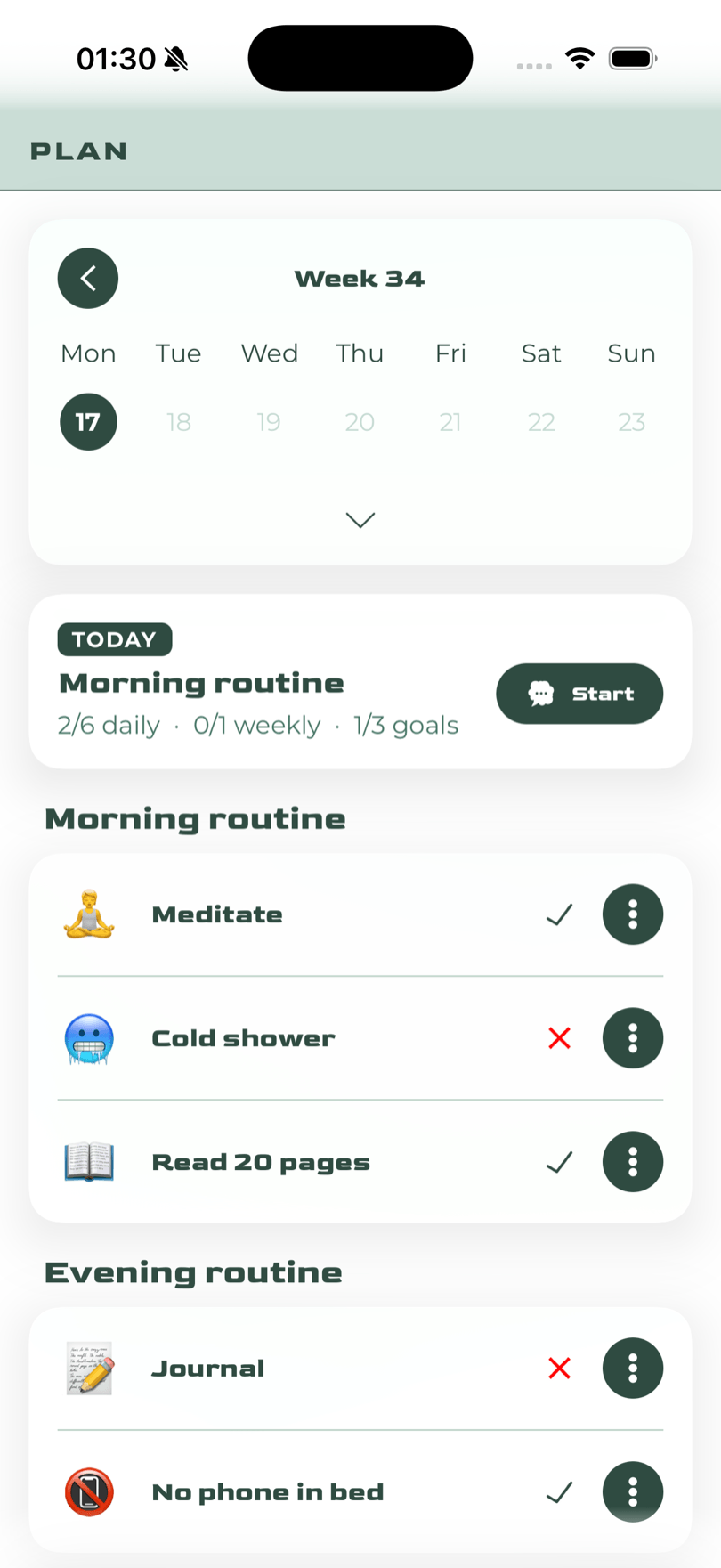
Stoicism was designed as a training regimen. Treating it as a reading list is the single most common way people get nothing out of it.
If you want to know how to practice Stoicism daily, the honest starting point is that the ancient Stoics would not have recognised what most people do today as practice at all. They had a word for what they were doing: askesis, meaning exercise, practice, disciplined training. The English word "ascetic" comes from it, but the original sense is closer to what an athlete does than what a monk does.
Reading philosophy produces a specific and misleading sensation. You finish a passage of Marcus Aurelius on not being disturbed by other people, you feel calmer and clearer, and your brain files that feeling as progress. It is not progress. It is the feeling of having understood something, which is available instantly and costs nothing.
The Stoics were blunt about this. Epictetus spent a lot of his teaching time attacking students who could explain the doctrine of assent beautifully and still lost their temper at a slave who broke a lamp. Musonius Rufus dedicated an entire lecture to the argument that practice matters more than theory, on the grounds that a doctor who knows the treatment and never administers it is useless.
The test is not whether you can explain the dichotomy of control. It is whether, on a bad Tuesday, you can actually run it.
Askesis was not vague self-improvement. It was a small, repeatable set of exercises, done on a schedule, most of them taking a few minutes.
| Exercise | What it is | When it runs |
|---|
| Attention (prosoche) | Watching your own judgements as they form | Continuously, throughout the day |
| Morning preparation | Naming what will be difficult today and how you will meet it | Before the day starts |
| Rehearsing difficulty | Picturing the setback in advance so it arrives as expected | Before a known hard thing |
| Evening review | Auditing what you did and said, honestly, without excuse | End of day |
| Written reminders | Writing the same lessons back to yourself, repeatedly | Daily or near daily |
| Voluntary discomfort | Deliberately going without something, on purpose, when you do not have to | Occasionally, on schedule |
Look at the right-hand column. Every one of these has a fixed slot in a day. That is what separates a practice from an interest.
The Stoics thought of character as a hexis, a settled disposition built by repeated acts. You do not become patient by concluding that patience is good. You become patient by behaving patiently on the hundredth occasion when you did not want to, at which point it stops being a decision.
This is the same logic that governs anything physical. Nobody expects to read about a barbell and get stronger. The reason consistency beats intensity in training is that adaptation comes from accumulated repetitions, not from insight. Stoic practice runs on exactly the same engine, and it fails in exactly the same way: people go looking for the profound realisation instead of doing the boring set.
Repetition also explains why the exercises are small. A five-minute review you do every night beats a two-hour philosophical session you do twice. The point is not depth per session. It is the number of times the mind gets walked through the same move.
Do not start with all six exercises. That is a reading-list decision, not a training decision.
Pick one. Run it for thirty days. Log whether you did it.
The best first choice for most people is the evening review, because it is bounded, it takes four minutes, and it generates the raw material for everything else. You cannot rehearse tomorrow's difficulty well if you have never audited today's.
Give it a fixed anchor in your day, the same way you would with any other habit. Then track it as a habit, because that is what it is. If you leave it as a good intention, it will get done in weeks when you did not need it and skipped in weeks when you did.
The most common failure is treating a missed day as evidence that you are not the kind of person who does this. The Stoics had a word for the practitioner, prokopton, one who is making progress. It exists specifically because nobody in the tradition expected to arrive. The sage was a theoretical construct. Everyone actually doing the work was, by definition, still bad at it.
That framing is not just consoling, it is operationally important, because the alternative is the pattern where one lapse becomes a permanent quit. The same thing happens with training, which is why discipline beats motivation as an engine: a system tolerates a bad day, a mood does not.
Write down one exercise, one anchor, and one duration. For example: "After I put my phone on the charger, I will review the day for four minutes, every night for thirty days."
Then do not add a second exercise until the first one runs without you thinking about it.

 iOS
iOS Android