Prosoche is the Stoic practice of watching your own judgements as they form, continuously, while everything else is happening.
Of all the Stoic exercises, this is the one with no scheduled slot, and that is precisely why it is the hardest and the most important. The evening review runs at night. Rehearsing difficulty runs before a known hard thing. Prosoche runs all day, or it does not run at all, and without it every other exercise becomes retrospective.
The word means attention, diligence, watchfulness. Donald Robertson renders it as "Stoic mindfulness", which is useful shorthand as long as you understand where the analogy stops.
Both are attention practices. They point attention at different things and use it for different purposes.
| Modern mindfulness | Prosoche |
|---|
| Target of attention | Present-moment experience: breath, body, sounds, thoughts as events | Your own judgements and the impressions you are accepting |
| Stance | Non-judgemental, accepting | Evaluative, against a standard |
| Purpose | Reduce reactivity, increase awareness | Catch a false judgement before you act on it |
| Typical format | Set sessions, often seated | Continuous, in the middle of ordinary activity |
The Stoic is not trying to observe a thought without judging it. The Stoic is trying to catch the judgement that has already been smuggled in. "He disrespected me" is not an observation, it is a verdict that arrived so fast it felt like perception. Prosoche is the habit of noticing the difference in real time.
The Stoics called the reasoning part of the mind the ruling faculty. Prosoche is attention directed at it, specifically at the moment where an impression arrives and you either accept it or you do not.
In practice, three things are worth watching for:
Verdicts disguised as facts. "This is a disaster", "she is being unfair", "I am behind". Each of these feels like a description and is actually a claim. The prosoche move is to restate what actually happened without the verdict attached, then decide whether the verdict survives.
Value creeping into things outside your control. Noticing the moment where your peace of mind quietly becomes dependent on someone else's reply, or on a number, or on the weather.
Drift from the intention you set. You decided this morning that today you would not argue about this. It is 4pm and you are arguing about it. Prosoche is what would have flagged it at 3:58.
Epictetus set the standard high: the person making progress should not be caught out by unexamined impressions, ideally not even in sleep. That is an ideal, not a target for month one.
Here is the honest problem. You cannot hold continuous attention by deciding to hold continuous attention. You will decide it, mean it, and forget within ten minutes, for the same reason that a vague intention to exercise more does not produce exercise: there is no cue.
So the practice has to be built the way any other behaviour is built, out of specific triggers rather than sustained effort.
Fixed check-ins. Three a day, anchored to things that already happen. After I sit down at my desk. After lunch. After I get in the car. At each one, a single question: what am I currently taking to be true, and is it actually true?
A trigger phrase for hot moments. Something short you have pre-loaded, so that irritation itself becomes the cue. Epictetus's version was to address the impression directly and tell it to wait.
The evening review as the feedback loop. This is the mechanism that makes the whole thing improve rather than just repeat. The Stoic evening review tells you which judgements caught you today, which means tomorrow's attention has a specific target instead of being spread thinly over everything.
That last point is the practical heart of it. Nobody can watch for everything. You can watch for the two things that caught you yesterday.
Not fewer bad impressions. They keep arriving at the same rate.
What changes is the gap. Early on, you notice the false judgement an hour later, usually during the evening review. Then you notice it twenty minutes later, once the argument is already lost. Then during. Then, occasionally, before.
Measure that gap, not your composure. Composure is an outcome and it fluctuates with sleep and stress. The delay between the judgement and the noticing is the thing your practice is actually training.
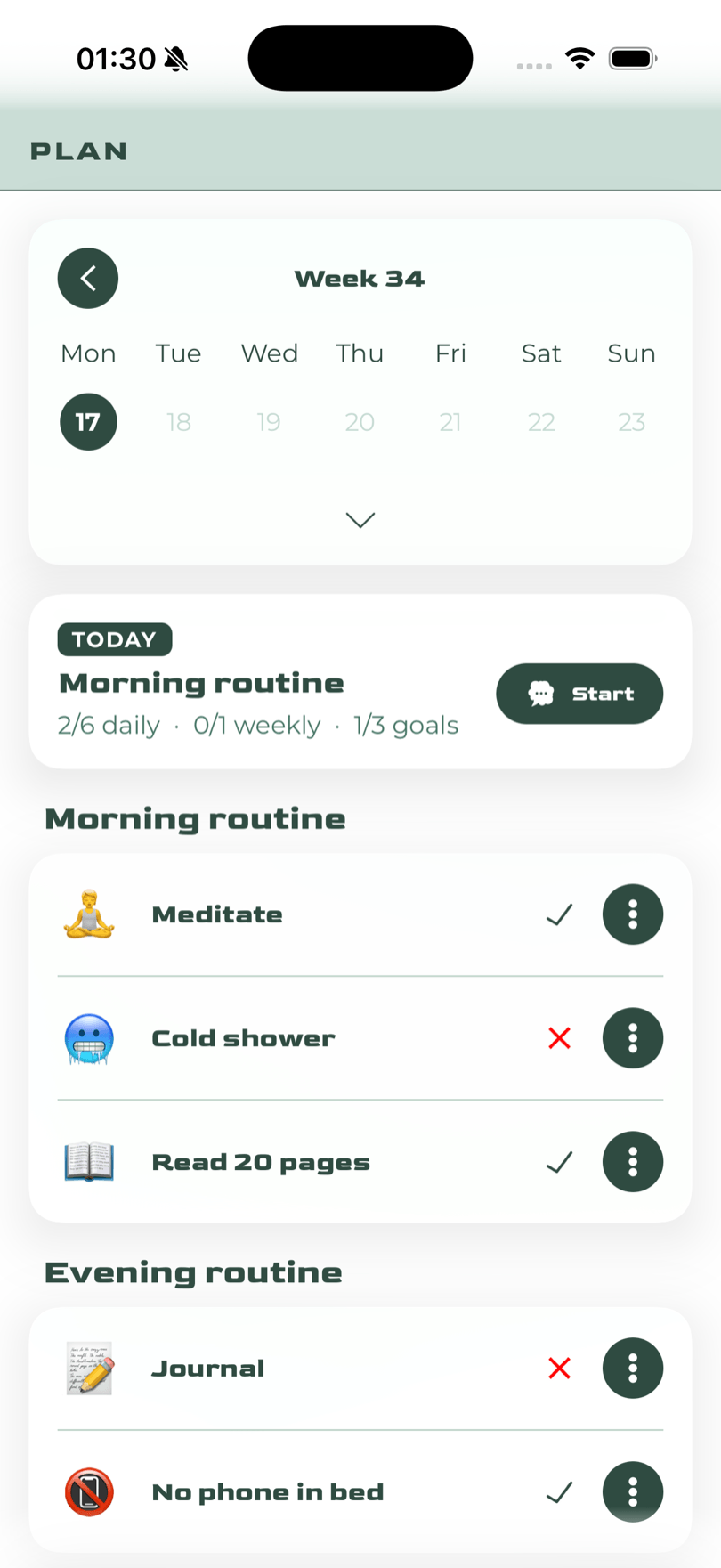
They treat it as a mood. Prosoche gets attempted on a calm Sunday, feels profound, and is completely absent by Wednesday afternoon, which is the only time it would have been useful. The fix is the same as for any other behaviour that only happens when you feel like it: give it fixed anchors, keep it small, and track whether it ran, exactly as you would with any of the exercises in daily Stoic practice.
Pick three moments that already happen every day. Attach one question to each of them. Run it for two weeks.
Then, at your evening review, write down which judgement caught you most often. That is your target for the following week. Attention with a target is trainable. Attention in general is not.

 iOS
iOS Android