Here is something the research has confirmed repeatedly: people consistently underestimate how much they will enjoy a workout and how good they will feel afterward. Every time you do not feel like training, your prediction about how the session will go is probably wrong, and that misprediction is costing you training days. Understanding why it happens and what to do about it is more useful than any amount of motivational advice.
Back to BlogMindset
Training When You Don't Feel Like It: What Actually Works
2026-07-25Updated 2026-10-027 min read
Written by Hamza J
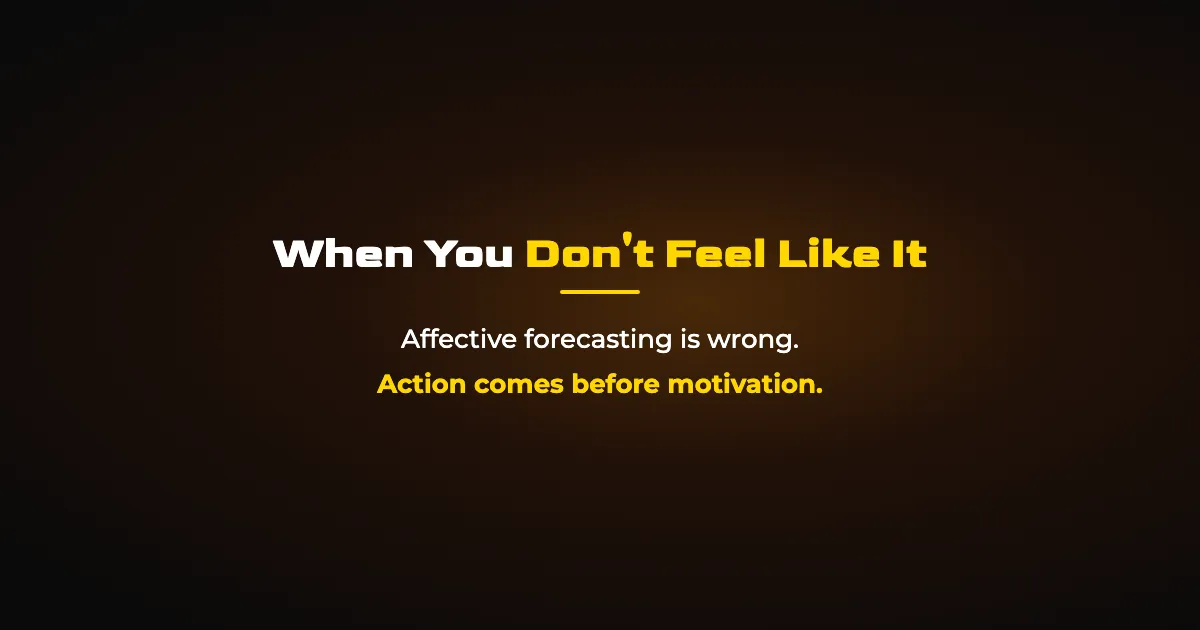
Table of Contents
Contents
You Are a Bad Forecaster of Your Own Workouts
The phenomenon is called affective forecasting error: the gap between how you predict you will feel doing something and how you actually feel while doing it.
Across studies, people who do not exercise regularly are particularly bad at forecasting how enjoyable and energizing a workout will actually be. A 2014 study by Loehr and Baldwin found that inactive individuals predicted significantly lower enjoyment from upcoming exercise than active individuals, yet both groups reported equivalent enjoyment afterward. One interpretation is that active individuals had accumulated enough post-workout experiences to calibrate their predictions; the inactive individuals had not.
Ruby and colleagues (2011) documented the broader pattern across four studies: people consistently underestimate how enjoyable and energizing a workout will actually be, even when asked to predict it immediately beforehand. One plausible explanation is that people weight the initial discomfort of a session heavily when imagining it, discounting how the experience shifts once past the first ten minutes, when the session clicks into gear and the whole thing becomes straightforward.
This means on every low-motivation day, the mental image you have of the upcoming workout is a systematically distorted one. The forecast is not just pessimistic, it is wrong in a measurable and consistent direction.
Action Comes Before the Feeling, Not After It
The intuitive model of motivation is: feel like doing something, then do it. The behavioral evidence says that is backwards, especially for people who are not yet habitual exercisers.
Behavioral activation, an evidence-based psychological treatment developed by Jacobson, Martell, and Dimidjian, is built on the explicit principle that action precedes motivation. The clinical version was developed for treating depression, a condition in which the normal motivation-then-action sequence is particularly broken. The treatment works by scheduling activity and following through regardless of how the person feels, with the finding that engagement, positive affect, and motivation return in response to the activity rather than before it. A landmark 2006 randomized trial by Dimidjian and colleagues showed behavioral activation was as effective as antidepressant medication and significantly outperformed cognitive therapy for patients with severe depression.
The implication for a lifter on a low-motivation day is direct: waiting to feel like training before training is not a reliable strategy. For most people, the feeling arrives after starting. The practical target is just the on-ramp, not the whole session.
The Two Tactics With the Best Evidence
Implementation intentions. A meta-analysis of 94 independent tests by Gollwitzer and Sheeran (2006) found that forming an if-then plan, "if it is Monday at 6pm, then I will go to the gym," produced a medium-to-large effect on follow-through (d = 0.65). The plan works by pre-deciding the response to a specific trigger, so the decision is made once instead of being renegotiated every day against fluctuating motivation. On a low-motivation Monday at 5:55pm, you are not deciding whether to train; you are just executing a prior commitment.
This is the same mechanism behind the discipline versus motivation argument: motivation is unreliable moment to moment, but a pre-decided system runs regardless of mood. The specificity matters, which means "I plan to work out more" is not an implementation intention. "I will train at 7am on Tuesday, Thursday, and Saturday at my gym" is.
Temptation bundling. A 2014 study by Milkman, Minson, and Volpp randomized participants into groups. One group could only listen to captivating audiobooks while at the gym. That group visited the gym 51 percent more frequently than the control group. The effect decayed during a period when participants' routines were disrupted by a university break, suggesting the bundling works best within an established schedule rather than as a standalone fix. And 61 percent of participants chose to pay to keep the restriction after the study ended, indicating genuine preference for the commitment device. The lesson is not that audiobooks are magic; it is that attaching the workout to something you already want to do lowers the activation energy on low-motivation days. The tactic is a supplement, not a cure, but the controlled trial is real.
When Mental Fatigue Is the Issue
There is a specific situation where low motivation is not a forecasting error or a habit problem, it is a physiological state: mental fatigue from cognitively demanding work.
A 2009 study by Marcora, Staiano, and Manning had participants cycle to exhaustion at high intensity after either 90 minutes of demanding cognitive tasks or 90 minutes of neutral video. The mentally fatigued group reached exhaustion roughly 15 percent sooner (640 seconds versus 754 seconds). Crucially, their cardiorespiratory and metabolic responses were identical to the control group. The impairment was entirely mediated by elevated perceived exertion: the same workload felt harder after cognitive work.
This matters for how you train, not whether you train. After a cognitively demanding day, the session does not have to be lighter, but it will feel harder at the same load. RPE-based training (covering how that works here) handles this naturally: if the session feels harder, you either accept fewer reps on your top set or reduce the working weight slightly. The training still happens, it just auto-adjusts for your state rather than grinding against it.
The Cost of Not Showing Up
The cost of skipping is not a single session. It is what that skip does to the habit and the pattern around it.
A 2023 study by Silverman and Barasch tracked 980 fitness app users and found that people with intact exercise streaks were significantly more likely to keep exercising than people whose streaks had broken. The mechanism was goal-based: participants treated maintaining the streak as an independent goal, and a broken streak undermined motivation to re-engage.
The research on habitual versus non-habitual exercisers also tells part of the story. In a review of the intention-behavior gap by Sheeran and Webb (2016), habitual exercisers showed a much weaker connection between daily motivation and whether they trained, because their behavior had become automatic, triggered by context rather than by feeling. Non-habitual exercisers depended far more on having good motivation in the moment. Low-motivation skips are therefore disproportionately damaging earlier in the habit-building process, exactly when you can least afford them. For how those early skips compound into quitting altogether, see why people quit the gym.
The minimum viable workout is the direct answer to this: it keeps the chain intact on the days the full session is genuinely not possible.
The Practical Stack
Combine what the evidence actually supports:
-
Correct your forecast before you decide. The specific thought "I don't feel like training today" is a prediction, and that prediction is systematically biased. Counter it with the track record: you have not regretted a completed session. That is worth more than a single forecast.
-
Use your implementation intention. If you have a fixed training schedule, today's session is already decided. You are not making a new decision, you are executing an old one. This is why logging workouts matters beyond tracking progress: the history makes the commitment concrete.
-
Commit to the minimum. On genuinely bad days, the goal is to start: put on gym clothes, get to the platform, do the first warm-up set. Most of the time the session follows. On the days it does not, a minimum session still counts.
-
Adjust, do not skip. If mental fatigue or accumulated tiredness is real, train at lower intensity or RPE, not at zero. The session is shorter, the loading is lighter, the habit survives.
References
- Loehr VG, Baldwin AS. (2014). Affective forecasting error in exercise: differences between physically active and inactive individuals. Sport, Exercise, and Performance Psychology. doi:10.1037/spy0000006
- Ruby MB, et al. (2011). The invisible benefits of exercise. Health Psychology. doi:10.1037/a0021859
- Dimidjian S, et al. (2006). Randomized trial of behavioral activation, cognitive therapy, and antidepressant medication in the acute treatment of adults with major depression. Journal of Consulting and Clinical Psychology. doi:10.1037/0022-006x.74.4.658
- Milkman KL, Minson JA, Volpp KGM. (2014). Holding the Hunger Games hostage at the gym: an evaluation of temptation bundling. Management Science. doi:10.1287/mnsc.2013.1784
- Marcora SM, Staiano W, Manning V. (2009). Mental fatigue impairs physical performance in humans. Journal of Applied Physiology. doi:10.1152/japplphysiol.91324.2008
- Silverman J, Barasch A. (2023). On or off track: how (broken) streaks affect consumer decisions. Journal of Consumer Research. doi:10.1093/jcr/ucac029

 iOS
iOS Android

Frequently Asked Questions (FAQ)
Why do I never feel like working out even though I enjoy it once I start?
This is a documented affective forecasting error: people, especially those who are not yet habitual exercisers, systematically underestimate how much they will enjoy a workout and how good they will feel afterward. The mind weights the uncomfortable beginning too heavily and discounts the rest of the session. It is a prediction bias, not a preference.
Does motivation come before or after exercise?
The evidence from behavioral activation research says action comes first, motivation follows. The treatment is built on the explicit principle that waiting to feel ready before acting is a losing strategy, and that engaging in activity first is what produces the motivation and positive affect. Starting a session is the trigger, not the reward for already feeling motivated.
What if I am mentally exhausted from work?
Mental fatigue measurably reduces perceived effort capacity, with a 2009 study finding roughly a 15 percent reduction in time to exhaustion at a given intensity after cognitive work. The impairment is real, but it is mediated by perceived exertion rather than actual physiological limitation. The practical response is to train at a reduced intensity or RPE rather than skipping, and to use an autoregulation approach that lets the session adjust to how you feel.
How do I make myself train on low-motivation days?
The most evidence-backed tactics are: first, correct the forecast (remind yourself that your prediction of how the session will feel is probably wrong). Second, use a specific implementation intention rather than a vague goal. Third, commit to the minimum (starting) rather than the full session. Fourth, attach training to something you enjoy (temptation bundling). These are not hacks; they are studied interventions with measurable effects.
Related Articles



Build discipline
Build the habits and goals that get you there, and control the work to achieve them. Free.