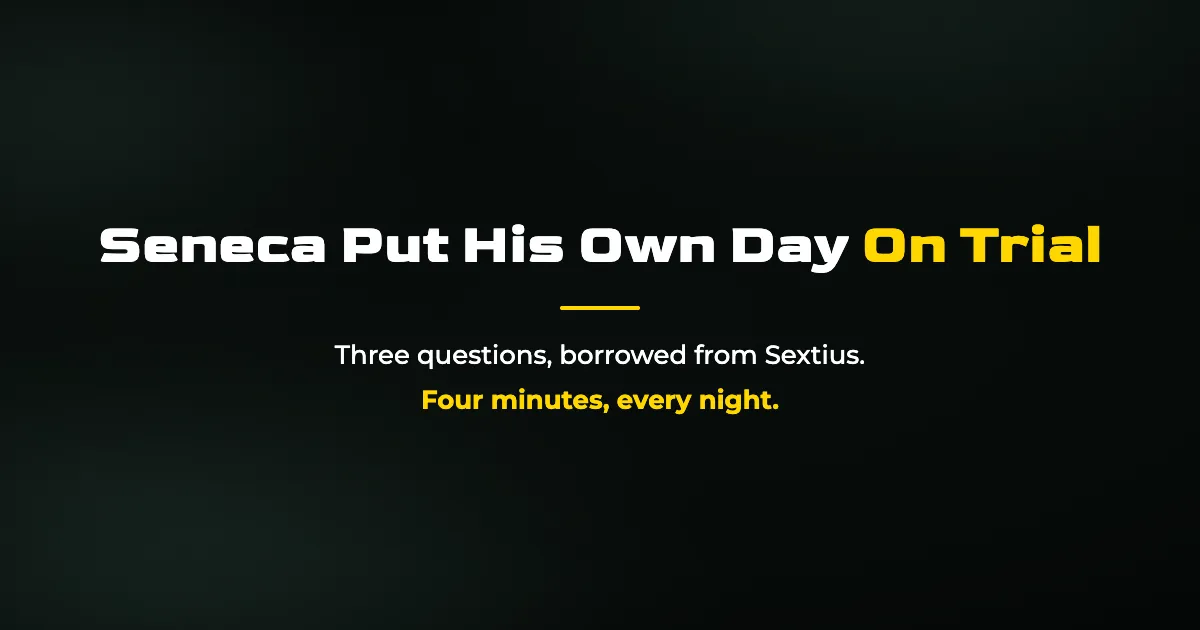
Every night, before sleep, Seneca put his own day on trial. He was explicit that he acted as the judge, not the prosecutor.
The Stoic evening review is the most practical exercise in the entire tradition, and the one with the clearest surviving instructions. Seneca describes it in On Anger, Book 3, chapter 36, and he is careful to say he did not invent it. He took it from Sextius.
The passage, in the Loeb translation:
I avail myself of this privilege, and every day I plead my cause before the bar of self. When the light has been removed from sight, and my wife, long aware of my habit, has become silent, I scan the whole of my day and retrace all my deeds and words. I conceal nothing from myself, I omit nothing.
Three details in that sentence do most of the work.
"When the light has been removed." It has a fixed slot, at the end of the day, in the dark, in bed. Not whenever he felt reflective.
"My wife, long aware of my habit." It was routine enough that the people around him had adjusted to it. This is a habit, not a mood.
"I conceal nothing from myself, I omit nothing." The value is entirely in the honesty. A review where you quietly skip the embarrassing part of the day is not a shorter review, it is a different exercise.
Sextius, the source of the practice, put three questions to himself each night:
- What bad habit have you cured today?
- What fault have you resisted?
- In what respect are you better?
Notice what is missing. There is no "what went well", no gratitude list, no plan for tomorrow. All three questions point at the same target: the gap between how you behaved and how you intended to behave, and whether that gap closed at all today.
Notice also that all three are answerable. "Was today a good day" is not a question you can answer honestly, because it has no criteria. "What fault did I resist" has a yes or a no attached to a specific moment.
Seneca is unusually direct about the tone. His reasoning for the practice is that anger "will cease and become more controllable if it finds that it must appear before a judge every day". A judge examines, rules, and moves on. He also notes what follows a properly conducted review: sleep that is tranquil, deep and untroubled, once the mind has either praised or admonished itself.
That is not softness. It is the operational point of the exercise. A review that turns into self-attack does not produce a corrected day tomorrow, it produces avoidance of the review. And there is a measurable cost to the self-attack itself: the distress that follows a perceived personal failure consumes the same self-regulatory capacity you need for the next decision, which is a large part of why one lapse tends to produce a second, as covered in the what-the-hell effect.
The practical rule: state the fact, name the correction, close the file. "I snapped at him at 6pm. The trigger was hunger. Tomorrow I eat before that call." Then stop. No re-litigating, no character verdict.
When. Anchor it to something you already do at the end of every day, such as putting your phone on the charger or getting into bed. A floating intention to reflect will happen on calm evenings and never on the evenings that generate the useful material.
How long. Four to six minutes. If it takes twenty, you have turned it into a diary, which is a different and much less repeatable thing.
How. Written beats mental. You will discover that thoughts which feel clear in your head turn out to be vague when you have to finish the sentence. Writing also gives you something to reread, which is where the patterns appear.
What to write. Three lines is enough:
| Line | Prompt |
|---|
| 1 | What did I do or say today that I would not defend? |
| 2 | What did I resist that I usually give in to? |
| 3 | What specifically will I do differently tomorrow? |
Line 3 is the one people drop, and it is the one that turns reflection into training. A review with no correction is just replay.
You only do it after bad days. This is the most common failure and it quietly inverts the exercise. Reviewing only when you feel bad trains you to associate the practice with punishment, and it removes the ordinary days, which are where the drift actually happens.
You write a diary instead. Recounting events is not auditing behaviour. If your entry describes what happened rather than what you did about it, you have written the wrong thing.
You use it to punish yourself. Covered above, and worth repeating, because it is the failure that ends the practice fastest. The exercise asks what you will do differently, not how bad you should feel.
Every other Stoic exercise depends on information this one generates. You cannot rehearse tomorrow's difficulty accurately if you have never catalogued today's. You cannot watch your judgements in real time if you have no idea which judgements keep catching you out.
That is why, of the exercises in daily Stoic practice, this is the one to start with. It is bounded, it is cheap, and it produces the raw material for the rest.
Pick the anchor tonight. Write the three lines. Do it for thirty days before you judge whether it is working, and track whether you did it, because a practice you cannot verify is a practice you will lose without noticing.

 iOS
iOS Android