Habit stacking means using a behaviour you already perform automatically as the cue for a new one.
Most new habits die because nothing reliably triggers them. You decide to stretch every day, you mean it, and then the day simply passes without ever presenting a moment that says "stretch now". Habit stacking fixes the trigger problem by borrowing one that already works: something you do every single day without deciding to.
A habit is not a behaviour you want badly enough. It is a learned association between a context and an action. Habits are defined as dispositions to automatically enact a behaviour in a specific context, acquired by repeatedly performing that behaviour in that same context. The context is doing half the work.
That is why the standard advice to "be more disciplined" fails. Discipline is what you spend when no cue fires. Every day you rely on it, you pay again. A cue costs nothing after the association is built, which is the real reason systems beat motivation over any long period.
Habit stacking takes the most stable cue available to you and reuses it. You already brush your teeth. You already start the coffee machine. You already close your laptop at the end of the workday. Those actions happen at roughly the same point in the same context, whether or not you feel motivated, which is exactly what a cue needs to be.
The formula is simple: after I [existing habit], I will [new habit].
That structure is a specific case of an implementation intention, the if-then planning method studied by Peter Gollwitzer. A meta-analysis of 94 independent tests by Gollwitzer and Sheeran (2006) found that forming an if-then plan produced a medium-to-large effect on follow-through, d = 0.65. The plan works by pre-deciding the response to a defined trigger, so the decision gets made once instead of being renegotiated daily against whatever mood you woke up in.
Standard implementation intentions use a time and a place as the trigger ("if it is 6pm on Monday, then I will train"). Habit stacking swaps in an existing habit instead. Be honest about the evidence here: habit stacking as a named technique is a popular framing, and its research base is inherited from implementation intentions rather than separately established. The mechanism is the same. The cue choice is the only difference.
A time-based trigger only fires if you happen to look at the clock, and only works if your schedule is identical every day. An existing habit is self-announcing. You cannot fail to notice that you have just finished brushing your teeth.
| Cue type | Fires reliably? | Survives a schedule change? |
|---|
| Clock time | Only if you check | No |
| Location | Yes, when you go there | Only if you still go |
| Existing habit | Yes, automatically | Usually, it moves with you |
| Feeling motivated | No | No |
The third row is the reason to stack. Your anchor habit travels with you through busy weeks, holidays, and bad moods, and it drags the new behaviour along with it.
Four tests. An anchor that fails any of them will quietly break the stack.
- It already runs on autopilot. If you still have to remind yourself to do the anchor, it is not an anchor, it is a second habit you are trying to build. Stack onto something you have done without thinking for years.
- The frequency matches. A daily habit needs a daily anchor. If you want to do something three times a week, anchor it to something that happens exactly on those days, not to a daily routine you will then have to override four times a week.
- It ends at a clean moment. "After breakfast" is vague. Breakfast ends when you put the plate in the sink, or when you push the chair back, or twenty minutes later when you finish reading. Pick the specific closing action: "after I put my plate in the sink".
- The location works. The new habit has to be physically possible where the anchor ends. Stacking ten pushups onto "after I park at the office" fails the moment you picture yourself doing it in the car park.
| Anchor (already automatic) | New habit | Why it works |
|---|
| After I pour my morning coffee | I write the one thing that matters today | Same place, same time, hands free while it brews |
| After I brush my teeth at night | I lay out tomorrow's training clothes | Bedroom is one step away, ends the day cleanly |
| After I close my laptop at 6pm | I walk for ten minutes | The close is a hard boundary you already observe |
| After I sit down on the train | I read two pages | Fixed context, dead time, nothing competing |
| After I put the kids to bed | I do five minutes of mobility | Reliable daily marker, no scheduling needed |
Notice what these have in common. The new habit is small, it starts within seconds of the anchor finishing, and nothing has to be fetched or set up first.
You stacked onto an unstable anchor. "After I get home from work" sounds fixed and is not. Some days it is 5pm and some days it is 9pm and some days you go straight out again. If the anchor moves, the stack moves with it and eventually stops firing. This is the same friction problem that decides whether a gym habit survives its first year, and it is fixed by choosing a better anchor rather than by trying harder.
You stacked too much onto one anchor. Three new habits hanging off the same morning coffee is not a stack, it is a morning routine you have not built yet. Add one. Wait until it runs without effort, which you can check with the four-question automaticity test rather than a streak. Then add the next.
You made the new habit too big. The stack gets you to the starting line, not through the whole task. If the new habit takes forty minutes, the cue will fire and you will override it, and every override weakens the association. Start with the version you cannot talk yourself out of, then grow it once it is sticking.
Write one sentence, in this exact shape, for one habit only:
After I [specific closing action of something I already do daily], I will [smallest useful version of the new habit].
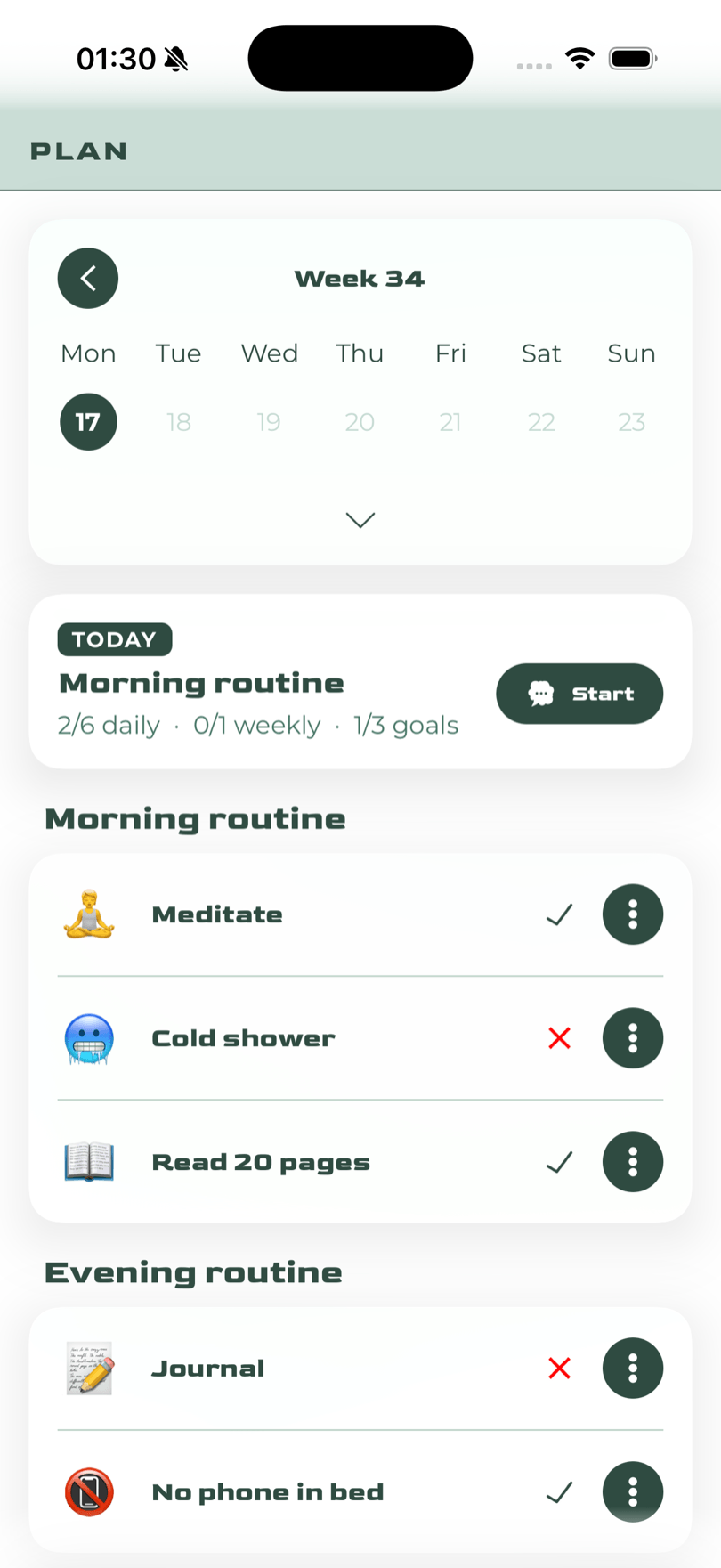
Then log it. Not because the log motivates you, but because you need to know within two weeks whether the anchor is actually firing. If you are missing it, the problem is almost always the anchor, not your willpower, and you can swap the anchor without abandoning the habit.

 iOS
iOS Android