The first 6 months of lifting decide whether you become a lifter for life or quit by month seven. Most people quit because their expectations were wrong, not because their effort was wrong.
This guide breaks down what actually happens to your body, your strength, and your visible progress in your first 26 weeks. Set the right expectations and the work pays off. Set the wrong ones and you will quit right before the good stuff starts.
Almost all strength gains in your first month come from your nervous system, not from new muscle. Your brain learns to recruit more motor units, fire them in sync, and coordinate the lift. You might double your starting weights on every compound lift without adding a visible gram of muscle.
This is good news. Strength compounds whether muscle grows visibly or not. The work being invisible from the outside is normal. Most beginners quit here because they expect mirror change in 4 weeks. There will not be much. See why early progress is invisible.
Targets at the end of month 1:
- Squat, bench, deadlift, row, overhead press each up 10 to 20 kilograms from your start
- Form locked on every compound
- A program you are sticking to (see 10 beginner mistakes)
Around week 6 to 8, the first real muscle starts to show. Shoulders look slightly wider, arms slightly thicker, posture improves. Friends and family who see you weekly will not notice yet. People who see you monthly might.
You should be eating in a slight surplus or at maintenance, hitting 1.6 to 2.2 grams of protein per kilogram of bodyweight daily, and sleeping 7 to 9 hours. If any of those is missing, muscle growth slows dramatically. See caloric surplus for muscle gain and sleep and muscle growth.
Targets at the end of month 2:
- 1 to 2 kg of new muscle for men, 0.5 to 1 kg for women
- Compound lifts still climbing every week
- Confidence in the gym, no longer feeling out of place
By month 3 you have logged 36 to 48 workouts. Your work capacity is bigger. You recover faster between sets. Your numbers keep climbing on every compound, often by 2.5 kilograms per session on bench and squat. Deadlift might climb faster.
The biggest risk in month 3 is hubris. New lifters who are seeing fast progress sometimes decide they are ready for an "advanced" 6-day split. They are not. Stay on the beginner program for the full first 6 months. Compound progress is doing all the work.
Targets at the end of month 3:
- 3 to 5 kg of total new muscle for men
- Strength roughly 50 percent above starting numbers
- Body composition shift visible in mirror, not yet visible in photos
Around weeks 14 to 16, the easy gains taper. The 2.5 kilograms per session becomes 2.5 kilograms per week. Some lifts (bench, overhead press) slow first, others (squat, deadlift) keep climbing. This is normal. It does not mean you stalled, it means you transitioned from a beginner to an early intermediate. See training age.
This is when double progression becomes useful. Instead of adding 2.5 kilograms every session, you add a rep at the same weight, then add weight only when you hit the rep cap.
Targets at the end of month 4:
- Squat and deadlift double of starting numbers for many male beginners
- 4 to 7 kg of new muscle for men
- First real plateau on one or two lifts, fixed by changing rep ranges
Around month 5, the people you see occasionally start asking if you "have been working out." Your shirts fit differently. Posture is dramatically better. You can see definition in your shoulders and arms in the right light.
This is also when you can introduce a small variation in programming, like swapping bent-over rows for Pendlay rows or adding a paused bench. Stay on the core 5 compound lifts. The variations are for spice, not substitution.
Targets at the end of month 5:
- 5 to 9 kg of new muscle for men
- Visible shoulder, arm, and back development
- Strength roughly 70 to 100 percent above start
By month 6, you have transitioned from a complete beginner to an early intermediate lifter. Some compound lifts will still progress weekly. Others move to bi-weekly progression. Total muscle gain in the first 6 months for a consistent male trainee is typically 5 to 10 kilograms. For women, 2.5 to 5 kilograms.
Month 6 is also the right time to evaluate the program. If you started on a basic 3-day full-body routine, you can consider moving to a 4-day upper/lower or staying with full-body for another 6 months. Both are valid. The lifters with the cleanest year-2 physiques almost always spent year 1 on a basic routine they refused to abandon. See consistency beats intensity.
Targets at the end of month 6:
- 5 to 10 kg of new muscle (men), 2.5 to 5 kg (women)
- Strength roughly 80 to 120 percent above start on big lifts
- Identity has shifted: you are now a lifter
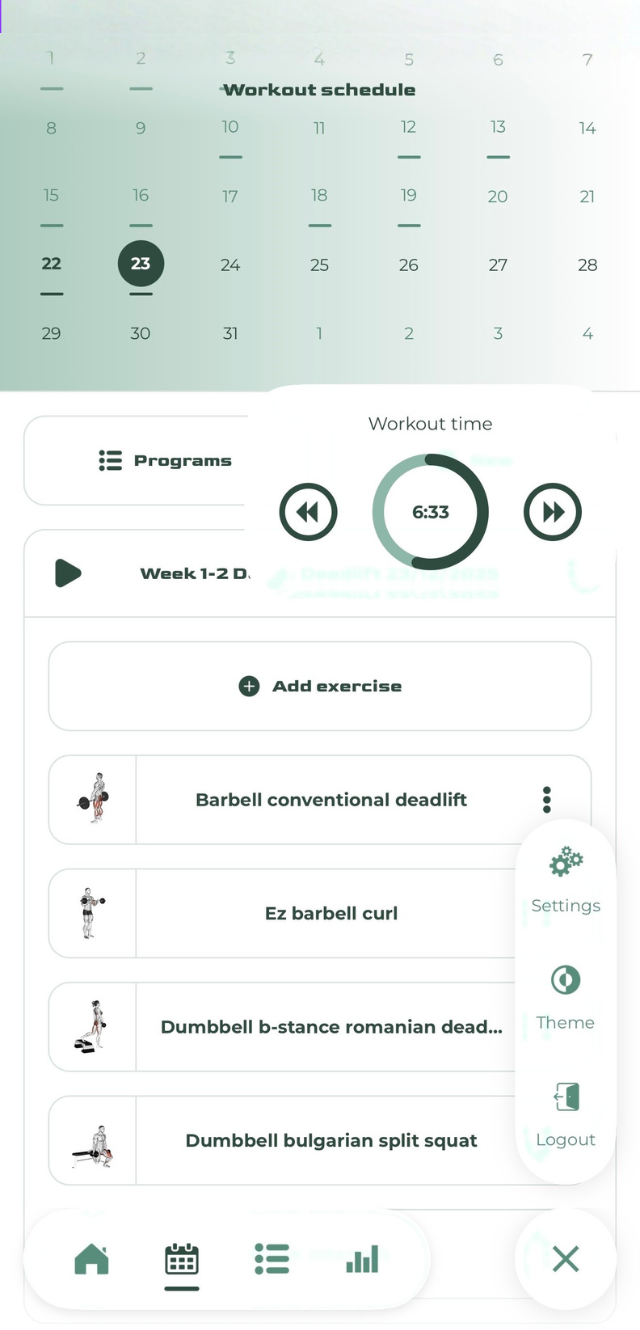
The first 6 months are the easiest 6 months you will ever have. Year two adds 4 to 6 kg of muscle if everything stays consistent. Year three adds 2 to 4 kg. By year five you are adding 1 to 2 kg per year and competing for diminishing returns. None of those years happen without showing up. The math always favors the consistent lifter. Logging every session is what keeps that math visible; if you have not picked a log yet, compare the best workout tracker apps.


 iOS
iOS Android