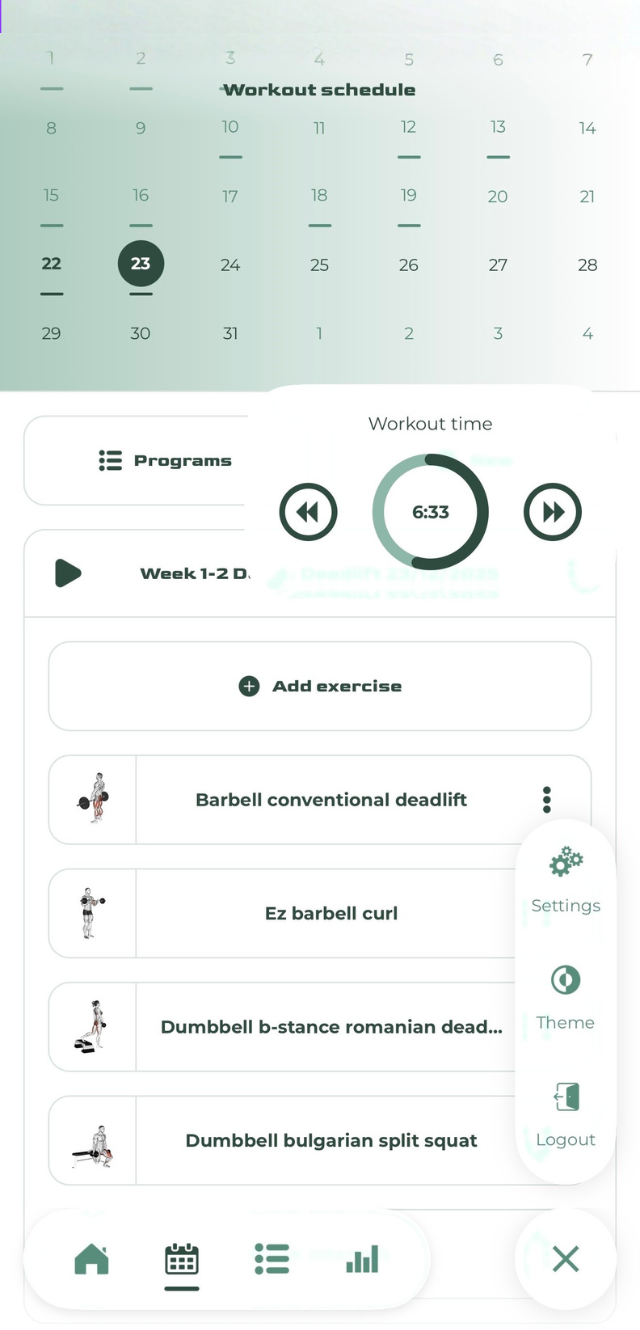
For muscle growth, rest 1.5 to 3 minutes between sets. Under a minute quietly costs you muscle by draining your next set. Past about two minutes adds little for growth but is exactly right for heavy strength work. The old advice to keep rest short for a better pump was wrong, and the research that overturned it is clear.
This is one of the most misremembered numbers in lifting, because the textbook recommendation flipped around 2016 and a lot of advice never updated. Here is the current evidence and what to actually do.
| Goal | Rest between sets | Why |
|---|
| Muscle growth | 1.5 to 3 minutes | Preserves the reps in your next set, which preserves volume |
| Maximal strength | 3 to 5 minutes | Full recovery of force output for heavy loads |
| Muscular endurance | 30 to 60 seconds | Trains fatigue resistance on purpose |
The rest of this article is about why the muscle-growth number is higher than most people were taught, and how to apply it without doubling your gym time.
For years the standard advice was to rest 30 to 60 seconds for hypertrophy. The logic was metabolic stress: short rest produces a bigger burn, a bigger pump, and a bigger acute growth hormone spike, and that was assumed to drive growth.
Then it got tested directly. Schoenfeld and colleagues (2016) took 21 resistance-trained men and assigned them either 1 minute or 3 minutes of rest, everything else equated, for 8 weeks. The longer-rest group came out ahead: significantly greater gains in squat and bench 1RM, and significantly greater growth in the front of the thigh. The short-rest group did not win on muscle anywhere.
The growth hormone theory did not survive contact with long-term data. The acute hormonal spikes from short rest are real, but they do not translate into more muscle over months. What short rest reliably does is the opposite of what was promised.
Here is the chain that actually matters.
When you rest only 60 seconds, you have not recovered, so your next set produces fewer reps. Fewer reps across all your sets means less total weight moved in the session, what lifters call volume load. And training volume is one of the primary drivers of muscle growth.
A 2024 Bayesian meta-analysis by Singer, Schoenfeld and colleagues, pooling the available rest-interval studies, concluded there is a small hypertrophy benefit to resting longer than 60 seconds, "perhaps mediated by reductions in volume load" at shorter rests. In one study within that analysis, 180 seconds of rest produced roughly 13 percent quadriceps growth versus about 7 percent with 60 seconds.
Short rest does not add a magic growth stimulus. It subtracts reps. The pump feels productive and is mostly just fatigue.
If more rest preserves more volume, why not rest five minutes on everything?
Because the benefit plateaus. That same 2024 meta-analysis found no appreciable difference in hypertrophy once rest passed roughly 90 seconds. The job of rest for growth is to recover enough to hit your target reps on the next set. Once you can do that, extra minutes buy you nothing for muscle, they just lengthen the workout.
So the muscle-growth window is bounded on both ends: at least 60 seconds so you do not bleed volume, no real growth benefit past about two minutes. The 1.5 to 3 minute recommendation sits right in that band, with the top end giving margin on heavy compounds.
Maximal strength plays by different rules. Here longer rest genuinely matters, all the way to 3 to 5 minutes.
A 2018 systematic review by Grgic and colleagues, covering 23 studies, concluded that rest periods longer than 2 minutes are required to maximize strength gains in trained lifters. Heavy singles, doubles, and triples tax the nervous system, and force output needs full recovery to express a true near-maximal effort. Rush it and the next set is artificially weak, which is the opposite of what strength work needs. If you are testing a 1RM, rest even longer between attempts.
This is the one case where the clock should read three minutes or more without apology.
Not every exercise needs the same rest, because not every exercise fatigues you equally.
A heavy squat, deadlift, or bench press is systemically exhausting: it loads the whole body and the central nervous system, so it needs the full 2 to 3 minutes (or 3 to 5 if you are training for strength). A set of curls, lateral raises, or leg extensions taxes one small muscle and clears much faster. Research on single-joint exercises shows performance recovers quicker than on compounds, so 60 to 90 seconds is usually enough on isolation work without losing reps.
A practical default:
- Heavy compounds: 2 to 3 minutes (3 to 5 for strength focus)
- Accessory compounds (rows, presses on machines): 1.5 to 2 minutes
- Isolation (curls, raises, extensions, calf work): 60 to 90 seconds
Note this is recovery-based reasoning, not a proven hypertrophy equivalence for short isolation rest, so the rule is simple: if your reps hold up on the next set, your rest was long enough.
The Time Math Nobody Mentions
This is the real reason people short their rest: time. So do the arithmetic honestly.
Take a session of 3 main exercises at 4 sets each, 12 working sets. Going from 90 seconds of rest to 3 minutes adds about 90 seconds to each rest period, which works out to roughly 16 to 18 extra minutes on the session. That is the entire trade.
The fix is not to slash rest and lose volume. It is to fill it. Pair non-competing exercises so you rest one muscle while training another: a set of curls during your back-row rest, calves during your leg-press rest, an unrelated mobility drill. You keep the recovery on each lift, and you reclaim the time. Done well, full rest costs you almost no extra minutes, just better organization.
"Rest until you feel ready" is a reasonable rule, with one catch. When lifters self-select rest, they tend to under-rest, cut sets short of recovery, and lose reps, the exact volume leak this whole article is about. The evidence that self-selected rest beats a fixed timer is thin.
The safe version: use feel, but anchor it to performance. You have rested long enough when you can hit your target reps on the next set, and not before. If set 3 falls two reps short of set 1, your rest was too short or the weight was too heavy. A tracked log makes that drop-off obvious set to set.
- Schoenfeld BJ, et al. (2016). Longer interset rest periods enhance muscle strength and hypertrophy in resistance-trained men. Journal of Strength and Conditioning Research. doi:10.1519/jsc.0000000000001272
- Singer A, et al. (2024). Give it a rest: a systematic review with Bayesian meta-analysis on the effect of inter-set rest interval duration on muscle hypertrophy. Frontiers in Sports and Active Living. doi:10.3389/fspor.2024.1429789
- Grgic J, et al. (2018). Effects of rest interval duration in resistance training on measures of muscular strength: a systematic review. Sports Medicine. doi:10.1007/s40279-017-0788-x


 iOS
iOS Android