Double Progression: The Simplest Way to Keep Getting Stronger

2026-04-305 min read

Written by Hamza J

Double Progression: The Simplest Way to Keep Getting Stronger

Two ways to progress instead of one.

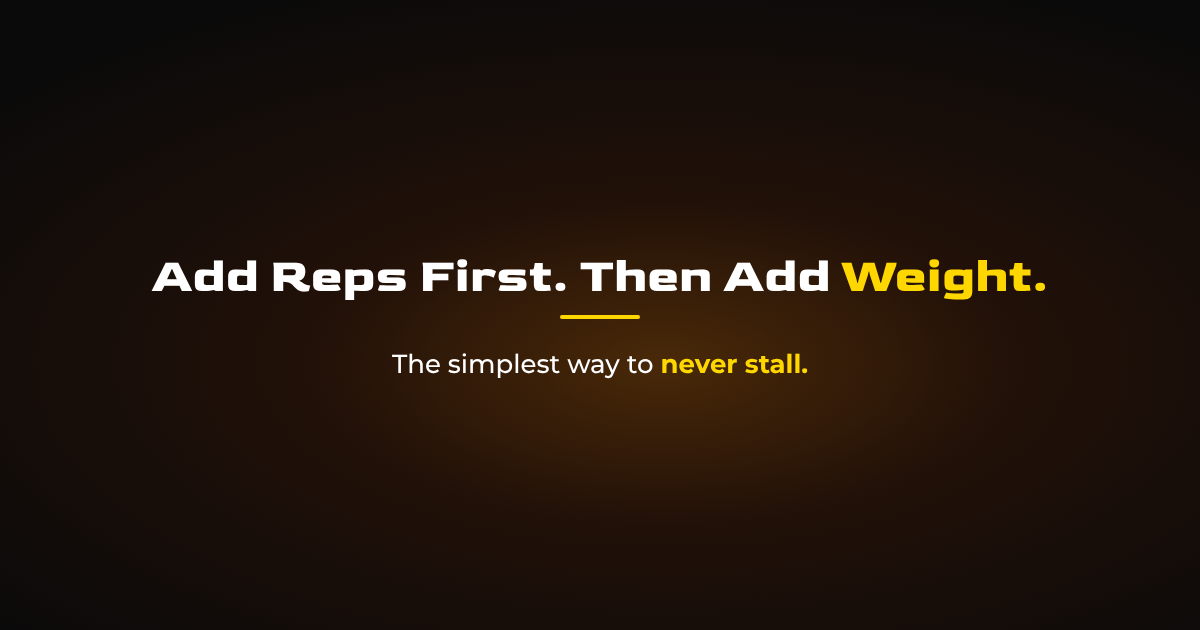
Linear progression tells you to add weight every session. That works until it does not. Double progression gives you a longer runway by letting you add reps first, then weight. It is the most practical progression method for intermediate lifters.


Why Linear Progression Stops Working

Linear progression is simple: add 2.5kg every session. For beginners, this works for months. But eventually, you hit a wall. You cannot add weight every week because your body needs more stimulus before it adapts to a heavier load.

This is not a failure. It is a signal that you need a smarter progression method.


How Double Progression Works

Pick a rep range. Start at the bottom. Add reps until you hit the top. Then add weight and reset to the bottom.

Here is the process:

  1. Choose a rep range. Common choices are 8-12, 6-10, or 10-15.
  2. Start at the bottom of the range. If your range is 8-12, start with a weight you can do for 8 reps across all sets.
  3. Add reps each session. Go from 8,8,8 to 9,9,9 to 10,10,10 and so on.
  4. When you hit the top of the range on all sets, add weight. Once you can do 12,12,12, increase the weight by 2.5-5kg.
  5. Reset to the bottom. With the new weight, you will be back around 8,8,8.

A Concrete Example

WeekWeightReps (3 sets)Action
160kg8, 8, 8Starting point
260kg9, 9, 8Adding reps
360kg10, 10, 9Adding reps
460kg11, 10, 10Adding reps
560kg12, 12, 11Almost there
660kg12, 12, 12Top of range hit
762.5kg8, 8, 8Weight increase, reps reset

You progressed from 60kg x 8 to 62.5kg x 8 over seven weeks. That is real strength gain, built gradually and sustainably.


Where Double Progression Works Best

Double progression is ideal for:

  • Accessory exercises. Rows, curls, lateral raises, leg press. These movements respond well to rep progression.
  • Upper body compounds. Bench press, overhead press. Upper body lifts are harder to load linearly because the increments are proportionally larger.
  • Intermediate lifters. Anyone past the beginner phase who can no longer add weight every session.

For heavy compound lifts like squats and deadlifts, other methods (wave loading, periodization) may work better. But double progression is a solid default for most of your training.


Why Tracking Matters

Double progression only works if you track your reps. You need to know exactly what you did last session so you can beat it this session. If you are guessing, you are not progressing.

Log every set. Write down the weight and the reps. Next session, your goal is clear: match or beat those numbers.

This is where a tracking app becomes essential. You cannot remember what you did on dumbbell rows three sessions ago. But your log can.


Frequently Asked Questions (FAQ)

What rep range should I use for double progression?
For hypertrophy, 8-12 is the most common and effective range. For strength-focused accessories, 6-10 works well. For endurance or isolation work, 10-15 is appropriate.
Do all sets need to hit the top of the range before I add weight?
Yes. All working sets should reach the top of the rep range before you increase weight. If you hit 12, 12, 10, keep the weight the same and push for 12, 12, 12 next session.
How much weight should I add when I move up?
For upper body exercises, add 2.5kg. For lower body, add 2.5-5kg. Smaller jumps mean smoother progression and fewer failed sessions.
Can I use double progression for barbell squats and deadlifts?
You can, but these lifts often benefit from periodized approaches with planned intensity waves. Double progression works best for movements where small rep increases are practical.
What if I get stuck at the same rep count for weeks?
If you stall for 2-3 sessions, consider one of these adjustments: reduce the weight by 10% and build back up, add an extra set for more volume, or check your recovery (sleep, nutrition, stress).
Is double progression better than linear progression?
Neither is universally better. Linear progression is faster when it works. Double progression lasts longer and is more forgiving. Use linear progression as a beginner, then switch to double progression when linear stalls.

Watch the Video Guide

Quick visual breakdown of this topic.

Open Video Page

Related Program Guides

Track Your Progress

Log every set, track your lifts, and see your progress over time. Free on iOS & Android.

Virtus Athlete

The workout app that puts YOU in control of your strength and fitness journey

Follow us

Get the App

Available on iOS and Android for free.

© 2026 Verum Services. All rights reserved.

Virtus Athlete is a training tool, not a medical device nor a substitute for professional guidance. Train responsibly, do your own research, and consult a qualified fitness professional if needed.