Most beginners don't stall because they lack talent. They stall because of ten fixable mistakes nobody warned them about.
Your first year of lifting is the most important year you will ever train. Get it right and you build the strength, technique, and habits that carry you for decades. Get it wrong and you grind for months with nothing to show for it. Here are the ten most common beginner lifting mistakes and how to fix each one fast.
Loading the bar to look strong instead of training to get strong. Form breaks down, range of motion shrinks, and the muscle you came to build never does the work. The fix: pick a weight you can move with clean technique for the prescribed reps. Add weight only when the last rep is still controlled. Read more on ego lifting vs proper form.
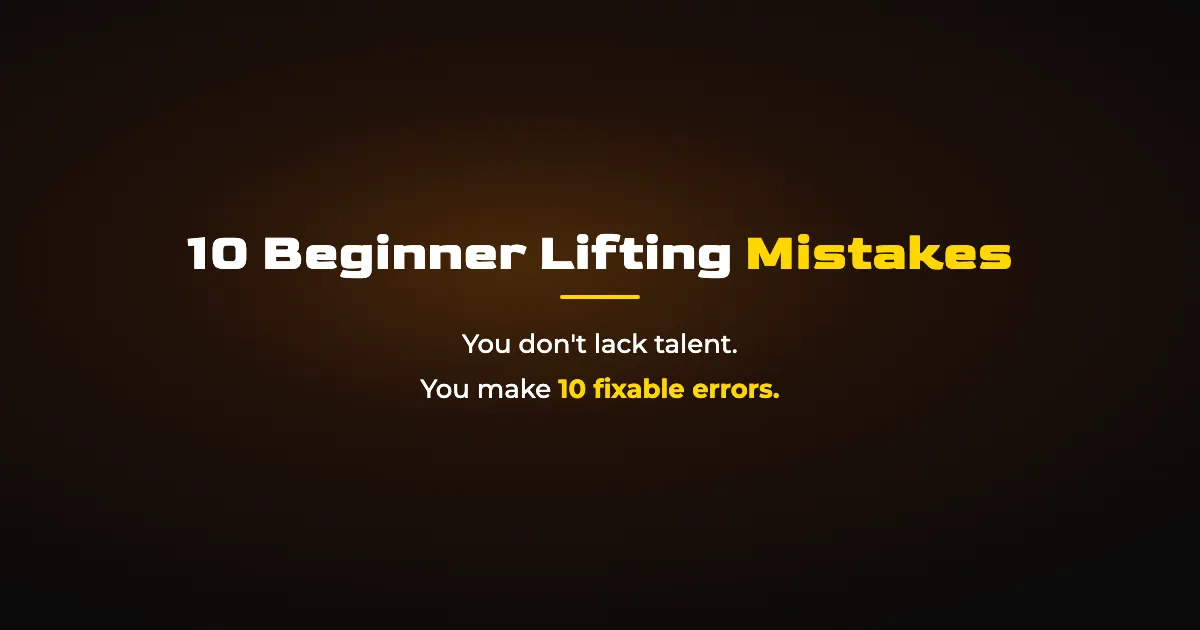
Random workouts produce random results. If your sets, reps, and exercise choice change every session, there is no signal in the noise and no way to know if you are progressing. Follow a structured beginner program for at least 12 weeks before you change anything. Strength is built by repeating the same lifts and adding weight over time. That principle has a name: progressive overload.
If you do not write down what you lifted last week, you cannot beat it this week. Memory is unreliable past two sessions, and intuition will lie to you about whether you are getting stronger. Track every set, every rep, every weight from day one. The compound interest of tracked progression is what separates lifters who keep growing from lifters who plateau in six months. See why you should track workouts.
Going straight to your working weight is a recipe for cold-muscle injuries and weaker top sets. Two or three progressive warm-up sets prime your nervous system and rehearse the movement at lower load. They take five minutes and add real numbers to your working sets. The protocol is in our guide to warm-up sets before lifting.
Half your muscle mass is below your waist. Skipping leg day shrinks your overall growth, ruins your proportions, and limits how much your upper body can ever grow because legs drive the systemic anabolic response. Squat or deadlift heavy at least once a week, every week, no exceptions.
Doing 25 sets per muscle per session because an advanced lifter on Instagram does it. Beginners recover slower than they think, and excess volume buries progress under fatigue. Start with 8 to 12 working sets per muscle per week and add slowly. More is not better. Better is better.
You cannot build muscle from thin air. Most new lifters undereat protein by 30 to 50 grams a day and wonder why nothing is growing. Target 1.6 to 2.2 grams of protein per kilogram of bodyweight, every day. For an 80 kg lifter that is 130 to 175 grams. Use the calorie calculator and the calorie surplus guide to set the rest of your intake.
Sleep is when your body actually grows. Train hard on six hours and the work is wasted. Seven to nine hours, consistent bedtime, dark room. Skip the late-night phone and the doomscroll. Sleep is not optional, it is the supplement that beats every supplement combined. See sleep and muscle growth.
Program-hopping is the single fastest way to make zero progress for an entire year. Every program needs at least 8 to 12 weeks to show results, and most need 16. If the bar is going up week to week, the program is working, even if it does not look exciting. Stay the course. The cure for boredom is heavier weights, not a new split. If you really are stuck, read how to break through a gym plateau.
The pump feels great. It is not progress. A pump is blood volume in the muscle, it disappears in 30 minutes, and it tells you nothing about whether you got stronger today. Track your top set weights and reps. If those climb week over week, you are growing. If only the pump climbs, you are wasting your time.
You do not need to fix all ten today. Pick the one that hurts your training the most right now and fix only that. For most beginners it is mistake 2 or 3, no program or no tracking. Solve those two and you put yourself in the top 10 percent of new lifters before you have touched a heavier dumbbell.
The hard truth nobody says out loud: consistency beats every other variable. A beginner who shows up three times a week for a year and follows any half-decent program will beat the beginner with the perfect plan who shows up twice a month. Pick the program. Track every session. Show up.

 iOS
iOS Android