Back to BlogPrograms

How to run the TSA 9-Week Intermediate program

2026-08-1113 min read

Written by Hamza J

How to run the TSA 9-Week Intermediate program
Contents

Based on The Strength Athlete's 9-Week Intermediate Approach, with some minor adaptations.

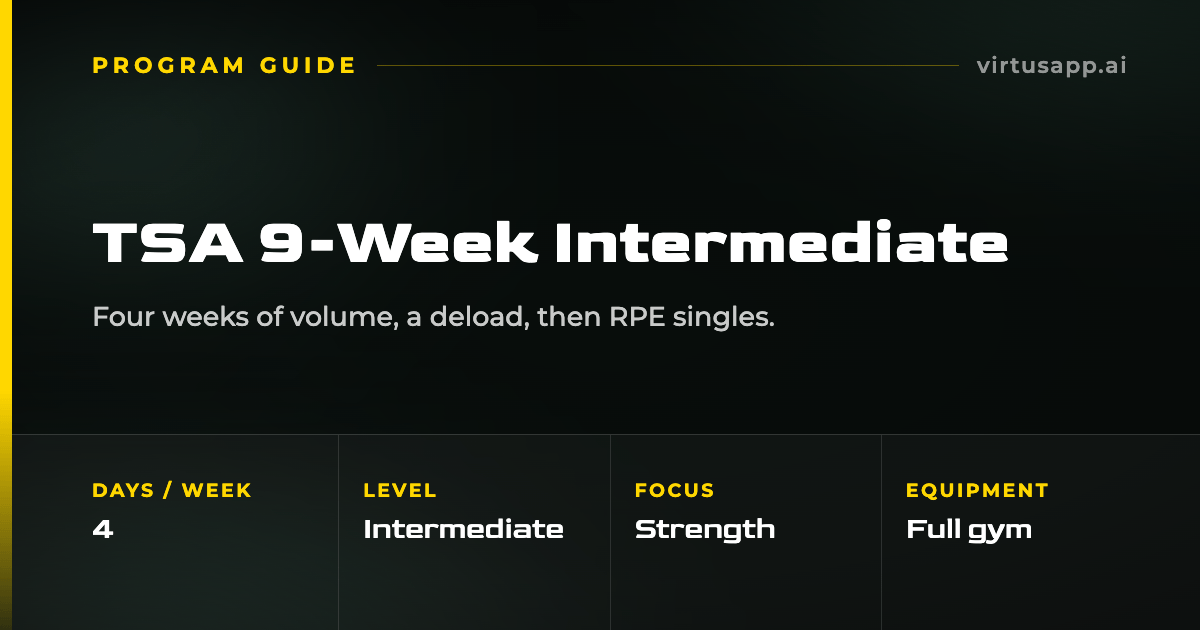
A free 9-week powerlifting block written by Bryce Lewis, Hani Jazayrli, and the TSA coaching team. Four training days per week. The first four weeks pile on volume at moderate percentages, week 5 sheds the fatigue, weeks 6 to 8 expose you to heavy RPE-based singles, and week 9 takes you into a competition or a max test.

Who Is This Program For?

The TSA 9-Week Intermediate Approach is for lifters with roughly one to three years of consistent barbell training who want to peak for a meet or a mock meet. TSA points anyone with under six months of experience to their Beginner Approach instead.

The program focuses on:

  • Fitness and fatigue: weeks 1 to 4 build fitness and fatigue on purpose, week 5 removes the fatigue so the fitness shows
  • Competition specificity: squat, bench, and deadlift with paused and competition-style variations, not a general strength grab bag
  • Percentages then RPE: the volume block is percentage-driven for predictability, the peak block is RPE-driven so autoregulation carries you to a real max
  • A hard deadline: nine weeks with a test at the end, not an open-ended progression

If you have run a linear progression into the ground and want a structured peak that ends with a number, this is a good fit.

Program Structure

The 3 Competition Lifts

LiftMovement Pattern
Barbell Back SquatLower body push
Barbell Bench PressHorizontal push
Barbell Conventional DeadliftHip hinge

Squat is trained twice per week, deadlift twice per week (competition style and paused), and pressing appears on every training day.

The 4-Day Split

A typical week looks like this. Days sit best on Monday, Tuesday, Thursday, Friday.

Day 1:

SlotWork
SquatTop set plus back-off sets
Bench PressHypertrophy focus, higher reps
Close Grip Bench PressSupplemental pressing
Incline RowUpper back
Reverse Fly, BandRear delt and rotator cuff

Day 2:

SlotWork
DeadliftCompetition style
Bench PressPower focus, lower reps
Pendlay RowUpper back
Back ExtensionPosterior chain
Pull-upsLats

Day 3:

SlotWork
SquatVolume focus, straight sets
Chest FlyPec volume
Leg PressQuad volume
Incline RowUpper back
Lateral RaiseDelts

Day 4:

SlotWork
Bench PressStrength focus, heaviest press of the week
DeadliftPaused
Legs Up Bench PressSupplemental pressing
Bent Over RowUpper back
Lat PulldownLats

Sessions run about 90 minutes.

The Three Phases

PhaseWeeksWhat Happens
Volume1 to 4Higher overall work, lower overall loading. Builds hypertrophy and work capacity. Fatigue accumulates on purpose
Deload5Volume drops sharply. Fatigue clears so the fitness built in weeks 1 to 4 can be expressed
Peak6 to 8Heavier loading, lower volume, RPE-based top singles
Test9Light prep on days 1 to 3, then singles at RPE 10 on day 4, or a meet

Week 5 is not optional. It is the mechanism that makes the peak work. Skipping it leaves you too fatigued to express anything in weeks 6 to 8.

Weeks 1 to 4: The Volume Phase

Everything in this phase is percentage-based off your entered 1RMs. Percentages climb roughly 2 to 3% per week while reps hold or fall slightly.

Squat, Day 1 (Top Set Plus Back-Offs)

WeekTop SetBack-Off Sets
180% × 369% × 8, 3 sets
282% × 371% × 8, 3 sets
384% × 373% × 7, 3 sets
486% × 375% × 7, 3 sets

Squat, Day 3 (Straight Sets)

WeekLoadSets
173%4 to 6 sets
275%4 to 6 sets
377%4 to 6 sets
479%4 to 6 sets

Deadlift

WeekLoad and RepsSets
174% × 54
277% × 55
379% × 45
481% × 46

Bench Press, Hypertrophy Day

WeekLoad and RepsSets
169% × 83
271% × 83
373% × 74
475% × 74

Bench Press, Power Day

WeekLoad and RepsSets
172% × 45
274% × 45
376% × 45
478% × 45

Week 1 should feel moderate and controlled. Nothing in week 1 sits above 80% and most of it is in the high 60s and low 70s. If you are grinding reps in week 1, your entered 1RM is too high. Drop it by 5 to 10% and restart the week rather than trying to survive the block.

Week 5: The Deload

Volume drops and intensity stays moderate. The point is to arrive in week 6 fresh, not to test anything.

LiftWork
Squat73% × 5, 3 sets, then 75% × 4, 5 sets
Deadlift79% × 3, 4 sets, then 72% × 3, 4 sets
Bench Press73% × 6, 3 sets, then 78% × 4, 5 sets

Do not add sets. Do not "make up" the volume you feel you are missing. The whole block hinges on this week doing its job.

Weeks 6 to 8: The Peak

The structure flips. Top sets become RPE-based singles, and back-offs stay percentage-based. RPE targets climb one half point per week.

Squat

WeekTop SetBack-Off Sets
6Single at RPE 6.585% × 3, 5 sets
7Single at RPE 7.587% × 3, 5 sets
8Single at RPE 8.589% × 2, 5 sets

Deadlift

WeekTop SetBack-Off Sets
62 singles at RPE 782% × 3, 4 sets
71 single at RPE 884% × 2, 5 sets
81 single at RPE 8.586% × 2, 4 sets

Bench Press, Day 4 (Strength)

WeekTop Set
62 singles at RPE 7
72 singles at RPE 8
81 single at RPE 9

Bench Press, Day 2 (Power)

WeekLoad and RepsSets
680% × 45
782% × 45
884% × 35

Week 9: Testing

Days 1 to 3 are light prep work at moderate loads. Day 4 is the test or the meet:

Squat:    1 rep at RPE 10
Bench:    1 rep at RPE 10
Deadlift: 1 rep at RPE 10

Those three numbers become your inputs if you run the block again.

How to Hit an RPE-Based Single

The peak weeks tell you to hit a single at a target RPE, not a target weight. TSA's method is a short ramp with gauging sets.

The rule: subtract about 5% per RPE point below your target, and climb roughly 1 RPE per set.

Example, targeting a single at RPE 8.5:

Gauging set 1: single at RPE 6.5   (roughly 10% below the target load)
Gauging set 2: single at RPE 7.5   (roughly 5% below the target load)
Top set:       single at RPE 8.5

If gauging set 2 already feels like RPE 8.5, that is your top single. Stop there. The prescription is the effort, not the plate math.

Reading RPE

RPEMeaning
10Nothing left
9One rep left in the tank
8Two reps left in the tank
7Three reps left in the tank
6Four reps left in the tank

Progression: How Weights Increase

There is no session-to-session weight increase. You never add 2.5 kg (5 lbs) to last week's bar because it felt easy.

Progression is written into the nine weeks:

MechanismWhere
Percentages climb 2 to 3% per weekWeeks 1 to 4 and the percentage back-offs in weeks 6 to 8
Sets increase within the volume phaseDeadlift goes from 4 sets to 6 sets across weeks 1 to 4
Reps fall as intensity rises8s become 7s, 5s become 4s, 4s become 3s and 2s
RPE targets climb half a point per weekWeeks 6 to 8 top singles

Everything is calculated from the 1RMs you entered at the start. Get those right and the block takes care of itself.

Get Your Form Right First

Everything below assumes your form is already solid. Finding your working weight, adding weight, chasing reps, all of it only works if you can perform the lift correctly. While your form is not locked in, that is your only job. Make good form the goal of every set, not the weight on the bar. Drilling the movement with an empty bar beats loading plates onto a lift you cannot control yet.

To learn, don't hesitate to search Google and YouTube (there is a lot of good free material) and record yourself from the side to compare against a proper demonstration. In general, good form means a full controlled range of motion, a braced neutral spine, no bouncing or momentum, a consistent setup every rep, and ending the set when technique breaks down rather than grinding sloppy reps.

Finding Your Starting Weights

You need a 1RM for squat, bench, and deadlift from a recent heavy set within the last three months. TSA is explicit about this: use current numbers or recent low-rep heavy sets, not theoretical maxes and not goal numbers.

If You Have Competed Recently

Use your best competition lifts.

If You Have Not

  1. Take a heavy single, double, or triple at RPE 9 from the last three months
  2. Convert with a 1RM calculator
  3. A common formula: Weight × Reps × 0.0333 + Weight

Example:

You bench 100 kg (220 lbs) for 3 reps at RPE 9:
  Estimated 1RM = 100 × 3 × 0.0333 + 100 = 110 kg
  In pounds: 220 × 3 × 0.0333 + 220 = 242 lbs

If you are between two numbers, take the lower one. Week 1 is your sanity check: it should feel like work, not like a test.

Warming Up

Ramp into the first working set of each main lift.

SetWeightRepsRest
1Empty bar, 20 kg (45 lbs)8 to 1030 to 45 seconds
2~40% of working weight545 seconds
3~60% of working weight360 seconds
4~80% of working weight1 to 290 seconds
Work setsPrescribed loadPrescribed reps2 to 5 minutes

Example: if your squat top set on week 1 is 80% of a 180 kg (400 lbs) max, that is 144 kg (320 lbs):

  • Set 1: 20 kg (45 lbs) × 8
  • Set 2: 57.5 kg (125 lbs) × 5
  • Set 3: 87.5 kg (190 lbs) × 3
  • Set 4: 115 kg (255 lbs) × 2
  • Top set: 144 kg (320 lbs) × 3

In weeks 6 to 8 the warm-up and the RPE ramp merge. Take bigger jumps early and small jumps near the top so you can feel each load change.

Rest Times

SituationRest Period
Heavy singles and top sets3 to 5 minutes
Back-off sets2 to 3 minutes
Compound accessories2 to 3 minutes
Band and isolation work60 to 90 seconds

Rest fully before a top single. An RPE call made on short rest is a rest reading, not a strength reading.

When Things Go Wrong

Week 1 Feels Brutal

Your 1RM is too high. Lower every entered max by 5 to 10% and restart week 1. This is the single most common failure mode and it is entirely fixable.

You Miss Reps in the Volume Phase

Cut one back-off set for that session and keep moving. If it happens twice in a week, lower the 1RM.

The RPE Single Comes In Light

That is fine and it is the point. RPE 7 in week 6 is supposed to feel easy. The program is walking you toward the max, not throwing you at it.

The RPE Single Comes In Heavy

Take the load that matches the effort, not the load you expected. If week 8's RPE 8.5 lands well under your projected max, your entered 1RM was optimistic. Adjust your expectations for week 9 rather than forcing plates onto the bar.

You Are Tempted to Skip Week 5

Do not. Weeks 1 to 4 deliberately bury you. Week 5 digs you out. If you carry that fatigue into week 6, every RPE target inflates and the peak is worthless.

You Miss a Session

Pick up where you left off. Do not double up two training days to catch up, especially in the peak weeks.

Program Duration

The program runs 9 weeks at 4 sessions per week, which is 36 total workouts across roughly two months.

Why 9 weeks?

  • Four weeks is enough to accumulate meaningful volume without wrecking you
  • One deload week is enough to shed that fatigue
  • Three weeks of rising intensity is enough to sharpen without over-peaking
  • Week 9 gives you a hard number to build the next block from

There is also a version 1.0 of this program that is purely percentage-based with no mid-cycle deload. TSA suggests alternating between 1.0 and 2.0 every few cycles so the loading style changes.

Run TSA 9-Week Intermediate on Virtus Athlete

Virtus Athlete handles the weekly percentage progression, the RPE targets on the peak singles, and the deload week for you. Enter your three current maxes and start training.

Free on iOS and Android.

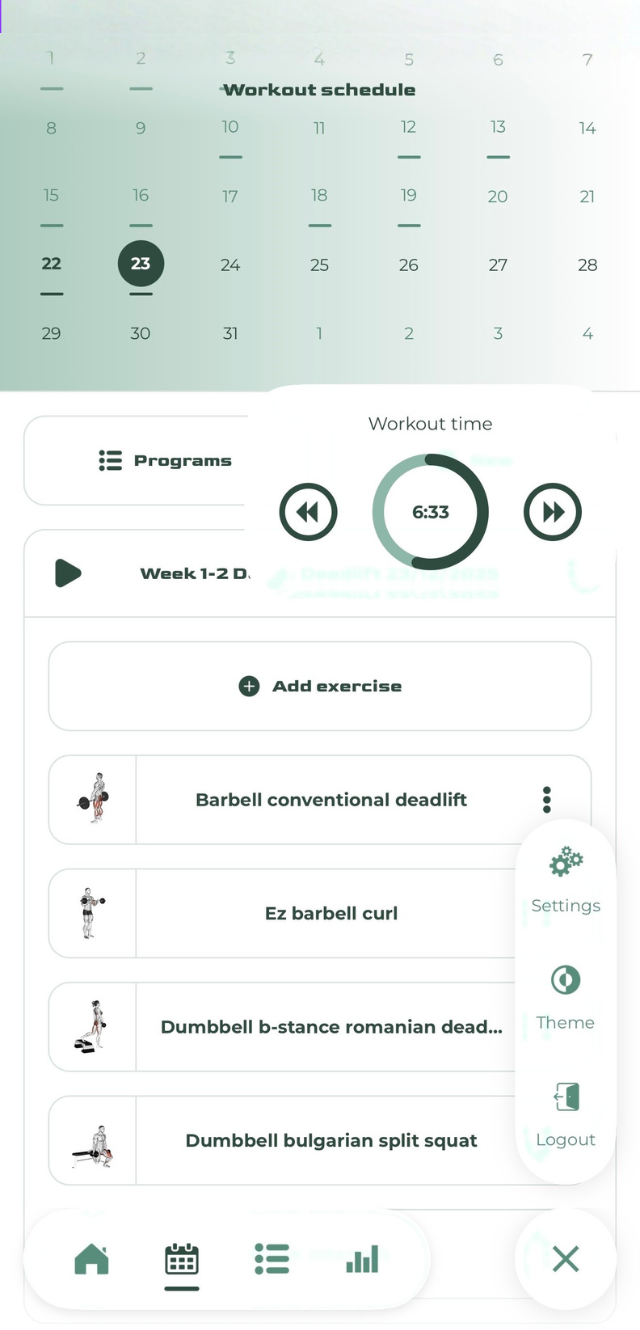
Virtus Athlete home screen with the week's scheduled workouts and progress summary

Frequently Asked Questions (FAQ)

How long does one full run take?
With 9 weeks at 4 sessions per week, expect 36 total workouts over roughly 2 months.
Do I need a meet to run this?
No. Week 9 doubles as a max testing week. Work up to singles at RPE 10 on all three lifts instead of competing.
Can I run it 3 days per week?
The block is written as four days with a specific distribution of squat, bench, and deadlift exposures. If you only have three days, run the four sessions on a rolling schedule and accept that the nine weeks will take longer than nine weeks.
What is the difference between 1.0 and 2.0?
Version 2.0 adds RPE-based bench singles from week 1, uses a top set plus back-off structure for squat instead of straight sets, adds paused deadlift volume, and swaps overhead press for chest accessories. Version 1.0 is purely percentage-based and builds continuously through weeks 1 to 5 with no mid-cycle deload.
Can I swap the accessories?
Yes. The competition lifts and their prescribed loading should stay as written. Rows, pulldowns, flies, and band work can be swapped for equivalents your gym supports.
What if my gym has no leg press?
Substitute any loaded quad-dominant movement you can add weight to over the block: hack squat, belt squat, or goblet squat for reps.
What happens after 9 weeks?
Take a recovery week, then rerun the block with your new maxes, alternate into version 1.0 for a different loading feel, or move into an off-season hypertrophy block before the next prep.

Related Articles

Track This Program

Build unlimited programs, log every set, and track your progress over time. Free on iOS & Android.