Based on Arnold Schwarzenegger's Blueprint to Mass, with some minor adaptations.
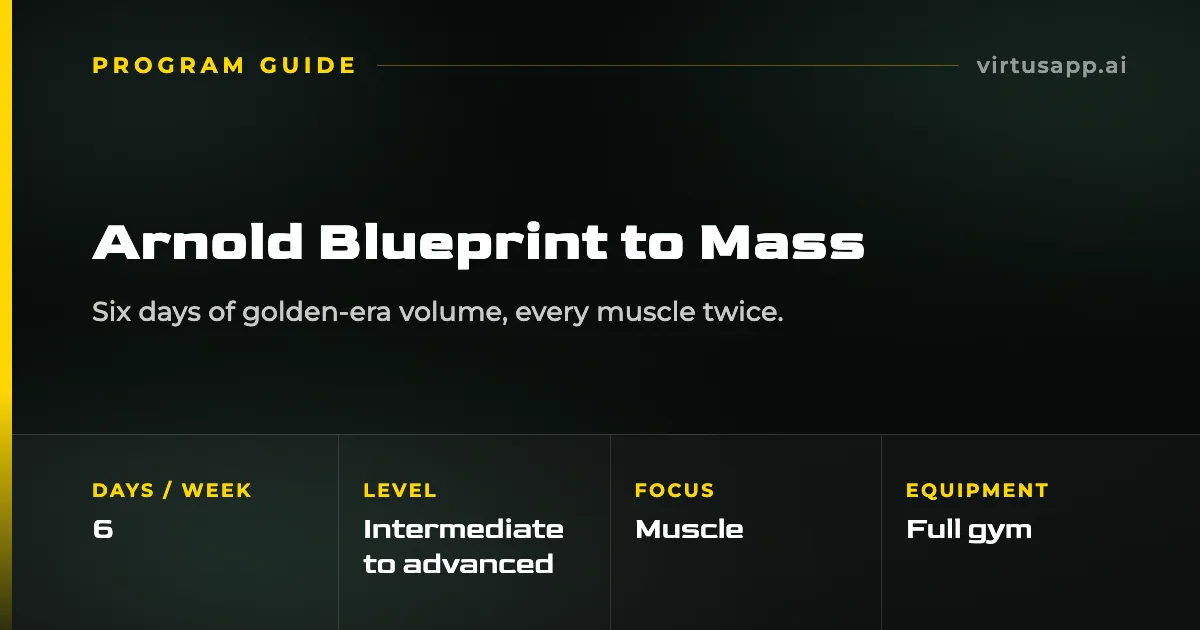
Arnold's golden-era training distilled into a program: a 6-day split hitting chest and back, shoulders and arms, and legs twice each per week, built on pyramid sets that start at 30 reps and climb down to heavy sets of 6. This guide covers Phase 1, the first 4 weeks. It is enormous volume, short rests, and old-school intensity techniques.
Blueprint to Mass is for intermediate and advanced lifters with the time, recovery, and appetite for golden-era volume. This is not an efficient minimalist program; it is a maximalist one, and that is the point.
The program focuses on:
- Volume: 5 sets per exercise, many exercises per session, 6 sessions per week
- Frequency: every muscle group trained twice per week
- Pyramid loading: from a 30-rep opener down to heavy sets of 6
- Intensity techniques: supersets everywhere, plus the stripping method and the 1-10 method
If you want to train like Arnold trained, eat like it, and sleep like it, this is it.
Weekly Schedule
| Day | Workout |
|---|
| Monday | Chest, Back, Abs |
| Tuesday | Shoulders, Arms, Forearms, Abs |
| Wednesday | Legs, Calves, Abs |
| Thursday | Chest, Back, Abs |
| Friday | Shoulders, Arms, Forearms, Abs |
| Saturday | Legs, Calves, Abs |
| Sunday | Rest |
The Pyramid Rep Scheme (Upper Body Days)
Unless listed otherwise, every upper body exercise uses 5 sets with this weekly scheme, adding weight each time the reps drop:
| Week | Reps Per Set |
|---|
| 1 | 30, 12, 10, 8, 6 |
| 2 | 30, 8, 6, 4, 2 |
| 3 | 30, 5, 5, 5, 5, 5 |
| 4 | Max out on ONE major exercise, then 20, 15, 12, 10 on the others |
The opening 30-rep set is a light warm-up set with an empty bar or very light weight. From there, each set gets heavier as the reps fall.
Day 1 and 4 - Chest, Back, Abs
| Exercise | Sets x Reps |
|---|
| Flat Barbell Bench Press | 5 sets, weekly pyramid |
| Incline Barbell Bench Press | 5 sets, weekly pyramid |
| Superset: Dumbbell Flye + Dumbbell Pullover | 5 sets each, weekly pyramid |
| Wide-Grip Chin-Up | 4 sets to failure |
| Superset: Bent-Over Barbell Row + Bent-Over Dumbbell Row | 5 sets each (Week 1: 30, 12, 10, 8, 6; Week 2: 30, 8, 6, 4, 2; Week 3: 30, 12, 10, 8, 6; Week 4: 20, 15, 12) |
| Deadlift | 3 sets: 10, 6, 4 or 5, 5, 5 or 12, 10, 8 |
| Hanging Leg Raise | 5 x 25 |
| Decline Sit-Up | 5 x 25 |
The incline bench angle rotates weekly: low angle in Week 1, medium in Week 2, high in Week 3, back to low in Week 4. In Week 2, finish your last flat bench set with the stripping method (see below). T-bar rows can substitute either rowing movement.
Day 2 and 5 - Shoulders, Arms, Forearms, Abs
| Exercise | Sets x Reps |
|---|
| Clean and Press (Tuesday) / Arnold Press (Friday) | 5 x 5 |
| Superset: Standing Dumbbell Press + Front Dumbbell Raise | 5 sets each, weekly pyramid |
| Superset: Dumbbell Lateral Raise + Upright Barbell Row | 5 sets each, weekly pyramid |
| Barbell Curl | 5 sets, weekly pyramid (1-10 method in Weeks 2 and 3) |
| Superset: Seated Incline Dumbbell Curl + Concentration Curl | 5 sets each, weekly pyramid |
| Close-Grip Bench Press | 5 sets, weekly pyramid |
| Superset: Skullcrusher + One-Arm Overhead Dumbbell Extension | 5 sets each, weekly pyramid |
| Superset: Wrist Curl + Reverse Wrist Curl | 5 sets each, weekly pyramid |
| Decline Sit-Up | 5 x 25 |
On Friday, the behind-the-neck press replaces the standing dumbbell press and rear delt flyes replace the lateral raises, and triceps pushdowns replace skullcrushers.
Day 3 and 6 - Legs, Calves, Abs
| Exercise | Sets x Reps |
|---|
| Back Squat (Wednesday) / Front Squat (Saturday) | 5 x 8-12 |
| Stiff-Legged Deadlift | 5 x 8-12 |
| Good Morning (only once per week) | 5 x 8-12 |
| Barbell Lunge | 5 x 8-12 |
| Superset: Leg Extension + Leg Curl | 5 x 8-12 each |
| Superset: Standing Calf Raise + Seated Calf Raise | 5 x 8-12 each |
| Kneeling Cable Crunch | 4 x 25 |
In Week 4, if you feel good, pick one day and work up to a 1-rep max squat using this build-up: 20, 15, 10, 8, 5, 3, 1, 1, then the max attempt.
The Intensity Techniques
Supersets: two exercises performed back to back with no rest in between, resting only after the pair.
Stripping method: after your final work set, immediately strip some weight off and rep out 5-10 reps, then strip again with no rest, repeating down to the empty bar for a final 20 reps.
1-10 method: find a weight you can lift only once, do 1 rep, strip just enough weight to get 2 reps, then 3, and so on up to 10, with no rest except while unloading plates. Used on barbell curls in Weeks 2 and 3.
The Blueprint progresses through the weekly rep waves, not through fixed weekly weight jumps:
- Within each pyramid, add weight every set as the reps drop; the final set should be near your limit for that rep count
- Week 2's low-rep wave (8, 6, 4, 2) forces heavier loads than Week 1
- Week 3's 5x5 wave consolidates that strength at moderate reps
- Week 4 tests it with a max and flushes with high reps (20, 15, 12, 10)
- When you repeat a rep target from a previous week, aim to beat the weight you used last time, in steps of 2.5 kg (5 lbs) for upper body lifts and 5 kg (10 lbs) for lower body lifts
On the legs days, use double progression: when all 5 sets reach 12 reps, add weight and drop back to 8.
Everything below assumes your form is already solid. Finding your working weight, adding weight, chasing reps, all of it only works if you can perform the lift correctly. While your form is not locked in, that is your only job. Make good form the goal of every set, not the weight on the bar. Drilling the movement with an empty bar beats loading plates onto a lift you cannot control yet.
To learn, don't hesitate to search Google and YouTube (there is a lot of good free material) and record yourself from the side to compare against a proper demonstration. In general, good form means a full controlled range of motion, a braced neutral spine, no bouncing or momentum, a consistent setup every rep, and ending the set when technique breaks down rather than grinding sloppy reps.
The pyramid finds your weights for you:
- Set 1 is always light: the empty bar (20 kg / 45 lbs) or light dumbbells for 30 reps
- Jump to a weight where 12 reps is challenging but clean
- Add 5-10% per set as the reps drop to 10, 8, and 6
- The set of 6 should be hard but leave a rep in reserve in your first week
Example bench pyramid: 20 kg (45 lbs) x 30, 60 kg (135 lbs) x 12, 70 kg (155 lbs) x 10, 80 kg (175 lbs) x 8, 85 kg (190 lbs) x 6.
Log every set; next week's pyramids are built from this week's numbers. It's better to start too light than too heavy, especially with this many sets still ahead of you.
The 30-rep opening set is the program's built-in warm-up, and the pyramid itself ramps the load gradually. Before the first exercise of each day, add 5-10 minutes of general warm-up (light cardio, arm circles, empty-bar sets). Later exercises for the same muscles need no extra preparation. Before the Week 4 max attempt, follow the full build-up pyramid listed above and rest fully between the heavy singles.
| Situation | Rest Period |
|---|
| Between sets and after supersets | 45-60 seconds |
| Within a superset | None. Move immediately |
| Before max attempts (Week 4) | 3-5 minutes |
Short rests are a deliberate part of the program. Keep a timer running; the volume only fits in a session because the pace is relentless.
Phase 1 is only 4 weeks, so there is no scheduled deload inside it. If you cannot complete the prescribed sets:
- First cut the intensity techniques (stripping, 1-10) for a week; they are the biggest recovery drain
- Check sleep (7-9 hours), calories (this program demands a surplus), and protein (1.5-2.2 g per kg of bodyweight, 0.7-1 g per lb)
- If a lift stalls across two weeks at the same rep target, reduce its weight by 10% and rebuild
- Take the Sunday rest day seriously. Nothing is trained on it
After completing Phase 1 (and Phase 2 if you continue), take a full deload week before the next program.
Phase 1 runs for 4 weeks (4 weeks at 6 sessions per week, totaling 24 workouts). The complete Blueprint to Mass runs 8 weeks: Phase 2 keeps the same split for weeks 5-8 with substitutions such as front squats and conventional deadlifts taking over on legs days.
Why 4 weeks per phase?
- Each week has a distinct rep wave, so the phase is one complete loading cycle
- The volume is too high to sustain indefinitely without rotating stimulus
- Week 4's max-out gives a clean measuring point before moving on
If you would like to read a full reproduction of the original program (the bodybuilding.com original is no longer online):
Arnold's Blueprint to Mass full split at BLK BOX
Arnold's Blueprint to Mass Phase 1 official PDF (archived)

 iOS
iOS Android