Back to BlogPrograms

How to run Arnold's Golden Six program

2026-08-1110 min read

Written by Hamza J

How to run Arnold's Golden Six program
Contents

Based on Arnold Schwarzenegger's Golden Six routine, with some minor adaptations.

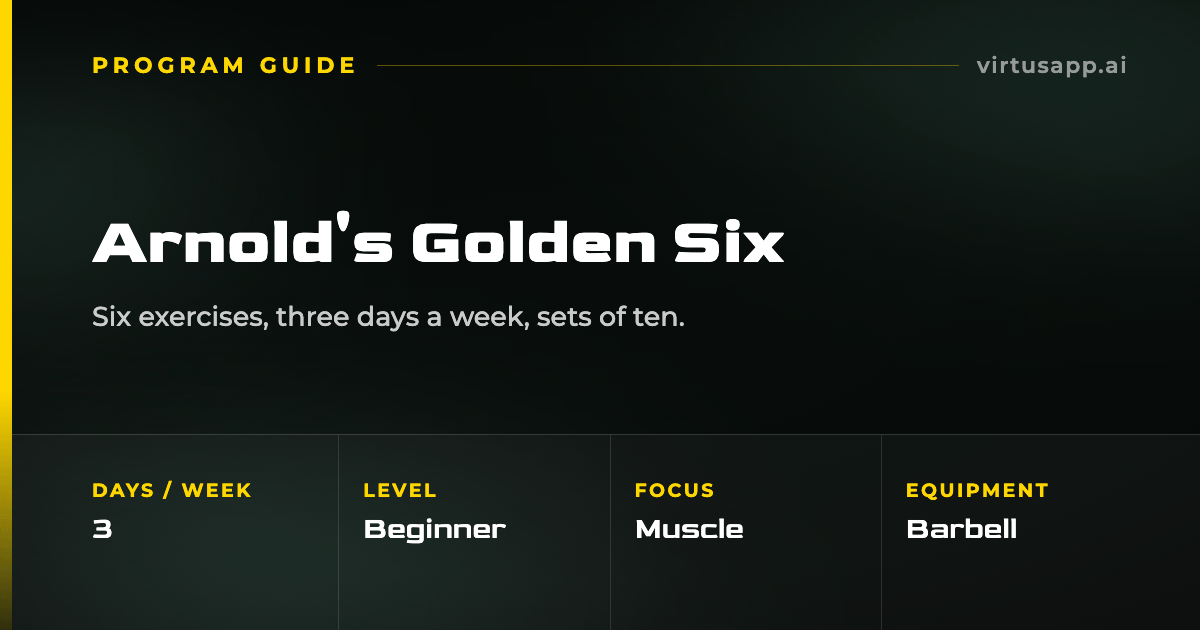
The full body routine Arnold Schwarzenegger used early in his career, before the famous high-volume splits. Six exercises performed in a fixed order, 3 days per week, mostly in sets of 10. Progression is rep-driven: earn extra reps above the target, then add weight. Designed to run as a 3 month cycle.

Who Is This Program For?

The Golden Six is for new lifters and returning lifters who care about building muscle, not just moving the biggest possible weights. Arnold started his career on full body training, and this routine reflects his priorities: full squat depth, controlled tempo, and chasing the pump in the 10 rep range rather than grinding heavy triples.

The program focuses on:

  • Simplicity: one workout, repeated three times a week
  • The 10 rep range: sets of 10 on the loaded lifts, the classic muscle-building zone
  • Full body frequency: every muscle trained three times per week
  • Low session volume: only six exercises, so each one gets full effort

If you want old-school bodybuilding with barbell basics and a routine you can memorize in a minute, this is it.

Program Structure

The One Workout

The same workout is performed every session, in this exact order:

#ExerciseSets × Reps
1Barbell Back Squat4×10
2Wide-Grip Bench Press3×10
3Chin-Up3× max reps
4Behind-the-Neck Overhead Press4×10
5Barbell Curl3×10
6Bent-Knee Sit-Up3-4× max reps

Exercise Notes

  • Squat: always first, non-negotiable for Arnold, and always to full depth
  • Wide-Grip Bench Press: a grip wider than shoulder width, lowered under control to emphasize the chest
  • Chin-Up: underhand grip, every set taken to as many reps as possible
  • Behind-the-Neck Press: requires good shoulder mobility; lower the bar under strict control and never bounce out of the bottom. If your shoulders can't reach the position comfortably, press from the front instead
  • Barbell Curl: strict, no swinging, full range
  • Bent-Knee Sit-Up: bend the knees to reduce hip flexor takeover, each set to max reps

Weekly Schedule

Train 3 times per week on alternating days, with a rest day between sessions and two at the end of the week. A typical schedule is Monday / Wednesday / Friday. There is no A/B alternation, every training day is the same workout.

Progression: How Weights Increase

The Golden Six uses rep-based progression: you earn the weight increase before you take it.

The rule: when you can perform 2-3 reps above the target on your sets (hitting 12-13 reps where 10 are prescribed), add weight next session.

ExerciseWeight Added When Earned
Squat+5 kg (10 lbs)
Wide-Grip Bench Press+2.5 kg (5 lbs)
Behind-the-Neck Press+2.5 kg (5 lbs)
Barbell Curl+2.5 kg (5 lbs)
Chin-UpBodyweight; add weight with a dip belt once you reach ~12 reps per set
Bent-Knee Sit-UpProgress by adding reps, or hold a plate once reps get very high

The weight added is to the total bar weight, not per side.

Practical application: run your first sets at the prescribed 10 reps, then push the final set for extra reps. If the final set reaches 12-14 with good form, the weight goes up next time. If you only manage 10-11, keep the same weight and build more reps. Don't be afraid of "slow" weeks: this is a bodybuilding program, and time spent owning a weight through a full range of motion is never wasted.

Get Your Form Right First

Everything below assumes your form is already solid. Finding your working weight, adding weight, chasing reps, all of it only works if you can perform the lift correctly. While your form is not locked in, that is your only job. Make good form the goal of every set, not the weight on the bar. Drilling the movement with an empty bar beats loading plates onto a lift you cannot control yet.

To learn, don't hesitate to search Google and YouTube (there is a lot of good free material) and record yourself from the side to compare against a proper demonstration. In general, good form means a full controlled range of motion, a braced neutral spine, no bouncing or momentum, a consistent setup every rep, and ending the set when technique breaks down rather than grinding sloppy reps.

Finding Your Starting Weights

If you don't know your starting weights:

  1. Start with just the empty barbell (20 kg / 45 lbs)
  2. Perform 10 reps
  3. Add 5-10 kg (10-20 lbs)
  4. Perform another set of 10 reps
  5. Repeat until the last 2-3 reps of the set become genuinely challenging while form stays clean
  6. Use that weight as your starting weight

Sets of 10 punish overshooting much harder than sets of 5, so err on the light side. A weight that gives you 12-13 reps on day one is perfect: the progression rule will move you up immediately, and you'll have grooved the movement in the meantime.

For chin-ups, start at bodyweight. If you can't get 5-6 reps yet, use band assistance or negatives until you can.

Warming Up

Before each loaded exercise, perform 2-4 warm-up sets with increasing weight. This prepares your joints and muscles for the working weight and lets you practice the movement pattern.

SetWeightRepsRest
1~40% of working weight545 seconds
2~60% of working weight360 seconds
3~80% of working weight260 seconds
Work sets100%As prescribed1-2 minutes

Example: If your working weight for squat is 60 kg:

  • Set 1: 22.5 kg × 5
  • Set 2: 35 kg × 3
  • Set 3: 47.5 kg × 2
  • Work sets: 60 kg × 4×10

Warm-up sets should feel easy. They are not work sets. The behind-the-neck press deserves extra attention: warm up the shoulders thoroughly and start your first working sets conservatively.

Rest Times

ExerciseRest Period
SquatUp to 2 minutes
All other exercisesUp to 1.5 minutes

The short rests are deliberate. This is a bodybuilding routine: the goal is quality reps and accumulated fatigue in the muscle, not maximal single-set performance. Keep the pace honest.

When You Fail Reps

The original routine doesn't prescribe a formal deload, so as an adaptation we apply the standard protocol:

  1. Fall short of the target reps: repeat the same weight next session and build the reps back up
  2. Stuck below target for three consecutive sessions: reduce the weight by 10% on that exercise and work back up

Example:

Bench stuck below 10 reps at 60 kg for 3 sessions:
  New weight: 60 × 0.90 = 54 kg (round to nearest increment)
  Build back to 12-13 reps, then progress normally

Each exercise deloads independently. And because the progression is rep-driven, most "stalls" on this program fix themselves: you simply stay at the weight and accumulate reps until the rule is satisfied.

Check your recovery basics too: sleep 7-9 hours, eat enough calories, and get 1.5-2.2 g of protein per kg of bodyweight (0.7-1 g per lb).

Program Duration

Run the Golden Six as a 3 month cycle (roughly 36 sessions at 3 per week). At the end of a cycle, take stock: if the weights are still climbing, run another cycle. Arnold built years of early progress on full body training before ever moving to a split, and the T-Nation writeup frames it the same way: not necessarily a program you run forever, but a superb start.

Run Arnold's Golden Six on Virtus Athlete

Virtus Athlete fully integrates Arnold's Golden Six, handling the rep targets, earned weight increases, and cycle tracking for you. Just enter your starting weights and start training.

Free on iOS and Android.

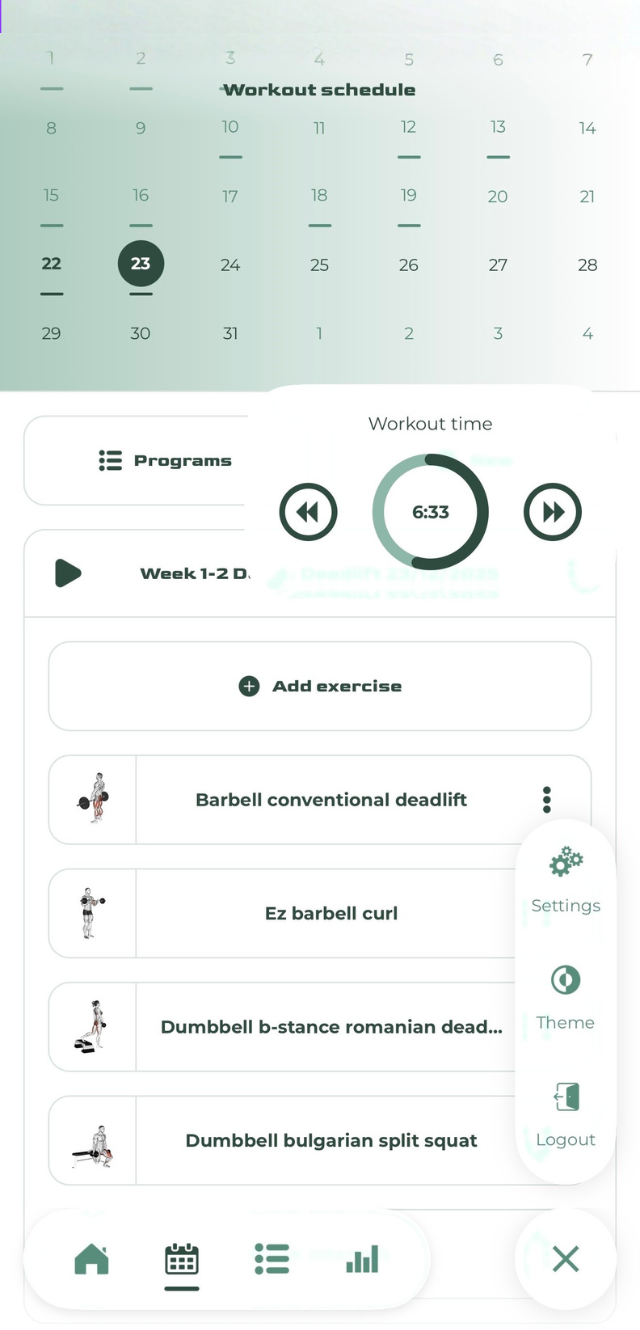
Virtus Athlete home screen with the week's scheduled workouts and progress summary

Frequently Asked Questions (FAQ)

How long does one full run take?
One cycle is 3 months, roughly 36 workouts at 3 sessions per week. The program can be repeated for multiple cycles as long as you keep progressing.
Is the behind-the-neck press safe?
It requires good shoulder mobility and strict control. Lower the bar slowly, never bounce, and keep the weight honest. If your shoulders can't comfortably reach the bottom position, press from the front instead. The muscle-building difference is small, the joint-comfort difference is not.
What if I can't do chin-ups?
Use band assistance, negatives, or a lat pulldown until you can perform sets of 5-6 strict reps, then transition to bodyweight chin-ups and build from there.
Why sets of 10 instead of 5?
This is a bodybuilding program. The 10 rep range with controlled tempo and short rests maximizes the muscle-building stimulus per set, which is what the routine was designed for.
Isn't 3 sets too little for arms?
The curls are direct arm work on top of chin-ups (biceps) and pressing (triceps) three times per week. For a beginner, that frequency beats a once-a-week arm day.
What happens if I miss a workout?
Pick up where you left off. Don't try to make up missed sessions by doubling up.
How do I enter my starting weights?
Enter a weight you can lift for 12-13 clean reps. If unsure, use the empty barbell method described above. The rep-based progression handles the rest.
What happens after the Golden Six?
When multiple exercises stop progressing across a full cycle, move to a program with more volume and variety, such as an upper/lower split or a linear progression strength program if your goals shift toward strength.

Related Articles

Track This Program

Build unlimited programs, log every set, and track your progress over time. Free on iOS & Android.