Back to BlogPrograms

How to run the Tactical Barbell Operator program

2026-08-1112 min read

Written by Hamza J

How to run the Tactical Barbell Operator program
Contents

Based on K. Black's Tactical Barbell Operator template, with some minor adaptations.

A minimalist strength template built for people who also have to run, ruck, fight, or work a physical job. You pick a small cluster of compound lifts, usually back squat, bench press and weighted pull-up, and hit them 3 times per week at submaximal percentages. The block runs 6 weeks as two 3-week waves, intensity climbing while volume drops, and you never train to failure. Sessions take about 40 to 60 minutes because the rest of your week belongs to conditioning.

Who Is This Program For?

Operator is for lifters who need strength but cannot make strength the only thing they do. It was written for police, military, firefighters and combat athletes, but it fits anyone who runs, cycles, plays a sport, or simply refuses to spend two hours a day under a bar.

The program focuses on:

  • Frequency over volume: a few lifts hit 3 times per week rather than a long session once per week
  • Submaximal loading: everything lives between 70% and 95% of a training max, never at a true limit
  • Leaving fuel in the tank: you finish sessions fresh, because conditioning is a separate job
  • Fixed blocks: 6 weeks of predetermined percentages, no in-block decisions to make

If you have already run a linear beginner program to its end and you now need strength that coexists with real conditioning, this is it.

Program Structure

The Cluster

Tactical Barbell calls your chosen group of lifts a cluster. The standard Operator cluster is:

LiftMovement PatternFrequency
Barbell Back SquatLower body push3x per week
Barbell Bench PressHorizontal push3x per week
Weighted Pull-UpVertical pull2x per week
Barbell Deadlift (optional)Hip hinge1x per week

Keep the cluster small. Three lifts per session is the design, and adding a fourth or fifth movement to every session defeats the point of the template.

Weekly Schedule

Train 3 days per week on non-consecutive days, for example Monday, Wednesday, Friday.

DaySession
Day 1Squat, Bench Press, Weighted Pull-Up
Day 2Squat, Bench Press, Weighted Pull-Up
Day 3Squat, Bench Press, Deadlift

If you keep the deadlift, it replaces the pull-up on the third day, which is why the deadlift is a once per week lift and the pull-up a twice per week lift. Lifters who find squatting 3 times per week plus a weekly deadlift too much can drop the squat on deadlift day, or cut it to a single work set there.

Sets Per Lift

LiftWork Sets
Squat, Bench Press, Weighted Pull-Up3 to 5 sets
Deadlift1 to 3 sets

Pick your set count based on what you can recover from alongside your conditioning. Three sets is the default and the right answer for most people running real conditioning on the side. On the heaviest weeks (week 3 and week 6) drop to the low end of the range.

The 6-Week Wave

Operator runs in fixed 6-week blocks made of two 3-week waves. Intensity rises and reps fall inside each wave, then the second wave restarts 5% higher than the first.

WeekSets x Reps% of Training Max
13-5 x 570%
23-5 x 580%
33-4 x 390%
43-5 x 575%
53-5 x 385%
63-4 x 1-295%

Every lift in your cluster follows the same percentage on the same day. There is no AMRAP set, no back-off set, no drop set. Straight sets at the prescribed percentage, then you go home.

Percentages Are of a Training Max, Not Your True Max

This is the single most misread part of the program. The percentages above apply to a training max equal to 90% of your true 1RM, and the book recommends using a training max especially on your first run.

So 90% in week 3 is really about 81% of your true one rep max, and the 95% peak week is really about 85%. That is deliberate. Operator is not a peaking program and week 6 is not a max attempt.

Example, squat with a true 1RM of 140 kg (310 lbs):

Training max = 140 x 0.90 = 126 kg (280 lbs)

Week 1: 126 x 0.70 = 87.5 kg (195 lbs) x 5
Week 2: 126 x 0.80 = 100 kg (225 lbs) x 5
Week 3: 126 x 0.90 = 112.5 kg (250 lbs) x 3
Week 4: 126 x 0.75 = 95 kg (210 lbs) x 5
Week 5: 126 x 0.85 = 107.5 kg (240 lbs) x 3
Week 6: 126 x 0.95 = 120 kg (265 lbs) x 1-2

Round to whatever your plates allow. Rounding down is always the safer error.

Own The Weight

The governing rule of the whole system is that you never go to failure and never grind. If a set turns into a fight, the weight is wrong, not your effort. You should finish every session feeling like you could have done more, because the conditioning side of the program still has to happen.

Progression: Between Blocks, Not Within Them

Nothing changes inside a 6-week block. The percentages are already written. Progression happens when the block ends, and you have two options.

Option 1: Forced Progression

Add a fixed amount to each training max and run the next block immediately.

LiftAdd Per Block
Bench Press, Weighted Pull-Up2.5 kg (5 lbs)
Squat, Deadlift5 kg (10 lbs)

This requires no testing and is the low-friction way to chain blocks together.

Option 2: Retest

Test a new 1RM every 6 to 12 weeks, meaning after one or two blocks, and rebuild your training max from the new number. Testing more often than that is not useful, since the block itself does not push you near a limit.

Get Your Form Right First

Everything below assumes your form is already solid. Finding your working weight, adding weight, chasing reps, all of it only works if you can perform the lift correctly. While your form is not locked in, that is your only job. Make good form the goal of every set, not the weight on the bar. Drilling the movement with an empty bar beats loading plates onto a lift you cannot control yet.

To learn, don't hesitate to search Google and YouTube (there is a lot of good free material) and record yourself from the side to compare against a proper demonstration. In general, good form means a full controlled range of motion, a braced neutral spine, no bouncing or momentum, a consistent setup every rep, and ending the set when technique breaks down rather than grinding sloppy reps.

Finding Your Starting Weights

Operator is a percentage-based template, so you need a number for every lift in your cluster before day one.

  1. Test a 1RM on squat, bench press and deadlift by warming up, then working up in singles until the bar slows noticeably. Stop there. That is close enough.
  2. Or estimate it from a set you have already done. A weight you can lift for 5 clean reps is roughly 87% of your 1RM, and a weight you can lift for 3 clean reps is roughly 93%.
  3. Multiply by 0.90 to get your training max.
  4. For the weighted pull-up, your 1RM is bodyweight plus added load. If you cannot do 5 strict bodyweight pull-ups yet, run bodyweight pull-ups for reps in the same slot until you can, then start loading.

If your estimate is off, it will show up in week 2 or week 3. Erring low costs you one block. Erring high costs you the whole block.

Warming Up

The template prescribes percentages for work sets only, so use a standard ramp into them. Two or three ramping sets is enough, and it should never become extra training volume.

SetWeightReps
1~50% of the work weight5
2~70% of the work weight3
3~85% of the work weight1-2
Work sets100%as prescribed

On week 1 and week 4, when the work weight is light, one or two ramp sets is plenty. On week 3 and week 6 use all three.

Rest Times

SituationRest
Between sets, weeks 1 and 4 (70% and 75%)2 minutes minimum
Between sets, weeks 2 and 5 (80% and 85%)2 to 3 minutes
Between sets, weeks 3 and 6 (90% and 95%)3 to 5 minutes
Between exercises2 to 5 minutes

Two minutes is the floor, not the target. You can also alternate lifts, resting one while you set up the other, to keep total session length near 45 minutes.

Conditioning Runs Alongside, Not Inside

Operator is deliberately low volume because it is only half of the system. The conditioning half lives in Tactical Barbell II: Conditioning and is programmed separately from the lifting.

The usual sequence is:

  1. Base Building first, an 8-week block that is mostly long slow steady-state work plus strength-endurance circuits, with max strength work reintroduced around week 5.
  2. Then a continuation protocol for the rest of the year, paired with Operator:
    • Black: 2 to 3 high intensity conditioning sessions per week plus an endurance session every other week. Suited to lifters who prioritise strength and power.
    • Green: 2 to 3 endurance sessions per week with less high intensity work. Suited to lifters who need a high aerobic ceiling.

The practical rule when combining them is simple. Lifting days stay easy enough that they never eat your conditioning days. If your conditioning quality is dropping, cut lifting sets before you cut conditioning.

When You Stall

Operator does not have missed reps in the ordinary sense, because you should never be near failure. If you cannot complete the prescribed reps, something upstream is wrong.

  • Week 2 is the canary. The 80% week is usually the first to break. If you are grinding there, your training max is too high.
  • Reduce the training max by 5 to 10% and restart the block. Do not reduce single sessions or single lifts on the fly.
  • Cut sets before you cut weight. If the percentages are right but you are exhausted, drop from 5 sets to 3, or drop the squat on deadlift day.
  • Check your conditioning load. Most Operator stalls are conditioning stalls in disguise. A hard interval session the day before a 90% squat day will cost you reps.
  • No mandatory deload. The 70% and 75% weeks are the built-in recovery. If you genuinely need more than that, take a week off and restart the block.

Program Duration

One block is 6 weeks, that is 18 lifting sessions.

Operator is designed to be run continuously, block after block, for as long as it keeps working. Add to your training max between blocks, or retest every 6 to 12 weeks. Many lifters run Operator for months at a time and only change the cluster, not the template.

Access the Original Program

If you would like to read the original program:

Tactical Barbell Official Website

The full Operator template, the alternative clusters, and the Fighter, Zulu and Mass templates are laid out in Tactical Barbell: Definitive Strength Training for the Operational Athlete by K. Black. The conditioning protocols referenced above are in Tactical Barbell II: Conditioning.

Run Tactical Barbell Operator on Virtus Athlete

Virtus Athlete fully integrates Tactical Barbell Operator, handling the training max calculation, the 6-week wave percentages, and the between-block progression for you. Just enter your tested maxes and start training.

Free on iOS and Android.

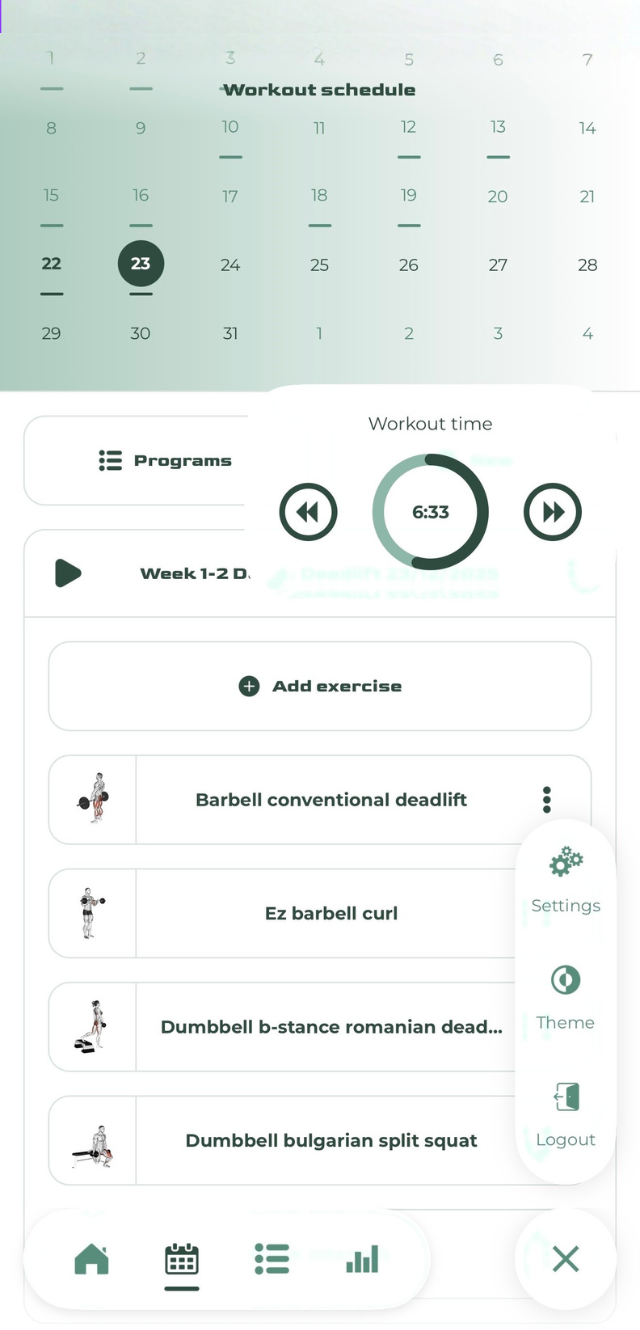
Virtus Athlete home screen with the week's scheduled workouts and progress summary

Frequently Asked Questions (FAQ)

How long does one full run take?
One block is 6 weeks at 3 sessions per week, so 18 total workouts over about a month and a half. Sessions run 40 to 60 minutes.
Can I change the lifts in the cluster?
Yes, that is what clusters are for. Keep them big compound lifts and keep the count at three per session. A cluster is not meant to cover every movement pattern, so whatever the cluster misses gets addressed during conditioning work rather than by adding lifts.
Do I have to deadlift?
No. The deadlift is optional in Operator and appears once per week at most. Dropping it and keeping pull-ups on all 3 days is a legitimate version of the template.
Why does everything feel too easy in week 1?
Because it is meant to. Week 1 is 70% of a training max that is itself 90% of your real max, so it is around 63% of your true 1RM. The work accumulates across the 6 weeks and across the conditioning you are doing on the other days.
Should I add accessory work?
Only if it does not cost you anything. Abs, grip, and light arm or rear delt work are fine at the end of a session. The moment accessories start affecting your main lifts or your conditioning, they go.
What happens after the block?
Add 2.5 kg (5 lbs) to upper body training maxes and 5 kg (10 lbs) to lower body training maxes and run it again, or retest your 1RMs and rebuild your training maxes from the new numbers.

Related Articles

Track This Program

Build unlimited programs, log every set, and track your progress over time. Free on iOS & Android.