Back to BlogPrograms

How to run the Tactical Barbell Mass Protocol

2026-08-1111 min read

Written by Hamza J

How to run the Tactical Barbell Mass Protocol
Contents

Based on K. Black's Tactical Barbell templates, with some minor adaptations.

Six weeks, four days, four lifts. The Mass Protocol is the Operator template rebuilt to add size instead of to leave room for conditioning: an extra day, an extra set, a lower entry percentage and a peak week that ends on a set you take past the number written.

Who Is This Program For?

The Mass Protocol is for the intermediate lifter who wants to get bigger without leaving a minimalist template. It suits you if:

  • You have run Operator or another percentage-based block and want a size phase
  • You want four training days and no more
  • You would rather do four lifts properly than fourteen lifts adequately
  • Your conditioning can take a back seat for six weeks

It is not for someone in a conditioning-heavy job or season. Operator exists precisely because that person needs strength work that leaves them capable of everything else, and Mass deliberately spends the room Operator protects.

Mass Versus Operator, In One Table

OperatorMass
Days per week34
Sets per lift34
Entry percentage70%67%
Peak week3 × 2 @ 95%3 × 3 + 1 × 3+ @ 81%
DeadliftInside the clusterIts own day
Block length6 weeks6 weeks

The two are the same skeleton with a different priority. Mass never goes above 81%, and that is the point: the block is built on repeatable volume rather than on top-end intensity.

Program Structure

4 Training Days

DayContent
Day 1Bench Press, Squat, Weighted Pull Up
Day 2Bench Press, Squat, Weighted Pull Up
Day 3Bench Press, Squat, Weighted Pull Up
Deadlift DayDeadlift

The three main days are identical. That is not laziness in the template, it is the whole method: frequency is what drives the adaptation, so the same three lifts get trained three times a week at the same prescription.

A typical layout is Monday, Wednesday, Friday for the main days with the deadlift day on Tuesday or Saturday. What matters is that the deadlift day is not adjacent to two squat days.

The Six Week Wave

All percentages are of your one rep max, not a training max.

Main lifts, days 1 to 3:

WeekPrescription
14 × 6 @ 67%
24 × 5 @ 72%
3 (peak)3 × 3 + 1 × 3+ @ 81%
44 × 6 @ 67%
54 × 4 @ 76%
6 (peak)3 × 3 + 1 × 3+ @ 81%

Deadlift day:

WeekPrescription
14 × 5 @ 67%
24 × 5 @ 72%
34 × 3 @ 81%
44 × 5 @ 67%
54 × 4 @ 76%
64 × 3 @ 81%

Two three-week waves. The second wave restarts at the same 67% entry week and then takes a different middle week, 4 × 4 at 76% instead of 4 × 5 at 72%, before peaking at the same 81%.

Why the second wave does not go heavier. Because the volume did the work. Week 4 at 67% is a genuine reset after a peak week, and week 5 asks for a heavier bar at fewer reps rather than a higher peak. The block tops out at 81% both times on purpose.

The Peak Week's Open Set

Weeks 3 and 6 end with 1 × 3+ on each main lift. Three reps is the minimum, not the target.

  • Take the three, then keep going with good form
  • Stop one or two reps before failure, when the bar slows or your position changes
  • Never grind. Nothing in this block is worth a missed rep

The deadlift has no open set. It is trained once a week and the peak weeks take it straight at 4 × 3.

Progression: How Weights Increase

There is no session-to-session increase and no mid-block change. Every weight in the six weeks comes off the maxes you entered on day one.

Progression happens between blocks:

LiftBetween-block increase
Squat, Deadlift5 kg / 10 lbs
Bench, Weighted Pull Up2.5 kg / 5 lbs

Or retest and use the real numbers. Either way, the block ends after 24 sessions and you start it again from a higher figure.

The open set on the peak weeks is your feedback, not an input. More reps at the same 81% in week 6 than in week 3 is the block having worked, and it tells you how much to add before the next one.

Get Your Form Right First

Everything below assumes your form is already solid. Finding your working weight, adding weight, chasing reps, all of it only works if you can perform the lift correctly. While your form is not locked in, that is your only job. Make good form the goal of every set, not the weight on the bar. Drilling the movement with an empty bar beats loading plates onto a lift you cannot control yet.

To learn, don't hesitate to search Google and YouTube (there is a lot of good free material) and record yourself from the side to compare against a proper demonstration. In general, good form means a full controlled range of motion, a braced neutral spine, no bouncing or momentum, a consistent setup every rep, and ending the set when technique breaks down rather than grinding sloppy reps.

Finding Your Starting Weights

You need four numbers: a one rep max for the bench, the squat, the deadlift, and the weighted pull up.

The Weighted Pull Up

Enter the weight you add, not your bodyweight plus the load. Everything the app can record is what hangs off the belt, so every percentage applies to that number.

If you cannot yet add weight, enter zero and take the prescribed reps at bodyweight. Add the belt when you can complete the week's sets comfortably.

If You Do Not Know Your Maxes

Do not max out to start the block. Estimate:

  1. Work up to a weight you can move for 3 to 5 clean reps
  2. Estimate with Weight × Reps × 0.0333 + Weight
  3. Round down to the nearest 2.5 kg / 5 lbs

Example:

You bench 90 kg / 200 lbs for 4 reps:
  Estimated 1RM = 90 × 4 × 0.0333 + 90 = 102 kg, round to 100 kg
                = 200 × 4 × 0.0333 + 200 = 227 lbs, round to 225 lbs
  Week 1 = 4 × 6 at 67% = 67.5 kg / 150 lbs

Round down. Week 1 at 67% should feel comfortable, because you are doing it three times that week.

Warming Up

Warm-up sets are never counted in the working sets above.

SetWeightRepsRest
1~50% of working weight545 seconds
2~70% of working weight360 seconds
3~85% of working weight290 seconds
Work sets100%As prescribed2-3 minutes

The pull up warms up with bodyweight reps rather than with a percentage: a fraction of the load on your belt is not a lighter pull up.

The deadlift day needs the fullest ramp of the week because it is cold, so add a set or two at the bottom.

Rest Times

SituationRest Period
All working sets2-3 minutes
Before the open set on a peak week3 minutes
Deadlift3 minutes

Two to three minutes across the board is what the template says, and it is enough because nothing here goes above 81%. If it is not enough, your entered max is too high.

When Things Go Wrong

If you miss reps in week 1 or 2, your max is wrong. Cut that lift by 10% and restart the block rather than trying to survive it: the peak week is 81% and it is coming either way.

If you miss reps on a peak week, finish the remaining sets at a reduced weight and take the next entry week as written. Do not repeat the peak.

If the open set gives you three reps and nothing more, your entered max is honest. If it gives you ten, it is far too low: add 5% and continue from the next week.

If you feel wrecked rather than tired, take an easy week at the entry percentage with two sets instead of four, then resume where you left off. Do not skip weeks, because the waves only work in order.

If you miss a session, pick it up where you left off. Never run two main days back to back to catch up.

Program Duration

The block runs 6 weeks at 4 sessions per week, which is 24 workouts.

At the end, add to your maxes or retest, take a few easy days, and run it again. The Mass Protocol is built to be repeated, and most people alternate it with an Operator block: six weeks of growing, then six weeks of keeping it while the conditioning comes back.

Access the Original Program

The Mass Protocol appears in K. Black's Tactical Barbell series:

Tactical Barbell

Run the Mass Protocol on Virtus Athlete

Enter four maxes once and Virtus Athlete works out all 24 sessions: both waves, the 50/70/85 ramp before every lift, the open set on the peak weeks, and the deadlift day's own rep counts. Every set logged, so week 3 and week 6 at the same 81% sit next to each other and tell you how much to add before the next block.

Free on iOS and Android.

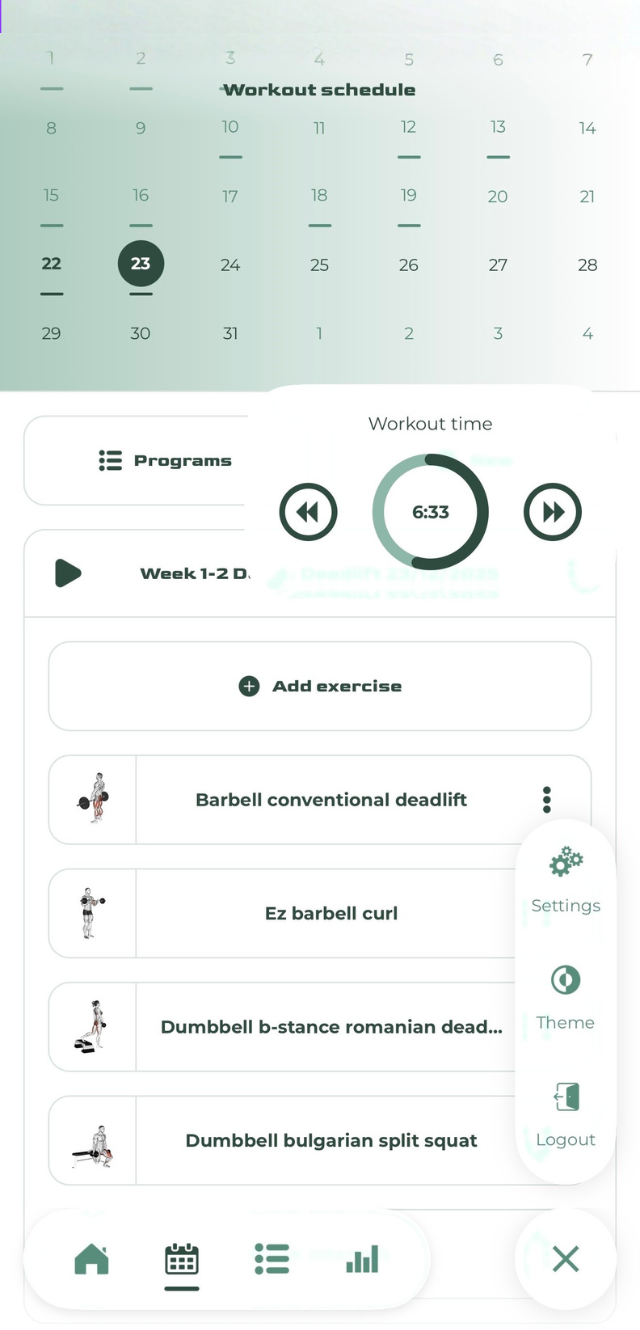
Virtus Athlete home screen with the week's scheduled workouts and progress summary

Frequently Asked Questions (FAQ)

How long does one full run take?
6 weeks at 4 sessions per week, so 24 total workouts. Two three-week waves.
Why are the three main days identical?
Because frequency is the mechanism. The same three lifts trained three times a week at the same prescription is what produces the adaptation, and varying them would spread the same volume across more movements and less practice.
Can I add accessories?
A little, at the end of a main day: curls, triceps, calves, abs. Keep it to two or three sets each. Anything that compromises the next day's four sets is too much.
Why does the block never go above 81%?
Because it is a size block. Top-end intensity is what Operator's 95% week is for. Mass is built on four repeatable sets three times a week, and 81% is as heavy as that stays repeatable.
Should I do conditioning?
Keep it easy and keep it short. The template spends the recovery that Operator protects, so hard conditioning on top of this is how people finish the six weeks smaller than they started.
What if I have no way to add weight to a pull up?
Enter zero and do the reps at bodyweight. When the week's sets stop being hard, get a belt or a dumbbell between your feet.
Can I swap the deadlift day for something else?
No. It is the only posterior chain work in the program and it is on its own day for a reason.
What comes after six weeks?
Add to your maxes and run it again, or alternate into an Operator block. The two are designed to be run back to back around whatever else you are doing.

Related Articles

Track This Program

Build unlimited programs, log every set, and track your progress over time. Free on iOS & Android.