Back to BlogPrograms

How to run the Starting Strength program

2026-08-1112 min read

Written by Hamza J

How to run the Starting Strength program
Contents

Based on Mark Rippetoe's Starting Strength novice program, with some minor adaptations.

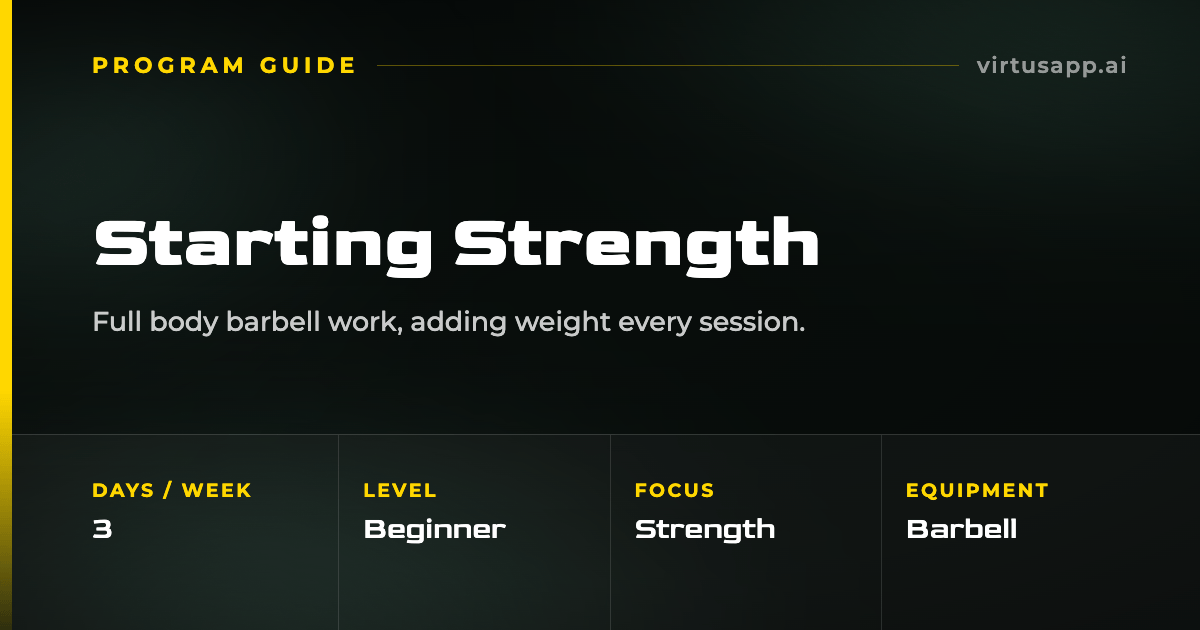
A full body barbell program for beginners built on the squat, press, bench press, deadlift, and power clean. 3 days per week with two alternating workouts and weight added every single session. The program moves through three phases as the weights get heavier.

Who Is This Program For?

Starting Strength is for new lifters who want to get as strong as possible, as fast as possible, using a handful of barbell lifts. Mark Rippetoe built the program around the idea that a novice can recover from session to session, so every workout is an opportunity to lift more than last time.

The program focuses on:

  • Simplicity: only 3 exercises per workout, two alternating templates
  • Compound movements: every exercise trains large amounts of muscle through a long range of motion
  • Linear progression: add weight every session while you can
  • Phased structure: the program changes as the weights grow, so recovery is never outpaced

If you want the most established barbell novice program in existence, with decades of results behind it, this is it.

Program Structure

The 6 Main Lifts

LiftMovement Pattern
Barbell Back SquatLower body push
Barbell Overhead PressVertical push
Barbell Bench PressHorizontal push
Barbell Conventional DeadliftHip hinge
Power CleanExplosive pull
Chin-UpVertical pull

Not all six appear from day one. The deadlift is there from the start, the power clean arrives in Phase 2, and chin-ups arrive in Phase 3.

Phase 1: The First 1-3 Weeks

You deadlift every single session while the weights are still light.

Workout A:

ExerciseSets × Reps
Squat3×5
Overhead Press3×5
Deadlift1×5

Workout B:

ExerciseSets × Reps
Squat3×5
Bench Press3×5
Deadlift1×5

Phase 1 ends after roughly 1-3 weeks, once the fast early jumps have pushed your deadlift well ahead of your squat and pulling heavy every session becomes too taxing.

Phase 2: Power Cleans Arrive

The power clean replaces the deadlift on alternate days, so you now pull heavy off the floor every session but only deadlift once per rotation.

Workout A:

ExerciseSets × Reps
Squat3×5
Overhead Press3×5
Deadlift1×5

Workout B:

ExerciseSets × Reps
Squat3×5
Bench Press3×5
Power Clean5×3

This is the longest phase of the program. Most lifters spend 2-4 months here.

Phase 3: Chin-Ups Arrive

The deadlift and power clean now share the A slot, alternating with each other, and chin-ups are added on B days for upper body pulling volume.

Workout A:

ExerciseSets × Reps
Squat3×5
Overhead Press3×5
Deadlift 1×5 or Power Clean 5×3 (alternate each A day)

Workout B:

ExerciseSets × Reps
Squat3×5
Bench Press3×5
Chin-Ups3 sets

Chin-ups are done for 3 sets to fatigue at bodyweight. Once you can complete 3 sets of 10 at bodyweight, do every other chin-up session as 3 sets of 5 with added weight, keeping the alternate sessions at bodyweight to fatigue.

Why Deadlift Is 1×5

The deadlift is the most systemically fatiguing lift in the program. One heavy set of 5 is enough to drive progress for a novice, and anything more would eat into the recovery that the rest of the program depends on.

Why Power Clean Is 5×3

Power production degrades quickly with fatigue. Five sets of three lets you practice the explosive movement with crisp technique on every rep instead of grinding out sloppy fives.

Weekly Schedule

The workouts alternate in an A/B pattern across each week:

Odd Weeks (1, 3, 5...):

  • Day 1: Workout A
  • Day 2: Workout B
  • Day 3: Workout A

Even Weeks (2, 4, 6...):

  • Day 1: Workout B
  • Day 2: Workout A
  • Day 3: Workout B

Train 3 days per week with at least one rest day between sessions. A typical schedule is Monday / Wednesday / Friday.

Progression: How Weights Increase

Starting Strength uses linear progression, meaning you add weight every session. The increments shrink as the lift gets heavier relative to your recovery.

ExerciseEarly SessionsStandard Increment
Squat+5 kg (10 lbs) for the first 2-3 sessions+2.5 kg (5 lbs) per session
Deadlift+5 to 7.5 kg (10-15 lbs) for the first few sessions+2.5 kg (5 lbs) per session
Bench Press+2.5 kg (5 lbs) per session+1.25 kg (2.5 lbs) once 2.5 kg jumps stall
Overhead Press+2.5 kg (5 lbs) per session+1.25 kg (2.5 lbs) once 2.5 kg jumps stall
Power Clean+1.25 to 2.5 kg (2.5-5 lbs) per session
Chin-UpBodyweight until 3×10, then +1.25 kg (2.5 lbs) on weighted days

The weight added is to the total bar weight, not per side. The upper body lifts move to microplate jumps (1.25 kg / 2.5 lbs) much sooner than the squat and deadlift, because they involve less muscle mass. Smaller lifters, women, and older lifters should switch to smaller jumps earlier.

Only add weight if you completed every prescribed set and rep with proper form.

Get Your Form Right First

Everything below assumes your form is already solid. Finding your working weight, adding weight, chasing reps, all of it only works if you can perform the lift correctly. While your form is not locked in, that is your only job. Make good form the goal of every set, not the weight on the bar. Drilling the movement with an empty bar beats loading plates onto a lift you cannot control yet.

To learn, don't hesitate to search Google and YouTube (there is a lot of good free material) and record yourself from the side to compare against a proper demonstration. In general, good form means a full controlled range of motion, a braced neutral spine, no bouncing or momentum, a consistent setup every rep, and ending the set when technique breaks down rather than grinding sloppy reps.

Finding Your Starting Weights

If you don't know your starting weights:

  1. Start with just the empty barbell (20 kg / 45 lbs)
  2. Perform 5 reps
  3. Add 5-10 kg (10-20 lbs)
  4. Perform another set of 5 reps
  5. Repeat until bar speed noticeably slows or form starts to break down
  6. Use that weight as your starting weight

For the deadlift, start with 40-45 kg (90-95 lbs) since the bar needs full size plates to sit at proper height. For the power clean, start with the empty bar and work up in roughly 5 kg (10 lb) jumps. A typical power clean starting weight is 30-43 kg (65-95 lbs).

It's better to start too light than too heavy. The linear progression will catch up quickly.

Warming Up

Before each exercise, perform 3-4 warm-up sets with increasing weight. This prepares your joints and muscles for the working weight and lets you practice the movement pattern.

SetWeightRepsRest
1~40% of working weight545 seconds
2~60% of working weight360 seconds
3~80% of working weight260 seconds
Work sets100%3×53-5 minutes

Example: If your working weight for squat is 80 kg:

  • Set 1: 30 kg × 5
  • Set 2: 47.5 kg × 3
  • Set 3: 62.5 kg × 2
  • Work sets: 80 kg × 3×5

Warm-up sets should feel easy. They are not work sets. If two exercises use similar muscles back-to-back, the second exercise needs fewer warm-up sets since the muscles are already warm.

Rest Times

SituationRest Period
Between sets (weight felt easy)1.5-3 minutes
Between sets (weight felt heavy)3-5 minutes
Power clean sets1-3 minutes
Between exercisesUp to 5 minutes

Take as much rest as you need to complete your sets with good form. As the weights get heavy in the second and third phases, expect to need the full 5 minutes between squat sets.

When You Fail Reps

If you cannot complete all prescribed reps with proper form:

  1. Rest longer between sets: try 5 minutes or more before calling it a failed session
  2. Repeat the same weight next session rather than adding more weight
  3. Microload: switch upper body lifts to 1.25 kg (2.5 lbs) jumps before you consider anything else
  4. Check your recovery: sleep 7-9 hours, eat enough calories, and get 1.5-2.2 g of protein per kg of bodyweight (0.7-1 g per lb)

Deload Protocol

If you fail to complete the prescribed sets and reps at the same weight for three consecutive sessions, deload:

  • Reduce the weight by 10% on that lift
  • Work back up using the standard increments

Example:

Press stuck at 50 kg for 3 sessions:
  New weight: 50 × 0.90 = 45 kg (round to nearest increment)
  Progress from 45 kg adding 1.25 kg per session

Each exercise deloads independently, so a stall on the press doesn't affect your squat weight. Exhaust the other solutions first (better sleep, nutrition, longer rest, microloading) before resorting to a deload.

Program Duration

The three phases together make up the novice linear progression:

  • Phase 1: 1-3 weeks
  • Phase 2: 2-4 months
  • Phase 3: until linear progression is exhausted

Most lifters get 3 to 9 months of steady session-to-session progress before the novice phase ends. When adding weight every session no longer works even after deloads and microloading, you have extracted the novice gains and are ready for intermediate programming.

Run Starting Strength on Virtus Athlete

Virtus Athlete fully integrates Starting Strength, handling the phase transitions, per-session increments, and deload logic for you. Just enter your starting weights and start training.

Free on iOS and Android.

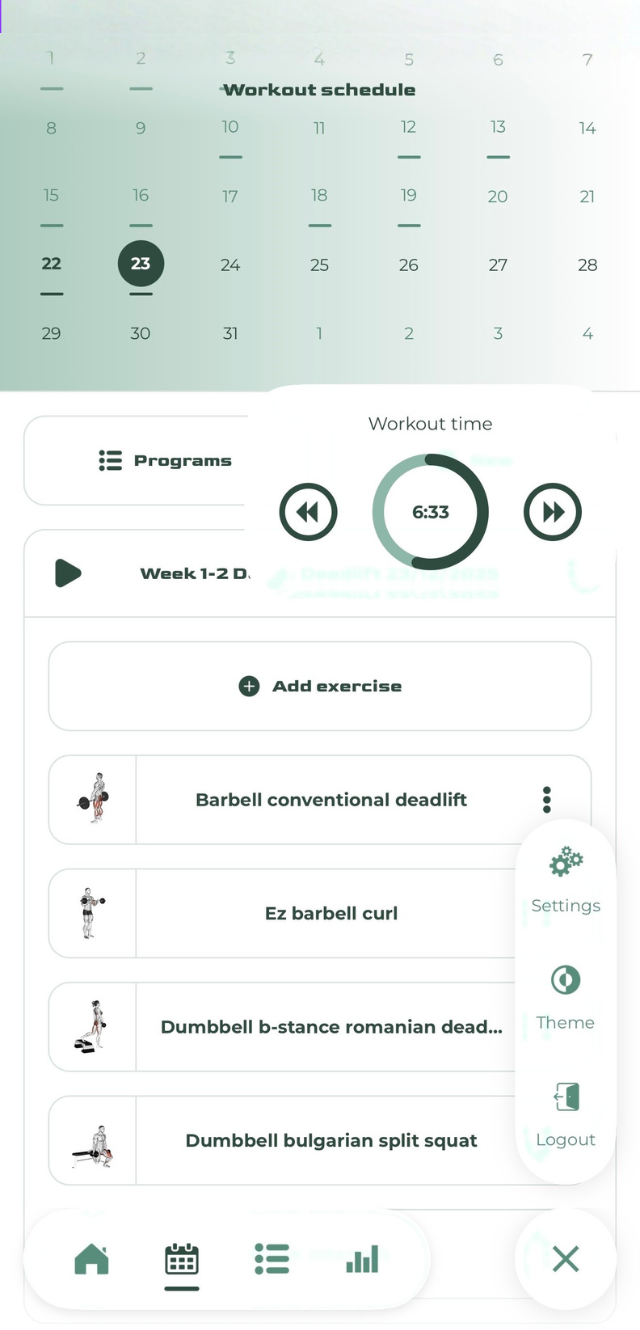
Virtus Athlete home screen with the week's scheduled workouts and progress summary

Frequently Asked Questions (FAQ)

How long does one full run take?
Expect 3 to 9 months across the three phases: 1-3 weeks in Phase 1, 2-4 months in Phase 2, and the remainder in Phase 3 until linear progression stops.
When do I move from Phase 1 to Phase 2?
When deadlifting every session stops being sustainable, usually within 1-3 weeks, once the fast early jumps have pushed your deadlift well ahead of your squat.
Can I substitute the power clean?
The program as written uses the power clean for explosive pulling. If you cannot perform it because of equipment or coaching constraints, the most common substitution lifters use is the barbell row, though it is not part of the original program.
When do chin-ups get weighted?
Once you can perform 3 sets of 10 at bodyweight. From then on, alternate sessions: 3 sets of 5 with added weight one session, bodyweight to fatigue the next.
What if I can only train 2 days per week?
Keep alternating Workout A and Workout B across your 2 days. Progress will be slower but the structure still works.
What happens if I miss a workout?
Pick up where you left off. Don't try to make up missed sessions by doubling up.
How do I enter my starting weights?
Enter the weight you can lift for 5 crisp reps with good form. If unsure, use the empty barbell method described above. The program handles all progression from there.
What happens after the program?
When the novice progression is exhausted, move to an intermediate program with weekly rather than per-session progression, such as the Texas Method or 5/3/1.

Related Articles

Track This Program

Build unlimited programs, log every set, and track your progress over time. Free on iOS & Android.