Back to BlogPrograms

How to run the Smolov Jr program

2026-08-118 min read

Written by Hamza J

How to run the Smolov Jr program
Contents

Based on the Smolov Jr program, with some minor adaptations.

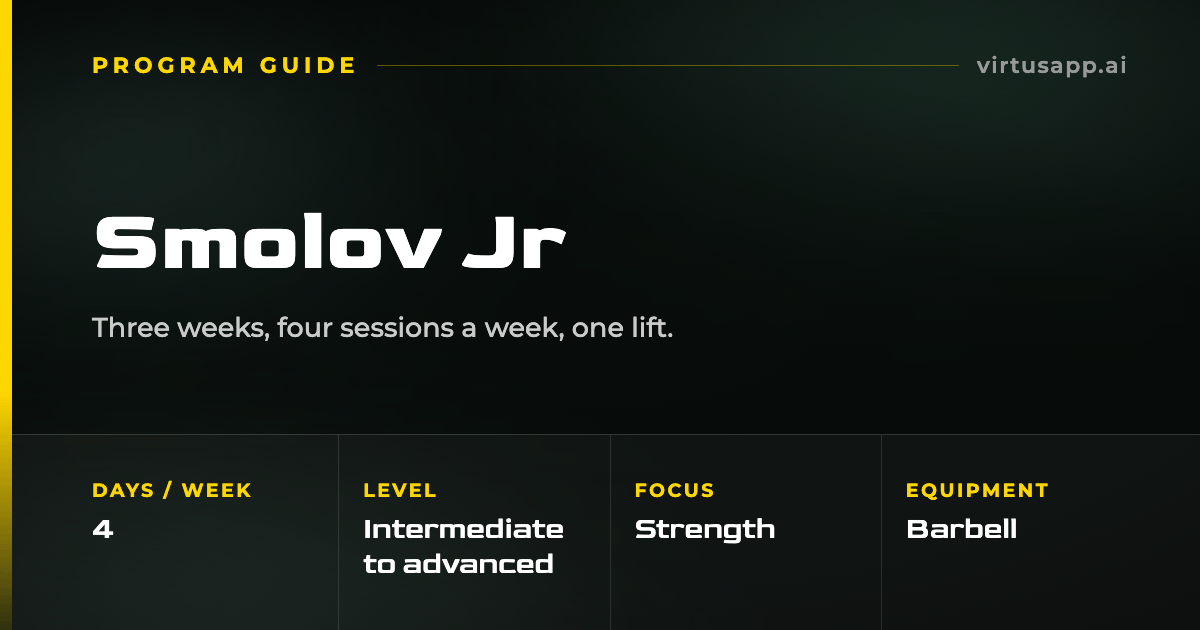
A brutal 3-week specialization block derived from the base mesocycle of the Russian Smolov squat routine. One lift, four sessions per week, the same four workouts every week (6×6 at 70%, 7×5 at 75%, 8×4 at 80%, 10×3 at 85%), with flat weight additions in weeks 2 and 3. Run it for the squat or, very commonly, the bench press.

Who Is This Program For?

Smolov Jr is for experienced lifters who want to specialize in one lift for a month. It is not a balanced program and it is not for beginners: it is a short, extremely demanding block that trades everything else for fast progress on a single lift.

The program focuses on:

  • One lift: squat or bench press, four times per week
  • Fixed structure: the same four rep schemes every week
  • Aggressive overload: flat weight added on top of the percentages in weeks 2 and 3
  • A short window: 3 weeks of work, then you test and get out

Lifters commonly report 20-30+ lbs (10-15 kg) on their max from one cycle, and 30-60+ lbs (15-27.5 kg) from two cycles separated by a recovery week. If your lift has been stuck and you can dedicate a month to it, this is the sledgehammer.

Program Structure

The Weekly Template

Four sessions per week, classically Monday / Wednesday / Friday / Saturday. Every session is the same lift:

DaySets × Reps% of 1RM
Day 16×670%
Day 27×575%
Day 38×480%
Day 410×385%

All sets are straight sets: the same weight for every work set of the day.

The Three Weeks

WeekLoading
Week 1The base percentages (70/75/80/85% of 1RM)
Week 2Base weights + 5-10 lbs (2.5-5 kg) on every session
Week 3Base weights + 10-20 lbs (5-10 kg) on every session

The added weight is a flat addition to the bar on top of week 1's weights, not a new percentage. Use the smaller additions for the bench press and for lighter lifters, the larger ones for the squat and stronger lifters.

Example (squat, 1RM 140 kg / 308 lbs):

Week 1 Day 1: 6×6 at 98 kg (215 lbs)
Week 2 Day 1: 6×6 at 100.5-103 kg (220-225 lbs)
Week 3 Day 1: 6×6 at 103-107 kg (225-235 lbs)

Squat or Bench?

The template is identical for both. The squat version is the classic; the bench version is at least as popular. Do not run both at once: the recovery cost of one lift four times per week at these volumes is the entire budget.

Progression: How Weights Increase

Progression inside the cycle is fixed: the weekly flat additions above. There are no AMRAP sets and no autoregulation. Your only jobs are to complete every prescribed rep and to recover.

One critical rule from the original program: if you failed sets, or soreness has you waddling through the week, keep the weights the same the following week instead of adding. Completing the volume is what drives the result, not forcing the extra 5 lbs.

After the cycle, the progress shows up in your new max. For continued gains, the original recommends up to two cycles back to back with one recovery week between them, then moving on. Do not run Smolov Jr year-round.

Get Your Form Right First

Everything below assumes your form is already solid. Finding your working weight, adding weight, chasing reps, all of it only works if you can perform the lift correctly. While your form is not locked in, that is your only job. Make good form the goal of every set, not the weight on the bar. Drilling the movement with an empty bar beats loading plates onto a lift you cannot control yet.

To learn, don't hesitate to search Google and YouTube (there is a lot of good free material) and record yourself from the side to compare against a proper demonstration. In general, good form means a full controlled range of motion, a braced neutral spine, no bouncing or momentum, a consistent setup every rep, and ending the set when technique breaks down rather than grinding sloppy reps.

Finding Your Starting Weights

Everything is computed from your 1-rep max on the chosen lift, and this program punishes dishonesty about it more than any other.

If You Know Your 1RM

Use a recent, real max: something you have actually lifted in the last few weeks, not a best-ever number or a calculator's optimistic estimate. When in doubt, round down. Every session of week 3 will remind you of the choice you made here.

If You Don't Know Your 1RM

  1. Find a weight you can lift for 3-5 reps with good form
  2. Estimate: Weight × Reps × 0.0333 + Weight, then round down

It's better to start too light than too heavy. At 70-85% for this many sets, even a conservative max produces a massive training effect.

Warming Up

Each session has one working weight, so warm up to it directly: empty bar, then 3-4 progressively heavier low-rep sets (5, 3, 2, 1 reps) until you reach the day's weight. On the 85% day, take the last warm-up as a single. Keep warm-ups crisp and low-rep: the workout itself has 30-36 working reps and you need everything for them.

Rest Times

The original program does not prescribe rest times. In practice:

SituationRest Period
Between work sets (70-75% days)2-3 minutes
Between work sets (80-85% days)3-5 minutes

Rest as long as it takes to complete every rep. A 10×3 session at 85% with short rests is how reps get missed, and missed reps are the one thing the program cannot absorb.

When You Fail Reps

  1. Missed reps in a session: finish the session as best you can, then keep the same weights next week instead of adding the weekly increment
  2. Repeated failure at the same weights: your 1RM was set too high. Recalculate the cycle from a max 5% lower and restart the week.
  3. Protect recovery: 8+ hours of sleep, a calorie surplus, protein at 1.5-2.2 g per kg (0.7-1 g per lb) of bodyweight. This program does not fit in a cutting phase.
  4. Cut everything else before cutting the program: the original guidance is to avoid accessory work during the cycle. Other lifts get maintenance work at most.

Aches that get worse week over week are a stop signal. Three weeks of gains are not worth a tendon.

Program Duration

The cycle is 3 weeks of training (12 sessions), followed by a rest-and-test week: the original page does not prescribe a formal testing protocol, so the common approach is to take several days completely off after the last session, then work up to a new single. All in, one run takes about 4 weeks. At most, run two cycles with a recovery week between them, then return to balanced training.

Run Smolov Jr on Virtus Athlete

Virtus Athlete fully integrates Smolov Jr, handling the four weekly sessions, the percentage math, and the weekly weight additions for you. Just enter your 1RM, pick squat or bench, and start training.

Free on iOS and Android.

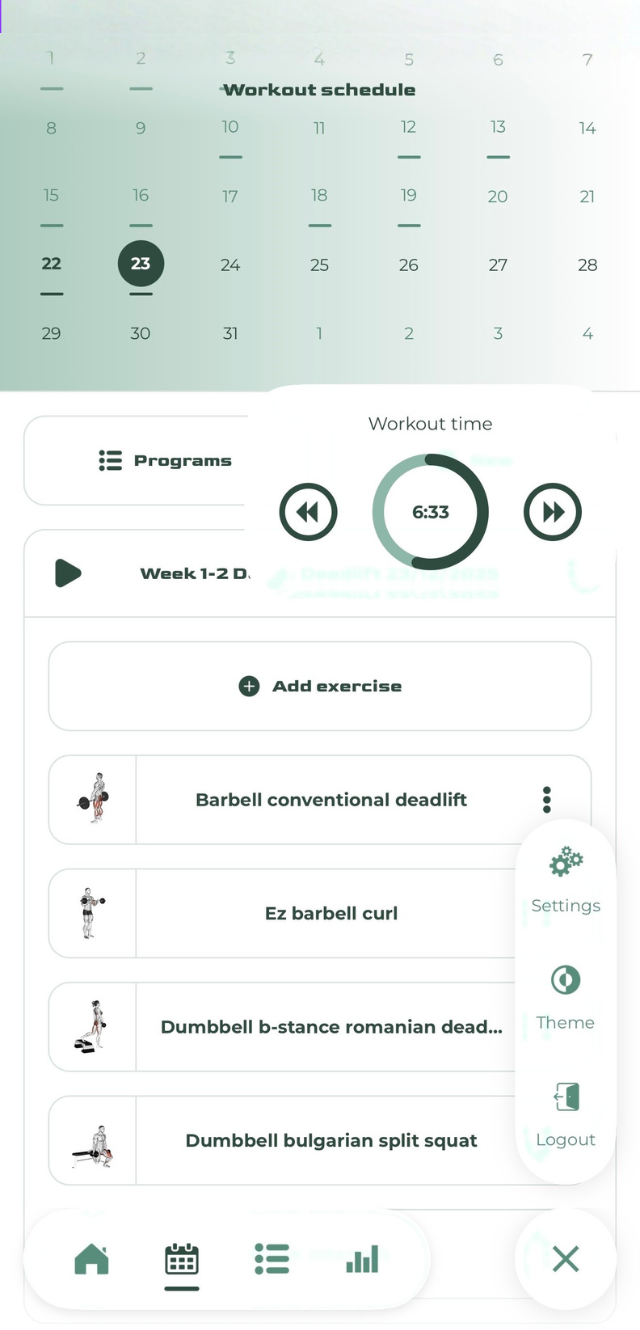
Virtus Athlete home screen with the week's scheduled workouts and progress summary

Frequently Asked Questions (FAQ)

How long does one full run take?
3 weeks of training (12 sessions) plus a rest-and-test week, so about one month total.
Can I train other lifts during the cycle?
Keep it minimal. The original guidance is to avoid accessory work during the cycle. Light maintenance for the rest of the body is the most you should add, and nothing the day before the 85% session.
Squat or bench, which should I pick?
Whichever lift you want to specialize in. The template is identical. The bench version tolerates the frequency slightly better for most lifters because the squat taxes the whole body harder.
What results should I expect?
Commonly 20-30+ lbs (10-15 kg) from one cycle, and 30-60+ lbs (15-27.5 kg) from two cycles with a recovery week between, assuming honest starting numbers and serious recovery.
Can I run it as a beginner?
No. Beginners progress faster on simple linear programs at a fraction of the wear. Smolov Jr assumes a well-trained lifter with solid technique under fatigue.
What happens if I miss a session?
Make it up within the week if possible: the volume is the program. If the week collapses entirely, repeat it at the same weights.
How do I enter my starting weights?
Enter a recent, honest 1-rep max for your chosen lift. The app calculates all four weekly sessions and the week 2 and 3 additions automatically.

Related Articles

Track This Program

Build unlimited programs, log every set, and track your progress over time. Free on iOS & Android.