Back to BlogPrograms

How to run the Smolov Base Cycle

2026-08-1112 min read

Written by Hamza J

How to run the Smolov Base Cycle
Contents

Based on the squat routine attributed to Russian Master of Sports Sergey Smolov, with some minor adaptations.

Six weeks of squatting and almost nothing else. Two weeks of introduction, three weeks of the base mesocycle at four squat sessions a week, then a rest and a new one rep max. It is the most demanding squat block in common circulation and it works for exactly one reason: it squats you more than you think you can recover from, for just long enough to get away with it.

Who Is This Program For?

Smolov is for the intermediate or advanced lifter whose squat has stalled and who has six weeks with nothing else to train for. Not a beginner program, not an all-round program, and not something to run into a meet you care about.

You should be able to say yes to all of these before you start:

  • You have squatted consistently for at least a year and know your true one rep max
  • You can train four times a week for three consecutive weeks without missing a session
  • You can eat and sleep like it is part of the program, because it is
  • You have nothing else you need to make progress on for six weeks

Miss one base mesocycle workout and the week it belongs to is compromised. There is no catch-up session and no way to fold it into the next one.

What This Block Is Not

This is the base cycle, weeks 1 to 6 of Smolov's full thirteen week system. The full system continues into a switching phase and an intense mesocycle. Those later phases are described in the source material as intensity ranges rather than as set lists, so what is written here is the part that is completely specified: the introduction, the base mesocycle and the retest. That is also the part almost everybody actually runs, and it is where almost all of the reported gain comes from.

Program Structure

Weeks 1 and 2: The Introductory Microcycle

Three sessions a week. This is not a warm-up phase you can skip. It is where you find out whether the number you entered is honest, with four weeks left to fix it if it is not.

Week 1 (three identical-in-purpose sessions):

DayWork
Day 13 × 8 @ 65%, 1 × 5 @ 70%, 2 × 2 @ 75%, 1 × 1 @ 80%
Day 23 × 8 @ 65%, 1 × 5 @ 70%, 2 × 2 @ 75%, 1 × 1 @ 80%
Day 34 × 5 @ 70%, 1 × 3 @ 75%, 2 × 2 @ 80%, 1 × 1 @ 90%

Week 2 (one work set per session, to check readiness):

DayWork
Day 11 × 5 @ 80%
Day 21 × 5 @ 82.5%
Day 31 × 5 @ 85%

If week 2 day 3 is a grind, your entered max is too high. Cut it by 5% and run week 2 again before you go anywhere near the base mesocycle.

Weeks 3, 4 and 5: The Base Mesocycle

Four squat sessions a week. This is the block Smolov is famous for.

DaySets and RepsLoad
Day 14 × 970%
Day 25 × 775%
Day 37 × 580%
Day 410 × 385%

That is 36, 35, 35 and 30 working reps, about 136 squat reps a week.

The percentages never change. The weight does.

WeekLoad
3The percentages above
4The same percentages plus 10 kg / 20 lbs on every set
5The same percentages plus 15 kg / 30 lbs on every set

This is the part most people get wrong. You do not recalculate a new percentage each week. You take week 3's weights and put more plates on them, the same amount on every session, whatever your max is.

A typical schedule is Monday, Wednesday, Friday, Saturday. What matters is that the 10 × 3 day has a rest day before it.

Week 6: Rest and Retest

One light session, then two to three days of complete rest, then a new one rep max.

Do not test on tired legs. The whole block is designed so that the fitness you built in weeks 3 to 5 shows up after the fatigue clears, and testing early is the most common way to finish six weeks of this and conclude it did not work.

Progression: How Weights Increase

There are only two mechanisms and neither is session to session.

1. Within the base mesocycle, weight is added in a flat amount: nothing in week 3, plus 10 kg / 20 lbs in week 4, plus 15 kg / 30 lbs in week 5. Same addition on all four days.

2. Between cycles, you retest in week 6 and any repeat of the block starts from the new number.

There is nothing else. You do not add weight because a session felt good and you do not chase reps. Every set in the base mesocycle is prescribed exactly, and the volume is doing the work.

Get Your Form Right First

Everything below assumes your form is already solid. Finding your working weight, adding weight, chasing reps, all of it only works if you can perform the lift correctly. While your form is not locked in, that is your only job. Make good form the goal of every set, not the weight on the bar. Drilling the movement with an empty bar beats loading plates onto a lift you cannot control yet.

To learn, don't hesitate to search Google and YouTube (there is a lot of good free material) and record yourself from the side to compare against a proper demonstration. In general, good form means a full controlled range of motion, a braced neutral spine, no bouncing or momentum, a consistent setup every rep, and ending the set when technique breaks down rather than grinding sloppy reps.

Finding Your Starting Weight

You need one number: your squat one rep max.

Use a Number You Have Actually Hit

Every percentage in six weeks comes off this one figure, and the base mesocycle multiplies any error by 136 reps a week.

  • If you maxed in the last two months, use that
  • If you did not, work up to a heavy triple and estimate with Weight × Reps × 0.0333 + Weight
  • If you are between two numbers, take the lower one. If you are unsure at all, take 95% of your best guess

Example:

You squat 150 kg / 330 lbs for 3 clean reps:
  Estimated 1RM = 150 × 3 × 0.0333 + 150 = 165 kg
                = 330 × 3 × 0.0333 + 330 = 363 lbs, round to 360 lbs
  Week 3 Day 1  = 4 × 9 at 70% = 115 kg / 250 lbs
  Week 5 Day 1  = the same, plus 15 kg / 30 lbs = 130 kg / 280 lbs

An inflated max does not make week 3 hard. It makes week 5 impossible, and by then you have spent four weeks getting there.

Warming Up

Warm-up sets are never counted in the working sets above.

SetWeightRepsRest
1Empty bar (20 kg / 45 lbs)845 seconds
2~40% of working weight545 seconds
3~60% of working weight360 seconds
4~80% of working weight290 seconds
Work setsAs prescribedAs prescribedSee rest table

Warm up properly on every one of the four base mesocycle days. The 4 × 9 day at 70% is the one people rush because the percentage looks small, and it is the session that produces the most soreness in the entire block.

Rest Times

SessionRest Period
4 × 9 and 5 × 7 days2-3 minutes
7 × 5 day3 minutes
10 × 3 day3-4 minutes
Introductory microcycle2-3 minutes

The 10 × 3 day takes over an hour with correct rest. Cutting it to keep the session short turns the heaviest day of the week into a conditioning workout and it is the fastest way to miss reps in week 5.

What Else You Can Train

Very little, and that is the point.

  • Upper body: bench press and pressing are fine, kept to two sessions a week and away from the 10 × 3 day
  • Pulling: light rows and chins are fine
  • Deadlifts: no. The base mesocycle is already more posterior chain work than most programs give you in a month
  • Legs: no additional leg work of any kind
  • Conditioning: walking only

If you find you have energy left for extra work, you entered your max too low.

When You Miss Reps

If you miss reps in the introductory microcycle, your max is wrong. Drop it 5 to 10% and restart week 1. Better to lose two weeks than five.

If you miss reps in week 3, the same answer applies with more urgency: the block gets 15 kg / 30 lbs heavier from here, so a week 3 miss is a week 5 disaster. Drop the max 10% and restart the base mesocycle.

If you miss reps in week 4 or 5, finish the session with whatever you can complete rather than repeating sets, and do not add the next increment. Hold the weight where it is for the remaining sessions and take the retest as scheduled.

If you miss a session entirely, do not double up and do not squeeze it in the next day. Carry on with the schedule and accept that the week was lighter than it should have been.

If your knees or lower back hurt rather than being tired, stop the block. There is no version of this program worth training through a joint on.

Program Duration

The base cycle runs six weeks: two of introduction at three sessions a week, three of the base mesocycle at four sessions a week, and a retest week. That is 19 squat sessions.

Afterwards, take at least a week of easy training. Do not run it back immediately. Most lifters get one good Smolov base cycle out of a training year, and the ones who try to run two back to back generally finish the second weaker than they started it.

Run the Smolov Base Cycle on Virtus Athlete

Enter your squat max once and Virtus Athlete works out all nineteen sessions, including the flat weekly additions in weeks 4 and 5 that most spreadsheets get wrong. Rest timers sized for the 10 × 3 day, every set logged, and a squat chart that tells you afterwards whether six weeks of this actually moved the number.

Free on iOS and Android.

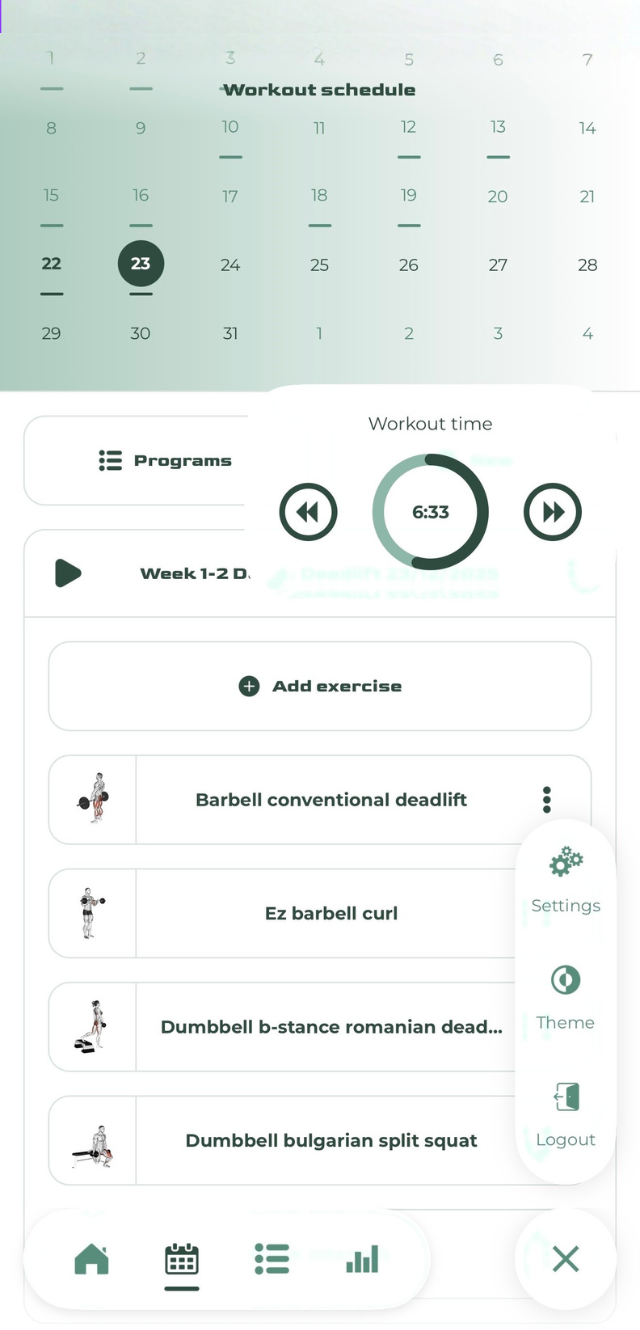
Virtus Athlete home screen with the week's scheduled workouts and progress summary

Frequently Asked Questions (FAQ)

How long does one full run take?
Six weeks and 19 squat sessions: three a week for the first two weeks, four a week for weeks 3 to 5, and one light session before the retest.
Why does the weight go up in kilograms instead of percent?
Because that is how the original is written. The same addition is made whatever your max, which means the block is proportionally harder for a lighter squatter, and that is deliberate: the absolute jump is what the program is calibrated on.
Can I squat three days a week instead of four?
No. The four daily schemes are the base mesocycle. Removing one removes a quarter of the volume the whole block is built on, and what is left is not Smolov.
Do I really need to eat that much?
Yes. This block is a caloric problem as much as a training one. If you are trying to lose weight, run something else.
What about the rest of the thirteen week system?
The switching phase and the intense mesocycle follow the retest. They are documented as intensity ranges rather than as complete set lists, so they are not written here. The base cycle is the specified part and it is where the reported gains come from.
High bar or low bar?
Whichever you compete or normally train in. Do not change your squat style for the block, because six weeks of high volume is the worst possible time to be learning a new bar position.
What happens after the retest?
Take an easy week, then move to a program with normal volume. Smolov is a specialisation block and its results need a normal training block afterwards to hold on to.

Related Articles

Track This Program

Build unlimited programs, log every set, and track your progress over time. Free on iOS & Android.