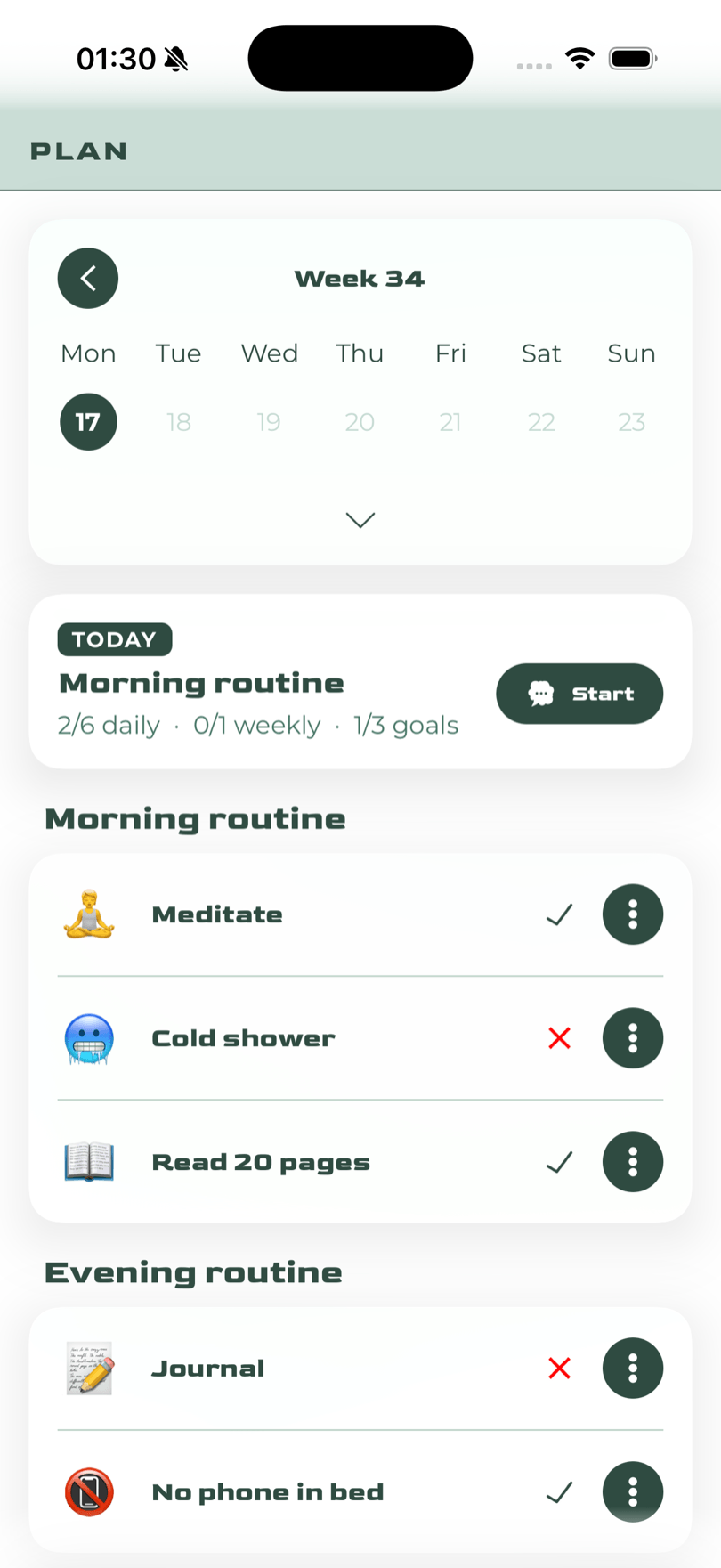
An outcome goal is the result you want. A process goal is the behaviour you will actually perform. You need both, and you should track them differently.
The distinction between process goals and outcome goals sounds academic until you notice how many abandoned plans die from getting it wrong. People write down the result, check it every few days, see nothing move, and conclude the plan is not working. The plan was never the problem. The result was the wrong thing to be watching.
| Outcome goal | Process goal |
|---|
| Example | Lose 8 kg by 1 December | Log every meal, daily |
| Answers | Where am I going | What do I do today |
| Control | Partial | Full |
| Feedback speed | Weeks | Same day |
| Failure mode | Demotivating drift | Perfect execution, wrong method |
| Where it lives | Goal, with a deadline | Habit, with a frequency |
The middle row is the important one. You do not control whether you lose 8 kg. You control whether you eat and train in a way that usually produces that. The gap is small in the long run and enormous day to day, and it is exactly the gap where motivation leaks out.
An outcome goal gives you direction and nothing else. On any given Tuesday it has no instruction in it. "Lose 8 kg" does not tell you what to do at 7pm on Tuesday, so the decision gets made by whatever else is happening at 7pm on Tuesday.
Worse, it gives you feedback on a schedule that punishes early effort. Body weight, revenue, follower counts and skill all move slowly and noisily. Three weeks of genuinely correct behaviour can show up as no visible change at all, which reads exactly like failure. People quit at that point, not because the method failed but because the only metric they were watching had not moved yet.
There is a sharper version of this problem on unfamiliar tasks. When you do not yet know the method, a hard outcome goal can actively hurt, because attention goes to the result instead of to figuring out how the thing is done. On genuinely new and complex work, a goal framed around learning the method beats a goal framed around hitting the number, at least until you have a method worth executing.
The mirror failure is less discussed and just as common: flawless execution of a process that does not produce the outcome.
You can log every meal for three months and gain weight. You can practise an instrument daily for a year, badly, and stay bad. A process goal is only as good as the causal link between it and the result, and that link is an assumption you made at the start when you knew the least.
This is why process goals need an outcome to be checked against. Not daily, which just recreates the drift problem, but on a fixed cadence where a real signal can accumulate. The outcome's job is not to motivate you. Its job is to tell you whether the process is worth continuing.
Every serious goal should be written as one outcome plus one or two processes.
| Outcome (finite, dated) | Process (recurring) |
|---|
| Squat 100 kg for 5 by 1 June | Train legs twice a week, log every set |
| Ship the app by 30 September | Two hours of build time before email, weekdays |
| Read 12 books this year | Twenty minutes of reading after dinner |
| Save 6,000 by 31 December | Transfer 500 the day salary lands |
Read the right-hand column. Every one is fully inside your control, verifiable the same day, and small enough to survive a bad week. That is not a coincidence, it is the specification. A process goal that fails on any of those three is a second outcome goal wearing a disguise.
The right-hand column is also, structurally, a habit. It repeats and has no endpoint, which means it belongs in a habit tracker anchored to something you already do, not in a goal list. The mechanics of making it fire reliably are covered in habit stacking.
The tracking rule follows directly from feedback speed.
Daily: the process. Did you do the thing. Binary, no interpretation, ten seconds.
Weekly or monthly: the outcome. Where is the number, and is it moving at a rate that reaches the target by the date.
Monitoring progress is not a nice-to-have here. A 2016 meta-analysis in Psychological Bulletin covering 138 studies and 19,951 participants found that interventions promoting monitoring of goal progress reliably improved goal attainment, with a larger effect when the information was physically recorded. Recording matters more than remembering. But you can only record something daily if it is a behaviour, which is the practical argument for the process being your daily metric.
The outcome review is where you get to change your mind. If eight weeks of a well-executed process has moved the outcome less than the pace you need, the honest conclusion is that the process is wrong, not that you need to try harder at it. Most people do the opposite: they keep the method and blame the effort.
Turning the outcome into a daily metric. Weighing yourself every morning and reacting to it is not tracking, it is noise amplification. The signal exists at the weekly level.
Turning the process into an outcome. "Be more disciplined this week" is not a process goal. It has no unit and no yes-or-no answer at the end of the day.
Having a process and no outcome. This is how people stay busy for years. The process becomes the point, nobody ever checks whether it produces anything, and the honest review never happens.
Having three outcomes and no processes. The most common of all. A list of results with nothing underneath, revisited every January.
Take your current goal. Write one line for each:
- The outcome, with a number and a date, per the rules in how to set goals that work.
- The one recurring behaviour you believe produces it, small enough to do on your worst day.
- The date of your next outcome review, and the pace number you expect to see by then.
If you cannot name the behaviour in line 2, you do not have a plan yet. You have a target.
- Harkin B, et al. (2016). Does monitoring goal progress promote goal attainment? A meta-analysis of the experimental evidence. Psychological Bulletin. doi:10.1037/bul0000025

 iOS
iOS Android