Back to BlogPrograms

How to run the Mike Mentzer Heavy Duty program

2026-08-1112 min read

Written by Hamza J

How to run the Mike Mentzer Heavy Duty program
Contents

Based on Mike Mentzer's Heavy Duty Ideal Routine, with some minor adaptations.

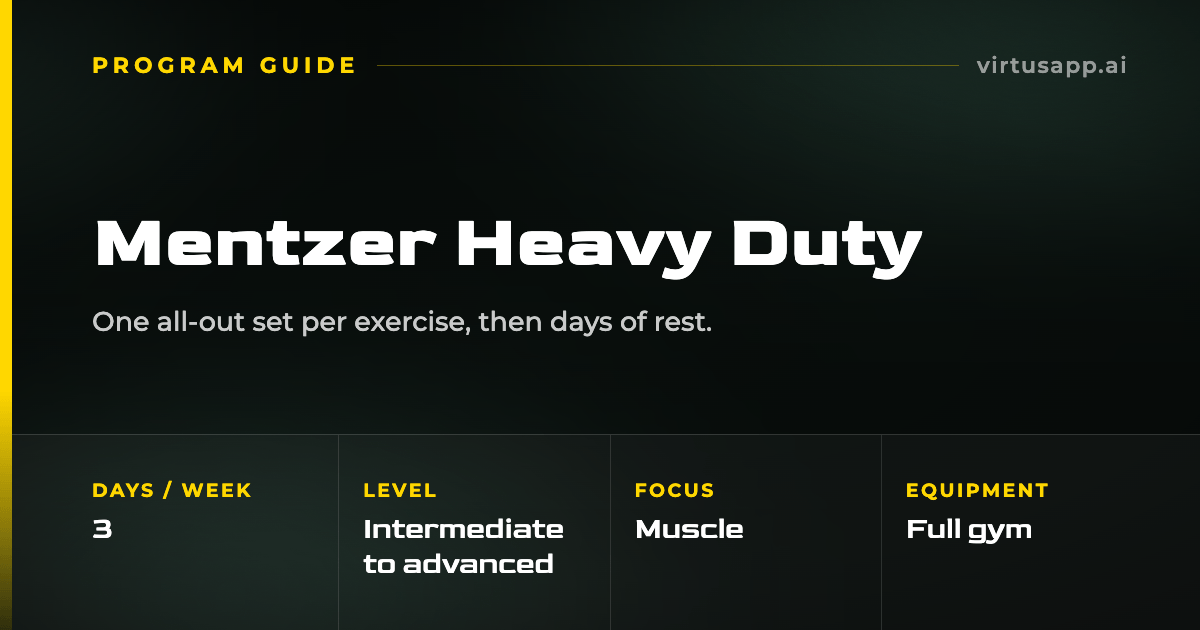
The opposite of high-volume bodybuilding: a 3-way split (chest and back, legs, delts and arms) where every exercise gets exactly one working set taken to true muscular failure, followed by 4 to 7 full days of rest before the next workout. Brief. Intense. Infrequent.

Who Is This Program For?

Heavy Duty is for lifters who want maximum results from minimum gym time and are willing to train with real intensity. Mentzer's position was that one set to true muscular failure is not only sufficient but optimal, and that the workout only stimulates growth; recovery produces it.

The program focuses on:

  • Intensity: every working set ends at the point where another rep is physically impossible
  • Brevity: 3-5 working sets per workout, 20-30 minutes in the gym
  • Infrequency: one workout every 4-7 days, nothing in between
  • Pre-exhaustion: isolation moves fatigue the target muscle before a compound finishes it

If long programs have burned you out, or you have stalled on volume training and suspect you are under-recovered, this is it.

Program Structure

The 3-Way Split

The Ideal Routine splits the body three ways: chest and back, legs, delts and arms. Because legs respond well to this approach, the rotation contains four workouts, with legs appearing twice:

WorkoutFocus
1Chest and Back
2Legs
3Delts and Arms
4Legs

After Workout 4, the rotation starts again at Workout 1.

Workout 1 - Chest and Back

ExerciseSets x Reps
Pec Deck or Dumbbell Flye1 x 6-10, superset with
Incline Press1 x 1-3
Close-Grip Palms-Up Pulldown1 x 6-10
Deadlift1 x 5-8

The pec deck set goes to failure, then you move immediately to the incline press with no rest. Because the chest is pre-exhausted, only 1-3 reps are possible; that is intentional. Mentzer called the deadlift the most productive exercise of all for the sheer amount of muscle it recruits.

Workout 2 - Legs

ExerciseSets x Reps
Leg Extension1 x 8-15, superset with
Leg Press or Squat1 x 8-15
Standing Calf Raise1 x 12-20

The leg extension pre-exhausts the quads, then you move immediately to the leg press or squat.

Workout 3 - Delts and Arms

ExerciseSets x Reps
Dumbbell Lateral Raise1 x 6-10
Bent-Over Rear Delt Raise1 x 6-10
Barbell Curl1 x 6-10
Triceps Pressdown1 x 6-10, superset with
Dips1 x 3-5

Front delts already get heavy work from pressing on chest day, so this day targets only the lateral and rear heads.

Workout 4 - Legs

ExerciseSets x Reps
Leg Extension1 x 8-15, superset with
Squat1 x 8-15
Standing Calf Raise1 x 12-20

Advanced trainees can replace the leg extension set with a single heavy static hold of 10-25 seconds before moving immediately to the squat.

The Schedule: Rest Days Are the Program

Perform one workout every 4 days (96 hours) to start. A typical layout:

  • Monday: Workout 1
  • Friday: Workout 2
  • Tuesday: Workout 3
  • Saturday: Workout 4, then repeat

As you get stronger, each workout imposes a deeper demand on your recovery, so Mentzer had trainees spread workouts further apart over time, up to 6-7 days between sessions. Nothing is trained on rest days. If you are not stronger than last time when you return, you have not rested enough: add another rest day.

Understanding One Set to Failure

A working set ends when, despite your full effort and perfect form, the next rep is physically impossible. Not "very hard", not "form is getting ugly", but impossible. Learn to distinguish a difficult rep from a genuinely impossible one.

Rules for every working set:

  • Move slowly and under control, roughly 4 seconds up and 4 seconds down, no momentum
  • Full range of motion on every rep
  • When you cannot complete a rep, keep pushing for a few seconds before ending the set
  • A training partner or spotter helps you push safely past hesitation

Because there is only one working set per exercise, that set has to count. Half effort on this program means no stimulus at all.

Progression: How Weights Increase

Heavy Duty uses double progression with a strength log as the referee.

  • Choose a weight where you reach failure inside the prescribed rep range
  • Each workout, try to beat your logbook: more reps at the same weight
  • When you hit the top of the rep range, increase the weight next time so you land back near the bottom of the range

Your single objective measuring stick is the logbook. If strength went up since the last session, growth was stimulated and recovery was sufficient. If it did not, add rest days before touching the weights or the exercises.

Get Your Form Right First

Everything below assumes your form is already solid. Finding your working weight, adding weight, chasing reps, all of it only works if you can perform the lift correctly. While your form is not locked in, that is your only job. Make good form the goal of every set, not the weight on the bar. Drilling the movement with an empty bar beats loading plates onto a lift you cannot control yet.

To learn, don't hesitate to search Google and YouTube (there is a lot of good free material) and record yourself from the side to compare against a proper demonstration. In general, good form means a full controlled range of motion, a braced neutral spine, no bouncing or momentum, a consistent setup every rep, and ending the set when technique breaks down rather than grinding sloppy reps.

Finding Your Starting Weights

For each exercise, find a weight where you fail within the prescribed rep range:

  1. Warm up, then pick a conservative weight and take a set to failure
  2. If you got more reps than the top of the range, add 5-10% next time
  3. If you failed below the bottom of the range, remove 5-10%
  4. Within 2-3 workouts each exercise settles at its correct weight

For the deadlift, stay 1 rep shy of absolute failure; grinding a failed deadlift rep is a technique risk, not a stimulus. It's better to start too light than too heavy: an honest set to failure with a lighter weight is still a full stimulus.

Warming Up

Before each working set, perform 1-2 light warm-up sets to rehearse the movement without generating fatigue:

SetWeightReps
1~50% of working weight5
2~75% of working weight3
Work set100%To failure

Warm-ups must never approach failure. Their only job is preparing joints and grooving the pattern. In a pre-exhaust superset, warm up both exercises before starting the working set of the first.

Rest Times

SituationRest Period
Inside a pre-exhaust supersetNone. Move immediately
Between exercises1-3 minutes, enough to give full effort
Between workouts4-7 full days

The rest that matters on this program is measured in days, not minutes.

Stall Protocol

On Heavy Duty, a stall is treated as a recovery failure, not a loading failure:

  1. First, add an extra rest day between workouts (5 days instead of 4, then 6, then 7)
  2. Check the basics: 7-9 hours of sleep, enough calories, 1.5-2.2 g of protein per kg of bodyweight (0.7-1 g per lb)
  3. If still stuck, remove an exercise or skip a rotation entirely, then return fresh
  4. Do not add sets or sessions. More volume is the opposite of the fix on this program

Reducing the weight is rarely needed; if form breaks inside the rep range, drop 10% and rebuild.

Program Duration

One full rotation (4 workouts at one workout every 4 days) takes about 16 days. Run the program for at least 12 weeks, roughly 5-6 full rotations, before judging it.

Why 12 weeks?

  • Strength on one-set training builds workout to workout, but visible size changes need months
  • The schedule keeps spreading out as you get stronger, so later rotations take longer
  • 12 weeks gives a clean logbook comparison of every lift at least 5 times

Run Heavy Duty on Virtus Athlete

Virtus Athlete fully integrates the Heavy Duty Ideal Routine, handling the rotation, the rest-day scheduling, and the logbook progression for you. Just enter your starting weights and start training.

Free on iOS and Android.

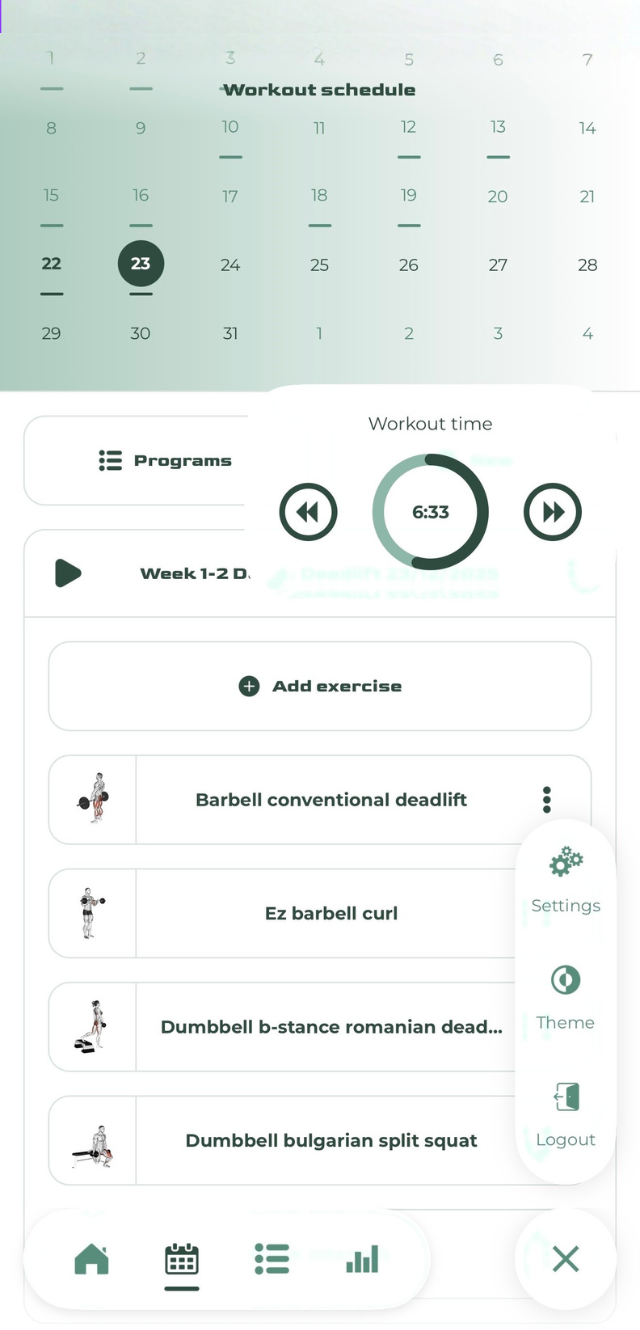
Virtus Athlete home screen with the week's scheduled workouts and progress summary

Frequently Asked Questions (FAQ)

How long does one full run take?
One rotation of the 4 workouts takes about 16 days. A 12-week run is roughly 21 workouts over ~3 months, fewer as rest days stretch out.
Only one set? Really?
One working set to true failure per exercise. Mentzer's entire argument is that intensity, not volume, triggers growth, and that extra sets only dig into the limited recovery budget that growth is paid from.
Can I train something on the rest days?
No. Rest days are the program. Walking is fine; training is not.
Can I swap exercises?
Machine and free-weight equivalents are interchangeable (pec deck or flyes, leg press or squat, machine or dumbbell laterals). Keep the pre-exhaust pairings intact.
Is training to failure safe?
With controlled reps, full range of motion, and a machine or spotter where relevant, yes for most healthy lifters. The one exception in this routine is the deadlift, which stays just shy of failure.
What happens if I miss a workout?
Nothing bad. An extra rest day on this program is usually a benefit. Do the missed workout next and continue the rotation.
How do I enter my starting weights?
Enter a weight where you expect to fail within the prescribed rep range. The logbook and double progression handle everything from there.
What happens after 12 weeks?
If your lifts are still climbing, keep going and keep spreading workouts apart. If progress has flattened for several rotations despite added rest, move to a different style of training for a block and return later.

Related Articles

Track This Program

Build unlimited programs, log every set, and track your progress over time. Free on iOS & Android.