Back to BlogPrograms

How to run the Juggernaut Method program

2026-08-1113 min read

Written by Hamza J

How to run the Juggernaut Method program
Contents

Based on Chad Wesley Smith's The Juggernaut Method 2.0, with some minor adaptations.

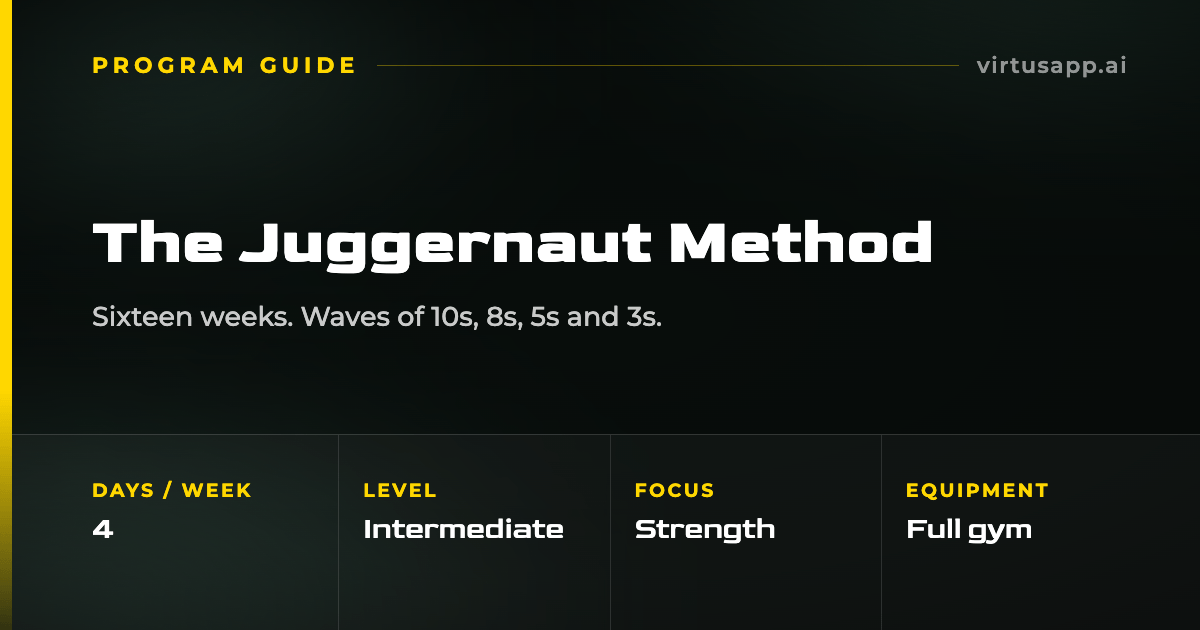
A 16-week block periodization program for squat, bench press, deadlift, and overhead press. Four days per week, one main lift per day. The 16 weeks are four waves of four weeks each, cycling through 10s, 8s, 5s, and 3s. Every wave runs the same four phases: accumulation, intensification, realization, deload. An all-out set in the realization week decides exactly how much your working max goes up.

Who Is This Program For?

The Juggernaut Method is for intermediate lifters who have exhausted session-to-session and week-to-week linear gains. If you are still adding weight every workout, keep doing that. This program is what comes after.

The program focuses on:

  • Submaximal work off a training max: you never work off your true 1RM
  • Four rep ranges in sequence: 10s build work capacity, 3s express strength, and the 8s and 5s bridge them
  • Earned progression: an all-out AMAP set in week 3 of every wave decides your next working max, using an actual formula
  • Built-in recovery: every fourth week is a deload, no exceptions

It sits closer in spirit to 5/3/1 than to a linear progression. Both use a training max and a monthly all-out set, but Juggernaut carries far more total volume per wave and runs a longer 16-week structure.

Program Structure

The 4 Main Lifts

LiftMovement Pattern
Barbell Back SquatLower body push
Barbell Bench PressHorizontal push
Barbell Conventional DeadliftHip hinge
Barbell Overhead PressVertical push

The 4-Day Split

One main lift per day, each followed by its own supplemental and accessory work.

DayMain Lift
Day 1Squat
Day 2Bench Press
Day 3Overhead Press
Day 4Deadlift

Sessions run about 45 to 60 minutes.

The Four Waves

WaveWeeksRep TargetPurpose
10s1 to 410Work capacity, hypertrophy, technique under load
8s5 to 88Bridge from volume toward strength
5s9 to 125Strength development
3s13 to 163Peak strength and specificity

The Four Phases Inside Every Wave

WeekPhaseWhat It Does
1AccumulationHighest volume of the wave at the lowest intensity. Build the skill of the lift and get masterful in the rep range
2IntensificationIntensity rises while volume drops to roughly 60% of the accumulation week
3RealizationLowest volume, highest intensity. One all-out set for maximum reps
4DeloadVolume is stripped by roughly 60% and you roll into the next wave

Every wave, every lift, follows this same shape.

The Training Max

Everything is calculated from a training max, which the book also calls the working max.

Your training max is 90% of your best current 1RM.

Your squat 1RM: 180 kg (400 lbs)
Your training max: 180 × 0.90 = 162 kg
In pounds: 400 × 0.90 = 360 lbs
Every percentage below is taken off 162 kg (360 lbs), not off 180 kg (400 lbs)

Why 90%?

  • It keeps the early weeks of each wave genuinely manageable
  • It means the realization AMAP set is productive rather than a survival test
  • It leaves room for the progression formula to actually move the number

If you are between two numbers, take the lower one. A training max that is 5 kg too light costs you almost nothing. A training max that is 5 kg too heavy poisons all sixteen weeks.

Weekly Set Structure

All percentages are of your training max. The plus sign marks the set where you push past the prescribed minimum.

Accumulation (Week 1 of Each Wave)

WavePrescription
10s60% × 5 sets of 10, last set 10+
8s65% × 5 sets of 8, last set 8+
5s70% × 6 sets of 5, last set 5+
3s75% × 7 sets of 3, last set 3+

Leave 2 to 3 reps in reserve on that final set. This is not the week to empty the tank.

Intensification (Week 2 of Each Wave)

Ramp up to the top load, then perform the working sets.

WavePrescription
10s67.5% × 3 sets of 10, last set 10+
8s72.5% × 3 sets of 8, last set 8+
5s77.5% × 4 sets of 5, last set 5+
3s82.5% × 5 sets of 3, last set 3+

Leave 1 to 2 reps in reserve on the final set.

Realization (Week 3 of Each Wave)

Work up to a single all-out set. This is the only truly maximal effort in the program.

WavePrescriptionMinimum Reps
10s75% × AMAP10
8s80% × AMAP8
5s85% × AMAP5
3s90% × AMAP3

AMAP means as many as possible. Hit the minimum, then keep going until the bar stops moving or your form breaks. This set is the entire feedback mechanism of the program, so do not sandbag it and do not grind ugly reps into it.

Deload (Week 4 of Each Wave)

Identical across all four waves:

40% × 5
50% × 5
60% × 5

Accessory work drops to 50% of its normal volume.

Progression: How the Working Max Moves

After each realization AMAP set, the working max for that lift is recalculated with a formula:

[(REPS PERFORMED - STANDARD) × INCREMENT PER REP] + WORKING MAX = NEW WORKING MAX

STANDARD is the wave's rep target: 10 in the 10s wave, 8 in the 8s wave, 5 in the 5s wave, 3 in the 3s wave.

INCREMENT PER REP:

ApproachUpper Body (Bench, OHP)Lower Body (Squat, Deadlift)
Standard1.25 kg (2.5 lbs)2.5 kg (5 lbs)
Conservative0.5 kg (1.25 lbs)1.25 kg (2.5 lbs)

Cap: count at most 10 reps above the standard. A monster AMAP does not get to inflate your working max beyond that.

Worked Example

3s wave realization, squat.
Working max: 162 kg (360 lbs)
Load: 90% of working max = 146 kg (324 lbs)
Standard: 3 reps
You perform: 8 reps

Extra reps: 8 - 3 = 5
Metric:   (5 × 2.5 kg) + 162 kg  = 174.5 kg new working max
Imperial: (5 × 5 lbs) + 360 lbs  = 385 lbs new working max

What Each Result Means

AMAP ResultWhat To Do
Well above the standardAggressive working max jump, use the standard increment
A couple of reps aboveNormal jump
Exactly the standardSmall jump or hold
Below the standardDo not increase. Repeat the wave at the same working max

If you miss the minimum reps on a realization set, the working max was wrong. That is information, not failure. Rerun the wave at the same number.

Supplemental and Accessory Work

The book prescribes work beyond the main lift on every day. Accessories are part of the program, not a bonus.

A workable template, three sets each on double progression:

DayAccessories
SquatLeg Press, Lying Leg Curl, Ab Wheel
Bench PressIncline Dumbbell Bench, One-Arm Dumbbell Row, Face Pulls
Overhead PressLateral Raises, Chin-ups, Triceps Pushdown
DeadliftBent Over Row, Hanging Leg Raises, Dumbbell Curls

Variation work such as paused benches, deficit deadlifts, and front squats fits the intent of each wave and can occupy the supplemental slot.

On deload weeks, cut accessory volume in half.

Get Your Form Right First

Everything below assumes your form is already solid. Finding your working weight, adding weight, chasing reps, all of it only works if you can perform the lift correctly. While your form is not locked in, that is your only job. Make good form the goal of every set, not the weight on the bar. Drilling the movement with an empty bar beats loading plates onto a lift you cannot control yet.

To learn, don't hesitate to search Google and YouTube (there is a lot of good free material) and record yourself from the side to compare against a proper demonstration. In general, good form means a full controlled range of motion, a braced neutral spine, no bouncing or momentum, a consistent setup every rep, and ending the set when technique breaks down rather than grinding sloppy reps.

The 10s wave is where this bites. Five sets of ten at 60% is a lot of reps for technique to drift under fatigue.

Finding Your Starting Weights

You need an estimated 1RM for squat, bench press, deadlift, and overhead press. The program takes 90% of each to build your training max.

If You Know Your 1RM

Enter it directly. If in doubt, round down.

If You Do Not

  1. Find a weight you can lift for 3 to 5 reps with good form
  2. Use a 1RM calculator to estimate your max
  3. A common formula: Weight × Reps × 0.0333 + Weight

Example:

You bench 90 kg (200 lbs) for 5 reps:
  Estimated 1RM = 90 × 5 × 0.0333 + 90 = 105 kg
  In pounds: 200 × 5 × 0.0333 + 200 = 233 lbs
  Training max = 105 × 0.90 = 94.5 kg, round to 94 kg (210 lbs)
  10s accumulation load at 60% = 56.5 kg (126 lbs)

Start light. The 10s wave with an inflated training max is genuinely miserable, and the AMAP set will tell you the truth in three weeks anyway.

Warming Up

The accumulation and intensification weeks build their own ramp into the working sets. On realization weeks you work up to the AMAP set, so the ramp and the warm-up are the same thing.

SetWeightRepsRest
1Empty bar, 20 kg (45 lbs)8 to 1030 to 45 seconds
2~40% of training max545 seconds
3~50% of training max560 seconds
4~60% of training max390 seconds
Work setsPrescribed loadPrescribed reps2 to 3 minutes

On realization weeks take smaller jumps near the top and keep the reps low, so you arrive at the AMAP set warm rather than pre-fatigued.

Rest Times

SituationRest Period
Accumulation and intensification main lift sets2 minutes
Realization AMAP set3 minutes before it
Deload sets90 seconds
Accessories60 to 90 seconds

Rest fully before the AMAP set. It sets your working max for the next four weeks.

When Things Go Wrong

You Miss the Minimum Reps on the Realization Set

Do not increase the working max. Repeat the wave at the same number. The most likely cause is that the training max was set too high at the start, so if it happens twice, drop it by 5 to 10%.

The 10s Wave Is Crushing You

That is the intended stimulus, but check three things before assuming otherwise: your training max, your sleep, and your food. The program is best run at maintenance calories or in a surplus. Running the 10s wave on a deep deficit is asking to fail.

You Want to Skip the Deload

Do not. Every wave ends with one, and it is what makes the next wave's accumulation week possible. Stripping 60% of volume for a week is the price of running four consecutive waves.

You Want More Heavy Work in the Early Waves

The 10s and 8s waves are intentionally light and it does not suit everyone. The published modification is to work up to a heavy set before the prescribed work in the intensification week, then perform only the minimum prescribed reps on the regular sets:

WaveHeavy Set Added To Intensification
10sWork up to a heavy set of 5
8sWork up to a heavy set of 3
5sWork up to a heavy set of 2
3sWork up to a heavy set of 1

Only do this if the standard version genuinely leaves you flat, not because light weeks feel unproductive.

You Miss a Session

Pick up where you left off. Do not double up two main-lift days, especially in the intensification and realization weeks.

Program Duration

The program runs 16 weeks at 4 sessions per week, which is 64 total workouts across roughly four months.

Why 16 weeks?

  • Four rep ranges, each needing a full four-week wave to be trained properly
  • The 3s wave only pays off on top of the volume the 10s and 8s waves built
  • Four realization sets per lift is four data points on how your body responds to load

At the end of the 16 weeks you can retest your 1RMs and start a new cycle from the new numbers. Between full cycles, the common adjustment is to add 2.5 to 5 kg (5 to 10 lbs) to upper-body training maxes and 5 to 7.5 kg (10 to 15 lbs) to lower-body training maxes, adjusted by how the realization sets actually went.

Run The Juggernaut Method on Virtus Athlete

Virtus Athlete handles the training max calculation, the wave and phase percentages, the AMAP tracking, and the working max formula for you. Enter your four 1RM values and start training.

Free on iOS and Android.

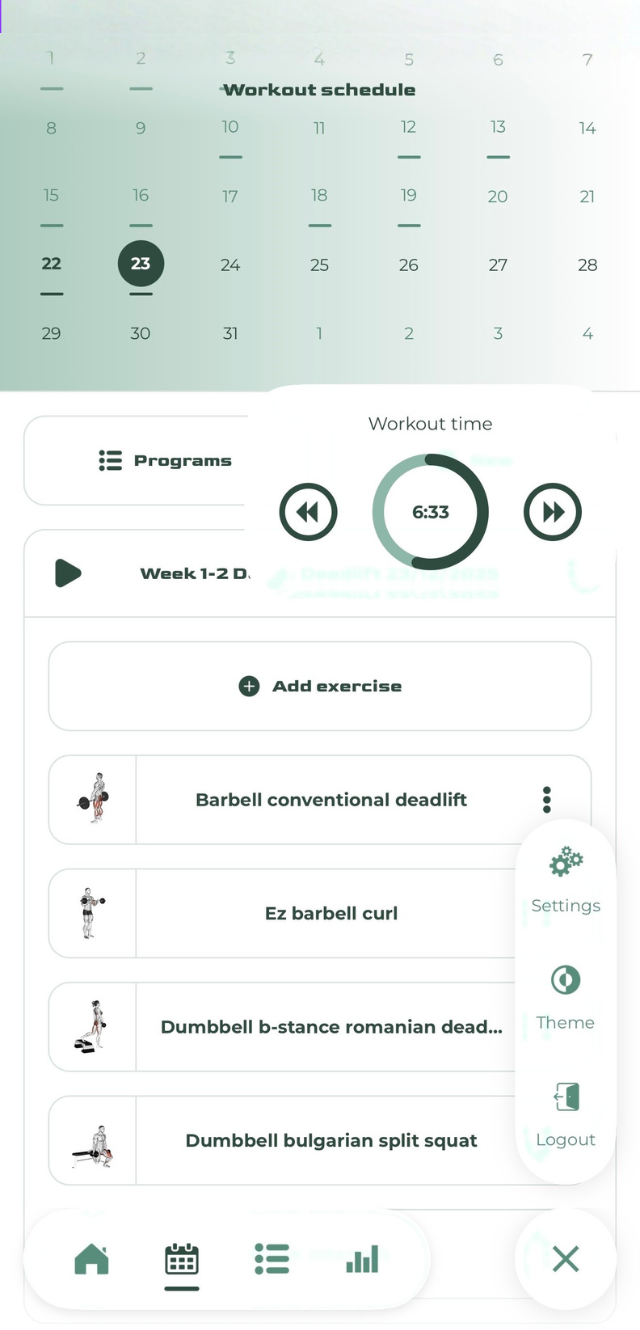
Virtus Athlete home screen with the week's scheduled workouts and progress summary

Frequently Asked Questions (FAQ)

How long does one full run take?
With 16 weeks at 4 sessions per week, expect 64 total workouts over roughly 4 months.
Do I use my 1RM or my training max for the percentages?
Your training max, which is 90% of your 1RM. Every percentage in every table is a percentage of that number.
How much does my training max go up each wave?
Use the formula. Reps above the wave standard, multiplied by 1.25 kg (2.5 lbs) for upper body or 2.5 kg (5 lbs) for lower body, added to the current working max. Count at most 10 reps above the standard.
What if I only hit the minimum reps on the AMAP?
Hold the working max or take a very small jump. Hitting the minimum is a pass, not a failure.
What if I miss the minimum reps?
Repeat the wave at the same working max. If it happens twice, drop the training max by 5 to 10%.
Can I skip the 10s wave and start at the 8s?
That removes the work capacity block the rest of the program is built on. Run the waves in order the first time through.
Can I run it 3 days per week?
The program is written around four main lifts on four days. On three days you would run the four sessions on a rolling schedule, which stretches each wave past a calendar week and blurs the accumulation and intensification structure. Four days is the intended shape.
Are the accessories optional?
No. Supplemental and accessory work is prescribed, not optional. Cut it to half volume on deload weeks only.
What is the difference between this and 5/3/1?
Both use a training max at 90% of 1RM and both use a monthly all-out set to drive progression. Juggernaut carries substantially more volume per wave, runs a fixed 16-week structure with four distinct rep ranges, and uses an explicit formula to convert AMAP reps into a working max increase.

Related Articles

Track This Program

Build unlimited programs, log every set, and track your progress over time. Free on iOS & Android.