Back to BlogPrograms

How to run the Jay Cutler Muscle Group Split

2026-08-1112 min read

Written by Hamza J

How to run the Jay Cutler Muscle Group Split
Contents

Based on the training split used by four-time Mr. Olympia Jay Cutler, with some minor adaptations.

One muscle group a day, five days a week, and a lot of exercises per session. This is old-school bodybuilding volume: eleven movements on arms day, fourteen on legs day, and nothing clever about the loading. It works the way it has always worked, by giving each muscle group one long session and a full week to recover from it.

Who Is This Program For?

This split is for the intermediate bodybuilder who wants size and has five days a week to give it.

It suits you if:

  • Your goal is muscle, not a squat, bench and deadlift total
  • You can train five days a week reliably and have 60 to 90 minutes per session
  • You have a full gym: this program uses machines, cables, dumbbells and barbells, and it uses all of them
  • You already know how to take a set close to failure without your form falling apart

It does not suit a beginner. Eleven exercises for arms is more direct arm volume than a beginner can use or recover from, and a beginner will get more from a full body or upper/lower program at a fraction of the time cost.

The Weekly Layout

DaySession
MondayChest and Calves
TuesdayTriceps and Biceps
WednesdayBack
ThursdayRest
FridayDelts and Traps
SaturdayLegs and Calves
SundayRest

The rest day in the middle is not optional. It sits after back day and before delts day, which is exactly where the fatigue from pulling would otherwise land on pressing.

Program Structure

Day 1: Chest and Calves

ExerciseSets × RepsRest
Incline Chest Press12 / 10 / 8 pyramid60 s
Dumbbell Bench Press12 / 10 / 8 pyramid60 s
Incline Chest Fly12 / 10 / 8 pyramid60 s
Chest Dip3 × 10-1490 s
Decline Bench Press3 × 10-1490 s
Standing Calf Raise3 × 12-1660 s
Seated Calf Raise3 × 12-1660 s

Day 2: Triceps and Biceps

ExerciseSets × RepsRest
Triceps Pushdown (rope)15 / 12 / 10 pyramid60 s
Triceps Pushdown (bar)15 / 12 / 10 pyramid60 s
Close Grip Bench Press12 / 10 / 8 pyramid120 s
Triceps Dip12 / 10 / 8 pyramid60 s
Skullcrusher12 / 10 / 8 pyramid60 s
Triceps Pushdown (reverse grip)12 / 10 / 8 pyramid60 s
Bicep Curl15 / 12 / 10 pyramid60 s
Incline Curl15 / 12 / 10 pyramid60 s
Preacher Curl15 / 12 / 10 pyramid60 s
Hammer Curl12 / 10 / 8 pyramid60 s
Lying Bicep Curl12 / 10 / 8 pyramid60 s

Six triceps movements and five biceps movements. That is the session and it is meant to be that way: arms get a whole day, so they get a whole day's worth of exercises.

Day 3: Back

ExerciseSets × RepsRest
Lat Pulldown (underhand)3 × 8-1290 s
Lat Pulldown3 × 10-1490 s
Deadlift3 × 6-10120 s
T Bar Row3 × 8-1290 s
One Arm Row3 × 10-1460 s
Bent Over Row3 × 10-1490 s
Seated Row3 × 10-1460 s

Day 4: Delts and Traps

ExerciseSets × RepsRest
Lateral Raise3 × 10-1460 s
Dumbbell Overhead Press3 × 8-1290 s
Machine Shoulder Press3 × 10-1460 s
Reverse Fly3 × 10-1460 s
Shrug3 × 10-1460 s
Upright Row3 × 10-1460 s

The lateral raise goes first on purpose. Side delts are the point of this session and putting them after two pressing movements means training them tired.

Day 5: Legs and Calves

ExerciseSets × RepsRest
Leg Extension (warm-up)2 × 12-1660 s
Squat3 × 8-12120 s
Leg Press3 × 10-1490 s
Dumbbell Lunge3 × 10-1460 s
Hack Squat3 × 10-1490 s
Leg Extension3 × 12-1660 s
Seated Leg Curl3 × 10-1460 s
Lying Leg Curl3 × 10-1460 s
Romanian Deadlift3 × 8-1290 s
Single Leg Deadlift3 × 10-1460 s
Hip Abductor3 × 10-1460 s
Hip Adductor3 × 10-1460 s
Standing Calf Raise3 × 12-1660 s
Seated Calf Raise3 × 12-1660 s

The opening leg extension is a warm-up for your knees, not a working exercise. Keep it light and keep it away from failure.

Progression: Two Rules, Not One

This program runs two different progressions and mixing them up is the main way people run it badly.

1. The Pyramids (Chest and Arm Work)

Marked as 12 / 10 / 8 or 15 / 12 / 10 above. The reps fall set to set and the weight climbs.

There is no formula here and there is not meant to be one:

  • Set 1 is the lightest and highest rep
  • Add weight for set 2 as the reps drop
  • Add again for set 3

When do you increase? When you decide a set stopped being hard. That is the whole rule. Keep a note of what you used on each set and beat one of them when you can.

Example, dumbbell bench press:

Set 1: 12 reps @ 27.5 kg / 60 lbs
Set 2: 10 reps @ 30 kg / 65 lbs
Set 3:  8 reps @ 32.5 kg / 70 lbs

Next time, if set 3 moved easily, take 35 kg / 75 lbs on it and leave the others alone.

2. The Rep Ranges (Back, Delts, Legs, Calves)

Ordinary double progression:

  1. Start at the bottom of the range
  2. Add one rep per session while your form holds
  3. When every set reaches the top, add weight and drop back to the bottom

The increments:

ExerciseIncrement
Squat, Deadlift, Romanian Deadlift, Leg Press, Hack Squat5 kg / 10 lbs
Everything else2.5 kg / 5 lbs

A miss holds: repeat the same prescription rather than dropping back.
Get Your Form Right First

Everything below assumes your form is already solid. Finding your working weight, adding weight, chasing reps, all of it only works if you can perform the lift correctly. While your form is not locked in, that is your only job. Make good form the goal of every set, not the weight on the bar. Drilling the movement with an empty bar beats loading plates onto a lift you cannot control yet.

To learn, don't hesitate to search Google and YouTube (there is a lot of good free material) and record yourself from the side to compare against a proper demonstration. In general, good form means a full controlled range of motion, a braced neutral spine, no bouncing or momentum, a consistent setup every rep, and ending the set when technique breaks down rather than grinding sloppy reps.

Finding Your Starting Weights

For the Rep Range Exercises

Pick a weight you could take for three or four more reps than the bottom of the range on every set. Within a month you will be at the top of the range and adding weight, and starting light costs you one week while starting heavy costs you the progression.

For the Pyramid Exercises

Enter the weight you would use for the first set, the highest-rep one. The app writes all three sets at that weight on your very first session, because there is nothing yet to copy. Load the second and third sets up yourself as the reps drop, and from then on the app remembers what you used on each.

Example:

Incline chest press, first session:
  The app writes 40 kg / 90 lbs for 12, 10 and 8
  You do 12 @ 40, then load to 45 for 10, then 50 for 8
  Next week the app writes 40 / 45 / 50 back to you

Warming Up

SessionWarm-up
Chest, delts1 to 2 light sets on the first exercise
Arms1 light set on the first pushdown, nothing else
Back2 sets on the pulldown, then a full ramp before the deadlift
LegsThe 2 × 12-15 leg extension, then a full ramp before the squat

The first pyramid set is itself a partial warm-up: it is the lightest and highest-rep set of the three, so you do not need a long ramp before it.

The deadlift and the squat are the two exercises here that need a proper ramp. Everything else is at a rep count that warms itself up.

Rest Times

The rest times in the tables are short, mostly 60 seconds, and that is deliberate: this is a bodybuilding split and the short rest is part of the stimulus.

SituationRest
Squat, Deadlift, Close Grip Bench120 seconds
Compound pressing, rowing, hack squat, leg press90 seconds
Everything else60 seconds

If 60 seconds is not enough for a 12-rep set, the weight is too heavy for the range.

When You Stall

On a pyramid exercise, there is nothing to stall on: you own the weights, so hold them until a set feels easy and then move it. If nothing has felt easy for a month, that is a recovery problem rather than a loading one.

On a rep range exercise, stalling means failing to add a rep for three sessions running.

  1. Check you started at the bottom of the range and not somewhere in the middle
  2. Check the rest: 60 seconds means 60 seconds, not 30
  3. Take a light week: same sessions, two thirds of the weight
  4. If it stalls again, drop that exercise 10% and build back through the range

If several exercises stall at once, that is the whole program telling you to take a light week. Do it before it becomes an injury rather than after.

Program Duration

The split runs as long as it keeps working, which for most people is several months at a time. There is no fixed block and no built-in deload.

Take a light week every eight to twelve weeks, or whenever three or four exercises stall together: same sessions, two thirds of the weight, no set taken near failure. Then pick up where you left off.

Run the Jay Cutler Split on Virtus Athlete

Forty five exercises across five days is exactly the kind of thing a notebook loses. Virtus Athlete writes back the weight you used on every pyramid set, runs the double progression on every rep-range exercise, and keeps a chart per movement so you can see which of your six triceps exercises is actually still moving.

Free on iOS and Android.

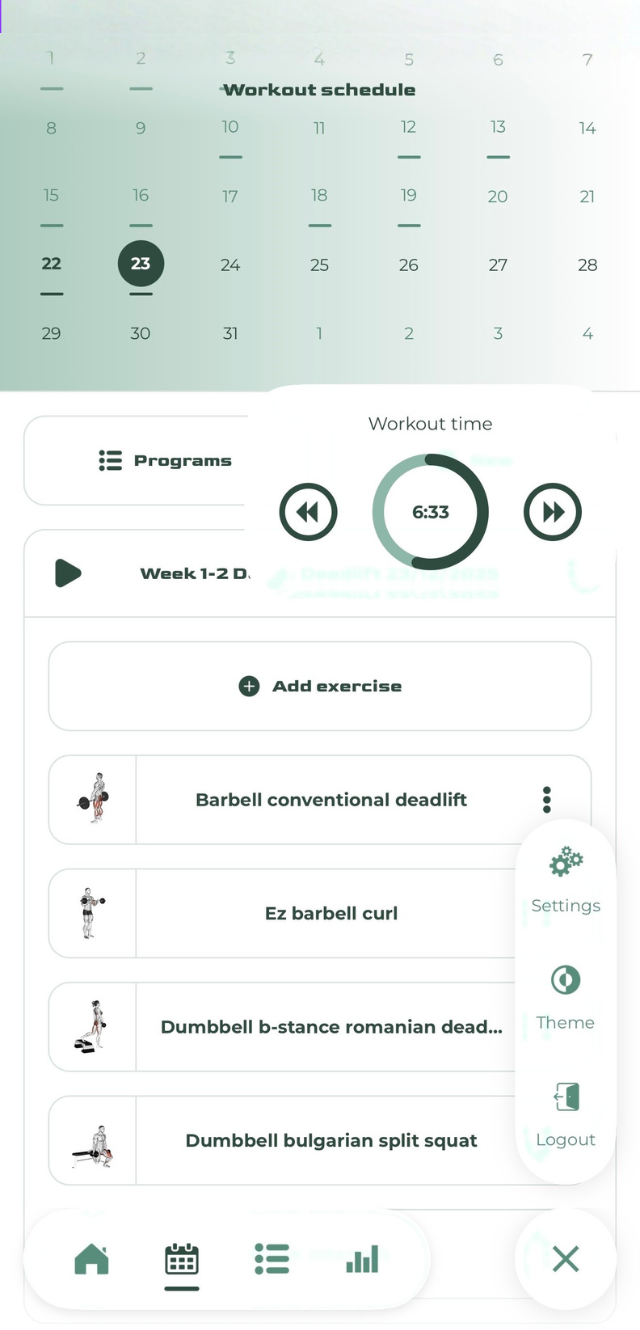
Virtus Athlete home screen with the week's scheduled workouts and progress summary

Frequently Asked Questions (FAQ)

How long does each session take?
Chest, back and delts run 60 to 75 minutes. Arms and legs run 75 to 90 because of the exercise count.
Eleven exercises for arms. Is that not too much?
It is a lot, and it is one day a week. Arms get trained once and recover for six days, which is what makes the volume survivable. If it is too much for you, cut the last triceps and last biceps movement rather than cutting sets everywhere.
Can I cut exercises?
Yes. Cut from the end of a session rather than from the start: the first movements are the ones the session is built on. Keep at least four for a big muscle group.
Why do chest and arms use pyramids and the rest use rep ranges?
Because they are different jobs. The pyramid lets you push a heavier top set on a movement you can safely add weight to alone, and the rep range gives a measurable rule to a session with too many exercises to manage by feel. Do not convert one into the other.
Can I swap exercises?
Yes, for anything training the same muscle with the equipment you have. Keep the set count and the rep prescription, because that is where the volume lives.
Should I train to failure?
On the last set of each exercise, close to it. On the earlier sets, one or two reps short. With this many exercises per session, taking every set to failure means the last four movements are junk.
What if I only have four days?
Fold delts into chest day and run chest and delts, arms, back, legs. It is a longer first session and a workable four day week.
Do I need to do all fourteen leg exercises?
That is the session as written. If you cannot finish it, cut the single leg deadlift, the abductor and the adductor first: they are the three least central to the day.

Related Articles

Track This Program

Build unlimited programs, log every set, and track your progress over time. Free on iOS & Android.