Back to BlogPrograms

How to run the Ice Cream Fitness 5×5 program

2026-08-1111 min read

Written by Hamza J

How to run the Ice Cream Fitness 5×5 program
Contents

Based on Jason Blaha's Ice Cream Fitness 5×5 novice program, with some minor adaptations.

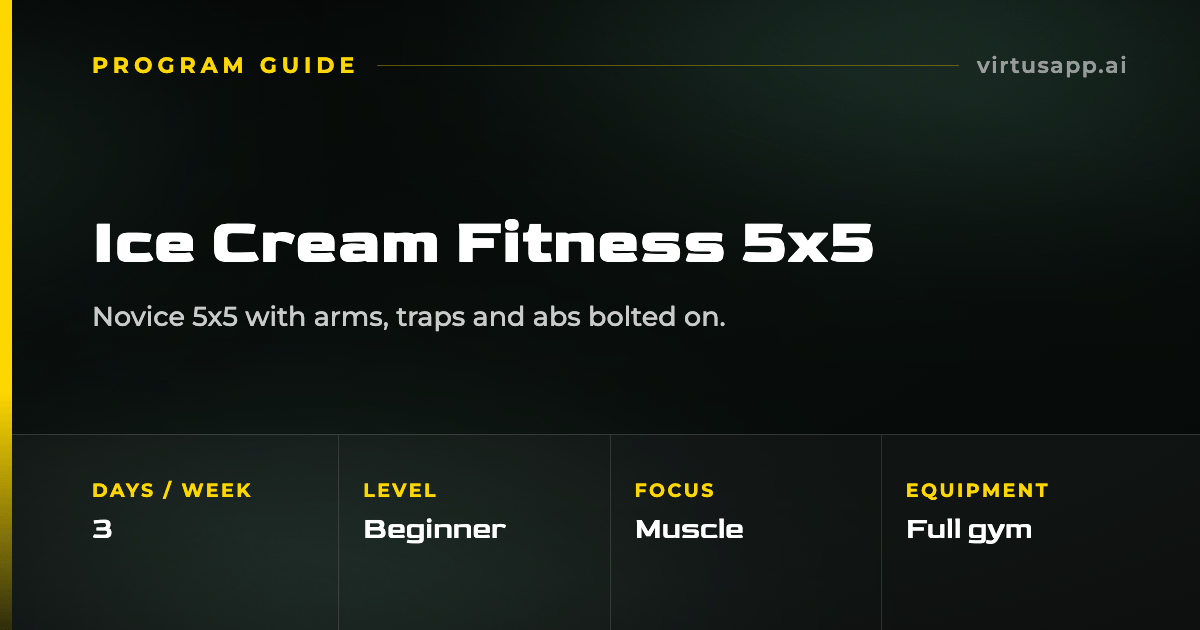
A novice program that keeps the classic 5×5 compound base for strength and stacks bodybuilding accessories on top. Two alternating full body workouts, 3 days per week, linear progression on the barbell lifts plus direct work for arms, traps, lower back, and abs. Designed to run for 12 weeks.

Who Is This Program For?

Ice Cream Fitness 5×5 (ICF) is for new lifters who want strength and a balanced physique at the same time. Jason Blaha built it as his answer to StrongLifts and Starting Strength: the same proven 5×5 compound engine, but with the accessory work those programs leave out. He describes it as a novice bodybuilding program.

The program focuses on:

  • Compound base: squat, bench, deadlift, press, and row drive the progress
  • Direct accessory work: curls, triceps, shrugs, lower back, and abs every session
  • Linear progression: add weight every session on the main lifts while you can
  • Higher volume: expect sessions of around 90 minutes, longer than minimalist 5×5 programs

If StrongLifts feels too bare-bones and you want your arms and abs trained from day one, this is the program.

Program Structure

A/B Alternating Workouts

The program uses two workouts that alternate across 3 training days per week.

Workout A:

ExerciseSets × Reps
Squat5×5
Bench Press5×5
Bent-Over Row5×5
Barbell Shrugs3×8
Tricep Extensions3×8
Straight Bar or Incline Curls3×8
Hyperextensions (with plate)2×10
Cable Crunches3×10

Workout B:

ExerciseSets × Reps
Squat5×5
Deadlift1×5
Standing Press5×5
Bent-Over Row (10% lighter than Workout A)5×5
Close Grip Bench Press3×8
Straight Bar or Incline Curls3×8
Cable Crunches3×10

Why Deadlift Is 1×5

Blaha programs the deadlift at 1×5 deliberately: it is extremely taxing on the central nervous system, and you are already squatting 5×5 in the same session. In his words, mess around with more heavy deadlift volume and you will get hurt.

The Lighter Row in Workout B

The bent-over row appears in both workouts, but in Workout B you use 10% less weight than your Workout A row. That keeps the extra rowing volume from interfering with recovery on a day that already has deadlifts.

Allowed Substitutions

  • Hyperextensions: good mornings or cable pull-throughs
  • Close grip bench press: dips
  • Squat: box squats are acceptable for lifters with knee issues
  • Abs: additional ab work on rest days is acceptable

Weekly Schedule

The workouts alternate in an A/B pattern across each week:

Odd Weeks (1, 3, 5...):

  • Day 1: Workout A
  • Day 2: Workout B
  • Day 3: Workout A

Even Weeks (2, 4, 6...):

  • Day 1: Workout B
  • Day 2: Workout A
  • Day 3: Workout B

Train 3 days per week with at least one rest day between sessions. A typical schedule is Monday / Wednesday / Friday.

Progression: How Weights Increase

ICF uses linear progression on the main barbell lifts, meaning you add weight every session.

ExerciseWeight AddedFrequency
Squat+2.5 kg (5 lbs)Every session
Bench Press+2.5 kg (5 lbs)Every session it appears
Standing Press+2.5 kg (5 lbs)Every session it appears
Bent-Over Row+2.5 kg (5 lbs)Every session (Workout B stays 10% lighter)
Deadlift+2.5 kg (5 lbs)Every session it appears
Close Grip Bench Press+2.5 kg (5 lbs)When all reps are completed

The weight added is to the total bar weight, not per side.

Accessories (curls, tricep extensions, shrugs, hyperextensions, cable crunches): progress these by feel, not on a fixed schedule. When all sets and reps are completed with good form and the weight feels manageable, add the smallest increment available.

The Cutting Variation

If you run ICF in a caloric deficit, Blaha prescribes a reduced version:

  • Main lifts drop from 5×5 to 3×5
  • Accessories drop from 3×8 to 2×8
  • Progress every other session instead of every session
Get Your Form Right First

Everything below assumes your form is already solid. Finding your working weight, adding weight, chasing reps, all of it only works if you can perform the lift correctly. While your form is not locked in, that is your only job. Make good form the goal of every set, not the weight on the bar. Drilling the movement with an empty bar beats loading plates onto a lift you cannot control yet.

To learn, don't hesitate to search Google and YouTube (there is a lot of good free material) and record yourself from the side to compare against a proper demonstration. In general, good form means a full controlled range of motion, a braced neutral spine, no bouncing or momentum, a consistent setup every rep, and ending the set when technique breaks down rather than grinding sloppy reps.

Finding Your Starting Weights

If you don't know your starting weights:

  1. Start with just the empty barbell (20 kg / 45 lbs)
  2. Perform 5 reps
  3. Add 5-10 kg (10-20 lbs)
  4. Perform another set of 5 reps
  5. Repeat until bar speed noticeably slows or form starts to break down
  6. Use that weight as your starting weight

For the deadlift and bent-over row, start with 30-45 kg (65-95 lbs) since these exercises require plates to reach proper bar height. For accessories, pick a weight you can complete all sets and reps with while staying 2-3 reps away from failure.

It's better to start too light than too heavy. The linear progression will catch up quickly.

Warming Up

Before each main exercise, perform 3-4 warm-up sets with increasing weight. This prepares your joints and muscles for the working weight and lets you practice the movement pattern.

SetWeightRepsRest
1~40% of working weight545 seconds
2~60% of working weight360 seconds
3~80% of working weight260 seconds
Work sets100%5×53-5 minutes

Example: If your working weight for squat is 80 kg:

  • Set 1: 30 kg × 5
  • Set 2: 47.5 kg × 3
  • Set 3: 62.5 kg × 2
  • Work sets: 80 kg × 5×5

Warm-up sets should feel easy. They are not work sets. Accessories don't need dedicated warm-up sets since the muscles are already warm from the main lifts.

Rest Times

Exercise TypeRest Period
5×5 main lifts3-5 minutes
3×8 and higher rep accessories1-2 minutes

Take the full rest on the main lifts, especially squats. Rushing rest periods leads to missed reps, and missed reps stall the progression. Expect the full session to take about 90 minutes.

When You Fail Reps

Blaha's failure protocol is simple and exact:

  1. Fail a rep or set: repeat that same weight during the next workout
  2. Fail again the next workout: lower the weight by 10% and continue from there
  3. Round reset weights down to the nearest increment

Example:

Bench stuck at 70 kg for 2 consecutive sessions:
  New weight: 70 × 0.90 = 63 kg (round down to nearest increment)
  Progress from there, adding 2.5 kg per session

Each exercise resets independently, so a stall on the bench press doesn't affect your squat weight.

Before blaming the program, check your recovery: sleep 7-9 hours, eat enough calories (ICF is built to be run in a surplus), and get 1.5-2.2 g of protein per kg of bodyweight (0.7-1 g per lb).

Program Duration

This program is designed to run for 12 weeks (12 cycles of 3 workouts each, totaling 36 sessions).

Why 12 weeks?

  • Linear progression stalls for most lifters within this timeframe
  • By 12 weeks you'll have built a solid strength base plus visible accessory-driven muscle
  • Blaha's own guidance: run it until your progress has clearly stalled, then move on

Run Ice Cream Fitness 5×5 on Virtus Athlete

Virtus Athlete fully integrates Ice Cream Fitness 5×5, handling the linear progression, workout alternation, and the 10% lighter Workout B row for you. Just enter your starting weights and start training.

Free on iOS and Android.

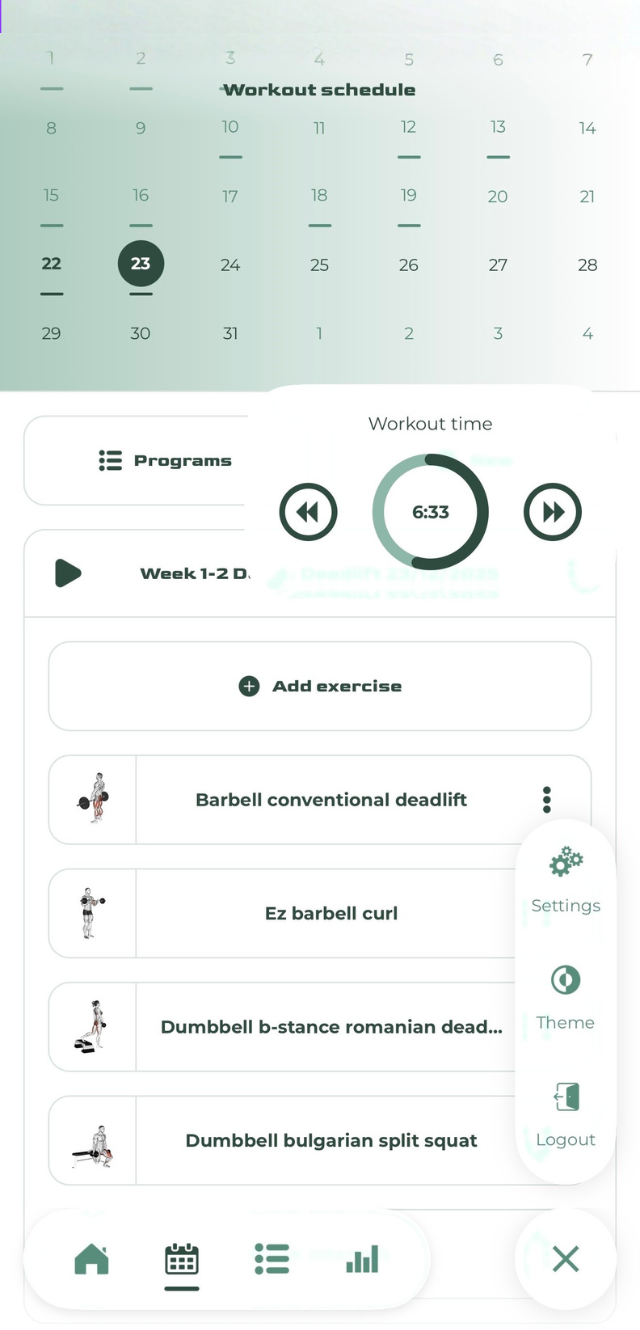
Virtus Athlete home screen with the week's scheduled workouts and progress summary

Frequently Asked Questions (FAQ)

How long does one full run take?
With 12 weeks at 3 sessions per week, expect 36 total workouts over ~3 months. If you're still progressing at 12 weeks, keep going until you stall.
How is ICF different from StrongLifts 5×5?
The compound engine is nearly identical (5×5 squat, bench, press, row, 1×5 deadlift). ICF adds direct accessory work every session: curls, triceps, shrugs, lower back, and abs. The tradeoff is longer workouts, about 90 minutes.
Why is the row 10% lighter in Workout B?
Workout B already contains the deadlift. The lighter row keeps rowing frequency high without cutting into recovery on the heaviest pulling day.
Can I swap exercises?
The main barbell lifts stay as-is. For accessories: good mornings or cable pull-throughs can replace hyperextensions, dips can replace close grip bench, and box squats are acceptable if you have knee issues.
Should I run this while cutting?
Yes, with the reduced version: 3×5 on main lifts, 2×8 on accessories, progressing every other session instead of every session.
What happens if I miss a workout?
Pick up where you left off. Don't try to make up missed sessions by doubling up.
How do I enter my starting weights?
Enter the weight you can comfortably lift for 5 reps with good form. If unsure, use the empty barbell method described above. The program handles all progression from there.
What happens after 12 weeks?
If you've stalled and deloaded on multiple lifts, transition to an intermediate program with weekly progression, such as 5/3/1 or a periodized routine.

Related Articles

Track This Program

Build unlimited programs, log every set, and track your progress over time. Free on iOS & Android.