Back to BlogPrograms

How to run the Hybrid Calisthenics routine

2026-08-1113 min read

Written by Hamza J

How to run the Hybrid Calisthenics routine
Contents

Based on Hampton Liu's Hybrid Calisthenics routine, with some minor adaptations.

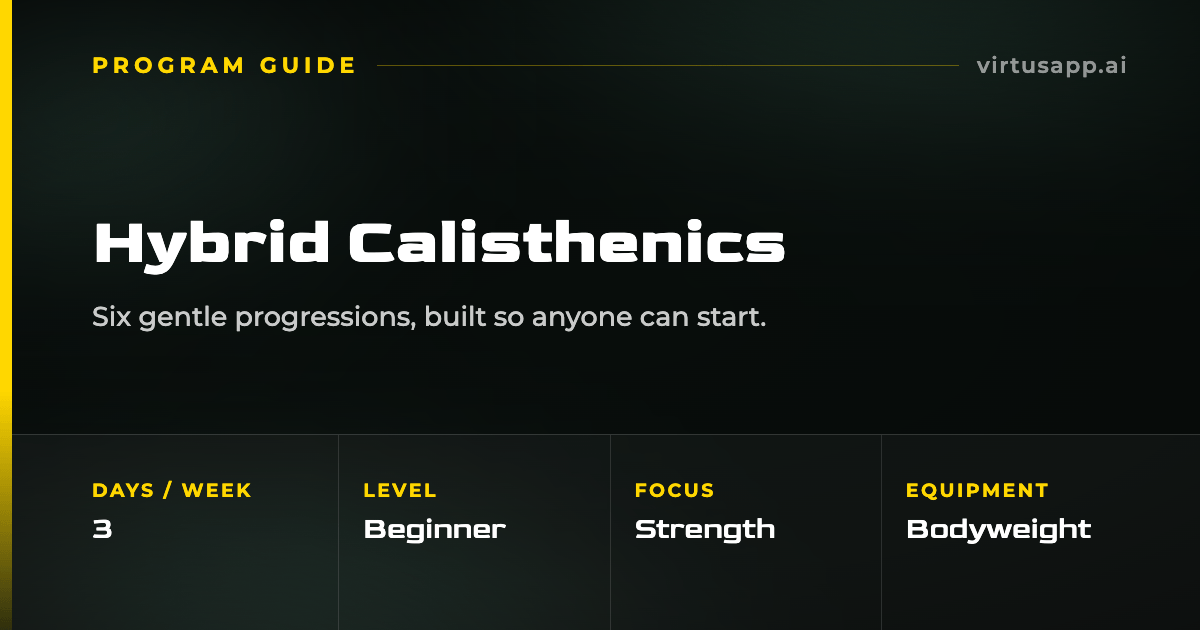
A full bodyweight training system built on six exercise families, each with a step-by-step progression path from the gentlest possible variation to an advanced skill. Two exercises per day, six days per week, and every step has a clear rep Standard that tells you exactly when to move up. The routine is provided free of charge so that it may help as many people as possible.

Who Is This Program For?

Hybrid Calisthenics is famous for meeting people exactly where they are. The first step of every path is doable by almost anyone, including complete beginners, overweight beginners, and people coming back from long breaks.

The program focuses on:

  • Accessibility: every path starts with a variation almost anybody can perform safely
  • Short daily sessions: just two exercise families per day, 2-3 sets each
  • Clear standards: each step has a rep target that tells you when to advance
  • No cost, ever: the routine, videos, and guides are free for everyone

If you want a sustainable, joint-friendly routine you can run for life with a pull-up bar and a few household objects, this is it.

Program Structure

The Six Exercise Families

FamilyMovement PatternFinal Step
PushupsHorizontal pushAdvanced One-Arm Pushups
PullupsPullOne-Arm Pullups
SquatsLower body pushOne-Leg Squats
Leg RaisesCore (hip flexion)Toe to Bars
BridgesPosterior chain and spineStand to Stand Bridges
TwistsRotation and mobilityFull Twists

Weekly Schedule (Hybrid Routine 2.0)

Each day pairs two families, 2-3 sets per exercise, and each pair comes around twice a week:

DayExercises
MondayPushups, Leg Raises
TuesdayPullups, Squats
WednesdayBridges, Twists
ThursdayPushups, Leg Raises
FridayPullups, Squats
SaturdayBridges, Twists
SundayRest and stretching

If six days is too much for your schedule or recovery, the legacy Solid Start layout (3 training days per week) is an accepted alternative. The sessions are short by design, so most people can fit the 2.0 schedule in.

The Progression Paths

Train the hardest step you can perform safely with good form. Each step lists its Standard: the sets and reps that graduate you to the next step. Where a step says "both sides", perform the sets on each side.

Pushup Path

StepExerciseStandard
1Wall Pushups3 sets of 50
2Incline Pushups3 sets of 40
3Advanced Incline Pushups3 sets of 35
4Knee Pushups3 sets of 30
5Full Pushups3 sets of 25
6Narrow Pushups3 sets of 20
7Side-Staggered Pushups2 sets of 20 (both sides)
8Archer Pushups2 sets of 12 (both sides)
9Sliding One-Arm Pushups2 sets of 12 (both sides)
10One-Arm Pushups2 sets of 9 (both sides)
11Advanced One-Arm Pushups2 sets of 9 (both sides)

Pullup Path

StepExerciseStandard
1Wall Pullups3 sets of 50
2Horizontal Pullups3 sets of 30
3Advanced Horizontal Pullups3 sets of 25
4Jackknife Pullups3 sets of 20
5Full Pullups3 sets of 12
6Narrow Pullups3 sets of 9
7One Hand Pullups2 sets of 9 (both sides)
8Advanced One Hand Pullups2 sets of 9 (both sides)
9Archer Pullups2 sets of 9 (both sides)
10One-Arm Pullups2 sets of 6

Squat Path

StepExerciseStandard
1Jackknife Squats3 sets of 35
2Assisted Squats3 sets of 30
3Half Squats2 sets of 50
4Full Squats2 sets of 30
5Narrow Squats2 sets of 30
6Side Staggered Squats2 sets of 20 (both sides)
7Front Staggered Squats2 sets of 15 (both sides)
8Assisted One-Leg Squats2 sets of 12 (both sides)
9One-Leg Chair Squats2 sets of 12 (both sides)
10One-Leg Squats2 sets of 12 (both sides)

Leg Raise Path

StepExerciseStandard
1Knee Raises2 sets of 30
2Advanced Knee Raises2 sets of 30
3Alternating Leg Raises2 sets of 25
4Full Leg Raises2 sets of 25
5Tuck Plow Raises2 sets of 20
6Plow Raises2 sets of 20
7Hanging Knee Raises2 sets of 15
8Advanced Hanging Knee Raises2 sets of 15
9Hanging Leg Raises2 sets of 25
10Toe to Bars2 sets of 25

Bridge Path

StepExerciseStandard
1Glute Bridges3 sets of 50
2Straight Bridges3 sets of 30
3Wall Bridges3 sets of 30
4Incline Bridges2 sets of 25
5Head Bridges2 sets of 25
6Full Bridges2 sets of 15
7Wheel Bridges2 sets of 15
8Tap Bridges2 sets of 30 taps (per side, alternating)
9Wall Walking Bridges2 sets of 10
10Stand to Stand Bridges2 sets of 5

The bridge path is the one where staying put is explicitly fine. If deep back bending does not agree with you, plateauing at wall bridges is an accepted long-term option.

Twist Path

StepExerciseStandard
1Straight Leg Twists3 holds of 60 seconds (both sides)
2Bent Leg Twists3 holds of 60 seconds (both sides)
3Full Twists3 holds of 60 seconds (both sides)

Twists are a mobility progression. Twist as hard as you safely can rather than relaxing into the hold.

Progression Rules

  • Each session, train the hardest step you can perform safely for 2-3 sets
  • When you can complete the Standard for your step with good form, move to the next step on your next session
  • After moving up, your reps will drop. That is expected, build them back toward the new Standard
  • Reps only count with a full, controlled range of motion. Half reps do not advance you
  • There is no deadline. Moving up a step every few weeks is excellent progress

Get Your Form Right First

Everything below assumes your form is already solid. Finding your working weight, adding weight, chasing reps, all of it only works if you can perform the lift correctly. While your form is not locked in, that is your only job. Make good form the goal of every set, not the weight on the bar. Drilling the movement with an empty bar beats loading plates onto a lift you cannot control yet.

To learn, don't hesitate to search Google and YouTube (there is a lot of good free material) and record yourself from the side to compare against a proper demonstration. In general, good form means a full controlled range of motion, a braced neutral spine, no bouncing or momentum, a consistent setup every rep, and ending the set when technique breaks down rather than grinding sloppy reps.

Finding Your Starting Step

For each of the six paths:

  1. Watch the exercise videos and start at step 1
  2. If you can comfortably perform the step's Standard with clean form, move up a step and test again
  3. Your starting step is the one where you can do solid sets but cannot yet hit the Standard
  4. When in doubt, start a step lower. The gentle start is the entire philosophy of this routine

There is no shame in wall pushups or assisted squats. They are the on-ramp that makes everything after them possible.

Warming Up

Before each session:

  1. Raise your temperature: run in place or do jumping jacks for 30-60 seconds
  2. Rehearse the movement: do 1-2 warm-up sets of an easier variation of the exercise you are about to train, at about 50% of your maximum reps

Example: if you are training full pushups, a set of knee pushups at half your usual rep count is a perfect warm-up set.

Rest Times

SituationRest Period
Between sets2-3 minutes
Between the two exercises5 minutes

Take as much rest as you need to complete your sets with good form. The sessions are short, so there is no reason to rush them.

Plateaus

If you are stuck below a Standard for weeks:

  • Check recovery first: sleep, food, and stress decide progress as much as training does
  • Add reps gradually: getting one more rep per set each week is real progress toward the Standard
  • Drop back one step for extra volume, then return
  • Stay put when it is wise: some steps (like wall bridges) are explicitly fine to plateau on if the harder variations do not suit your body

The routine has no clock. A slow climb is still a climb.

Program Duration

Hybrid Calisthenics is open-ended, designed to be run for life.

  • Beginners typically spend weeks per step in the early paths
  • The advanced steps (one-arm pushups, one-arm pullups, stand-to-stand bridges) are multi-year goals
  • There is nothing to finish. When you top out a path, you keep training its final step, or explore the site's Pure Strength and Bodyweight Muscle variants

Progress is measured in Standards reached, not weeks completed.

Run Hybrid Calisthenics on Virtus Athlete

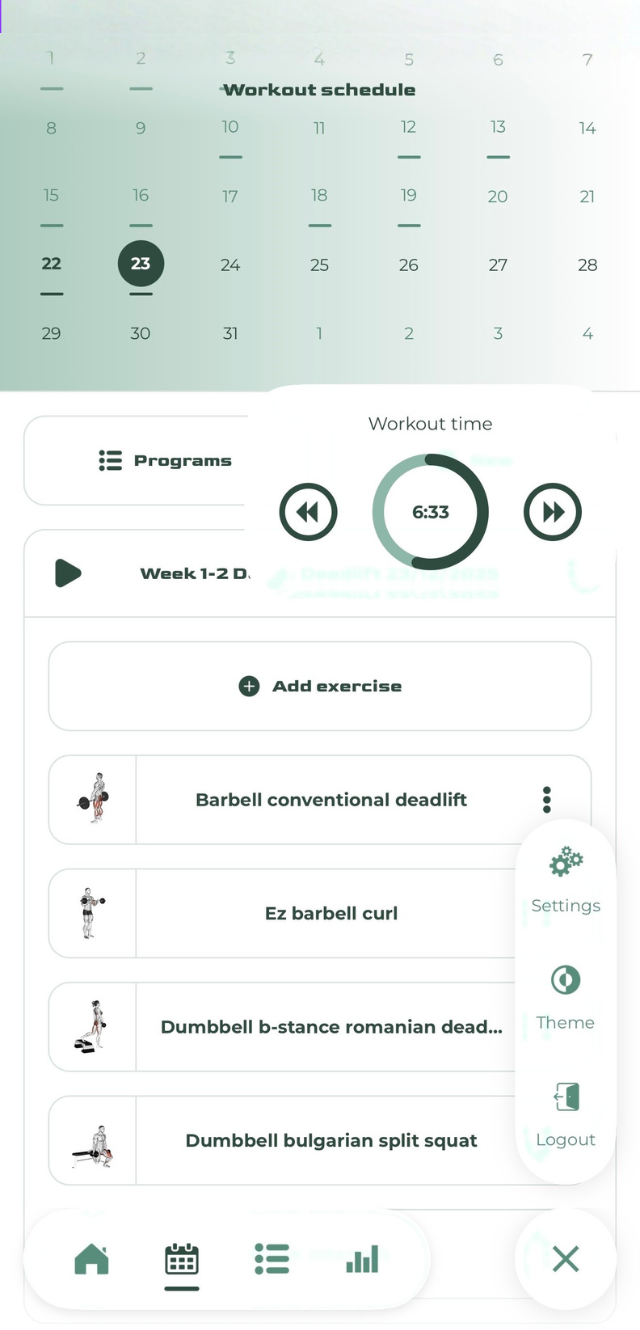
Virtus Athlete fully integrates the Hybrid Calisthenics routine, tracking your step on every path and each step's Standard for you. Just pick your starting steps and start training.

Free on iOS and Android.

Virtus Athlete home screen with the week's scheduled workouts and progress summary

Frequently Asked Questions (FAQ)

How long does one full run take?
There is no fixed end. Sessions take well under an hour, six days per week. Early steps take weeks each, and the final steps of each path are multi-year goals. The routine is built to be a lifetime practice, not a program with a finish line.
Is it really free?
Yes. The routine, the videos, and the guides are provided free of charge so that they may help as many people as possible. There is nothing to buy to run the full program.
What equipment do I need?
A pull-up bar for the pullup and hanging leg raise steps, plus household objects: a wall, a sturdy table or counter for inclines and horizontal pullups, and a chair for assisted work.
I'm very out of shape. Can I start this?
Yes. That is the routine's specialty. Wall pushups, jackknife squats, and knee raises are chosen precisely so that almost anyone can begin safely, and the twists and bridges rebuild mobility as you go.
Can I train only 3 days per week?
Yes. Use the legacy Solid Start layout with three training days. Progress will be slower than the 6-day schedule but the progression rules stay identical.
What happens if I miss a day?
Pick up where you left off. Each pair of exercises comes around twice a week, so a missed day costs little. Don't double up sessions to catch up.

Related Articles

Track This Program

Build unlimited programs, log every set, and track your progress over time. Free on iOS & Android.