Back to BlogPrograms

How to run the GZCL General Gainz Bodybuilding program

2026-08-1112 min read

Written by Hamza J

How to run the GZCL General Gainz Bodybuilding program
Contents

Based on Cody LeFever's General Gainz Body Building post, with some minor adaptations.

The General Gainz framework pointed at size instead of strength. It deletes the heavy tier entirely, splits the week by body part, and spends everything it saved on volume: eight exercises a day, run as supersets, at 139 sets a week. It is what the author ran himself during a year in which he put on 21 lbs at roughly 3% more bodyfat.

Who Is This Program For?

GGBB is for the intermediate to advanced lifter whose goal is size and who has the recovery to spend.

It suits you if:

  • You already understand the General Gainz find and extend cycle
  • You have at least a year of consistent training behind you
  • You can give four sessions of ninety minutes a week
  • Your arms and shoulders are what you actually want to grow, because that is where this program aims

It does not suit someone chasing a squat, bench and deadlift total. Nothing here goes heavier than a six rep max, and that is not an oversight.

What Changed From General Gainz

General GainzGGBB
SplitUpper/lower by main liftBody part
T1 (heavy)One a day, 3 to 6 repsNone at all
T2One a dayThree a day
T3Two a dayFive a day
StructureStraight setsT2/T3 supersets
Weekly sets~50139

Deleting T1 is the whole idea. The heavy tier is where strength comes from and where most of the fatigue comes from too. GGBB spends that recovery on three more T2s and three more T3s instead.

Program Structure

4 Training Days, Body Part Split

DayBody Part
Day 1Legs and Abs
Day 2Shoulders
Day 3Back
Day 4Arms

Each day is eight exercises arranged as four supersets: a T2 paired with a T3, four times. You rest about ten seconds between the T2 and its T3, then take the full rest before the next pair.

That pairing is why the sessions fit in ninety minutes at all. Doing them as straight sets adds half an hour.

Day 1: Legs and Abs

ExerciseTierSets × Reps
Safety Squat Bar SquatT26RM + 4 × 3
Ab WheelT34 × 15-20
Romanian DeadliftT26RM + 4 × 3
Cable CrunchT34 × 15-20
Leg PressT26RM + 4 × 3
Seated Leg CurlT34 × 15-20
Standing Calf RaiseT34 × 15-20
Cable TwistT34 × 15-20

Day 2: Shoulders

ExerciseTierSets × Reps
Behind The Neck PressT26RM + 4 × 3
Reverse FlyT34 × 15-20
Incline Bench PressT26RM + 4 × 3
Lateral Raise (cable)T34 × 15-20
Chest DipT26RM + 4 × 3
Front RaiseT34 × 15-20
Push UpT34 × 15-20
Lateral Raise (dumbbell)T34 × 15-20

Two lateral raise variations in one session is not a mistake. Side delts are the point of this day.

Day 3: Back

ExerciseTierSets × Reps
CleanT26RM + 4 × 3
Pull UpT34 × 15-20
Bent Over RowT26RM + 4 × 3
Lat PulldownT34 × 15-20
Seated RowT26RM + 4 × 3
Dumbbell Shoulder PressT34 × 15-20
One Arm RowT34 × 15-20
ShrugT34 × 15-20

Day 4: Arms

ExerciseTierSets × Reps
Bicep Curl (EZ bar)T26RM + 4 × 3
Triceps PushdownT34 × 15-20
Triceps Extension (dumbbell)T26RM + 4 × 3
Bicep Curl (cable)T34 × 15-20
Bicep Curl (band)T34 × 15-20
Triceps Extension (band)T34 × 15-20
Hammer CurlT34 × 15-20
SkullcrusherT34 × 15-20

Three biceps and three triceps movements plus a T2 for each. This is the day the program exists for.

Progression: Two Rules

T2: Find and Extend

  1. Find one set inside 6 to 10 reps at this weight
  2. Extend with four half sets at the same weight, doubling the volume:
    10 reps on the find set -> 4 × 5 after it
    6 reps on the find set  -> 4 × 3 after it
    
  3. If the session felt easy, add up to two more extension sets. That is your call.
  4. Next session, hold: repeat exactly
  5. The session after, push: go for one more rep

The weight moves when you reach 10 reps on the find set with every extension set completed. Add 5 kg / 10 lbs and drop back to a 6 rep target.

T3: Max Rep Sets

One set of 15 to 20, then three more at the same weight, each taken as far as your form holds.

The weight moves when you actually PERFORM 20 or more on every set. Not when you are prescribed twenty, when you do twenty. Add 2.5 kg / 5 lbs.

Falling short on the third and fourth set is expected and is not a failure. That is what the volume is for.

Get Your Form Right First

Everything below assumes your form is already solid. Finding your working weight, adding weight, chasing reps, all of it only works if you can perform the lift correctly. While your form is not locked in, that is your only job. Make good form the goal of every set, not the weight on the bar. Drilling the movement with an empty bar beats loading plates onto a lift you cannot control yet.

To learn, don't hesitate to search Google and YouTube (there is a lot of good free material) and record yourself from the side to compare against a proper demonstration. In general, good form means a full controlled range of motion, a braced neutral spine, no bouncing or momentum, a consistent setup every rep, and ending the set when technique breaks down rather than grinding sloppy reps.

Finding Your Starting Weights

General Gainz names a weight by the rep max it represents rather than by a percentage, so you enter weights directly.

For a T2, enter the weight you can take for 6 clean reps. Not your best six, a six you are sure of.

For a T3, enter the weight you can take for 15 clean reps.

If you have to guess, guess low on both. Every T2 in this program has four extension sets behind the find set, and a weight that only just gives you six reps gives you nothing afterwards.

Warming Up

TierWarm-up
The first T2 of the session2 light sets
Later T2s1 light set, since the pattern is warm
T3None, the first set is at 15 to 20 reps

Days with a barbell T2 in a new pattern, the clean on back day above all, need a real ramp. Everything else in this program is at a rep count that warms itself.

Rest Times

SituationRest
Between a T2 and its paired T310 seconds
After the T3, before the next pair2 minutes
Between T2 extension sets1 to 2 minutes

The ten seconds is the point of the superset. The T2 and the T3 in a pair do not compete with each other, so pairing them buys density rather than costing performance.

Managing the Volume

139 sets a week is a lot and the author says so himself. Start conservatively and add volume over time:

  • Week one, cut the last T3 pair from each day. That is six exercises a session instead of eight
  • Add the pairs back once you are recovering between sessions
  • Cut them again the moment you are not

The T3 tier is the cheapest thing to remove and the first thing to go. Do not cut the T2 extension sets to save time, because they are what makes the T2 worth doing.

When Things Go Wrong

If the third and fourth T3 sets are collapsing to single figures, the weight is too heavy for the tier. Cut it 10%.

If you cannot finish the T2 extension sets, take one fewer rep on the find set and complete the extension instead.

If you are still sore from the last session, cut the last T3 pair rather than skipping the day.

If your arms stop growing, that is not this program's failure mode. It has six direct arm exercises. Look at food and sleep.

Program Duration

There is no block length and no scheduled deload. GGBB runs until it stops working.

Take a light week when several exercises stall at once: same sessions, two thirds of the weight, nothing near failure. Most people run a size phase like this for eight to sixteen weeks before moving back to something with a heavy tier in it.

Run GGBB on Virtus Athlete

Thirty two exercises across four days, each with its own find and extend cycle or its own max rep target, is more than a notebook holds. Virtus Athlete writes the right number of extension sets for what you actually did, tracks whether today is a hold or a push, and moves each T3 the moment you genuinely perform twenty on every set.

Free on iOS and Android.

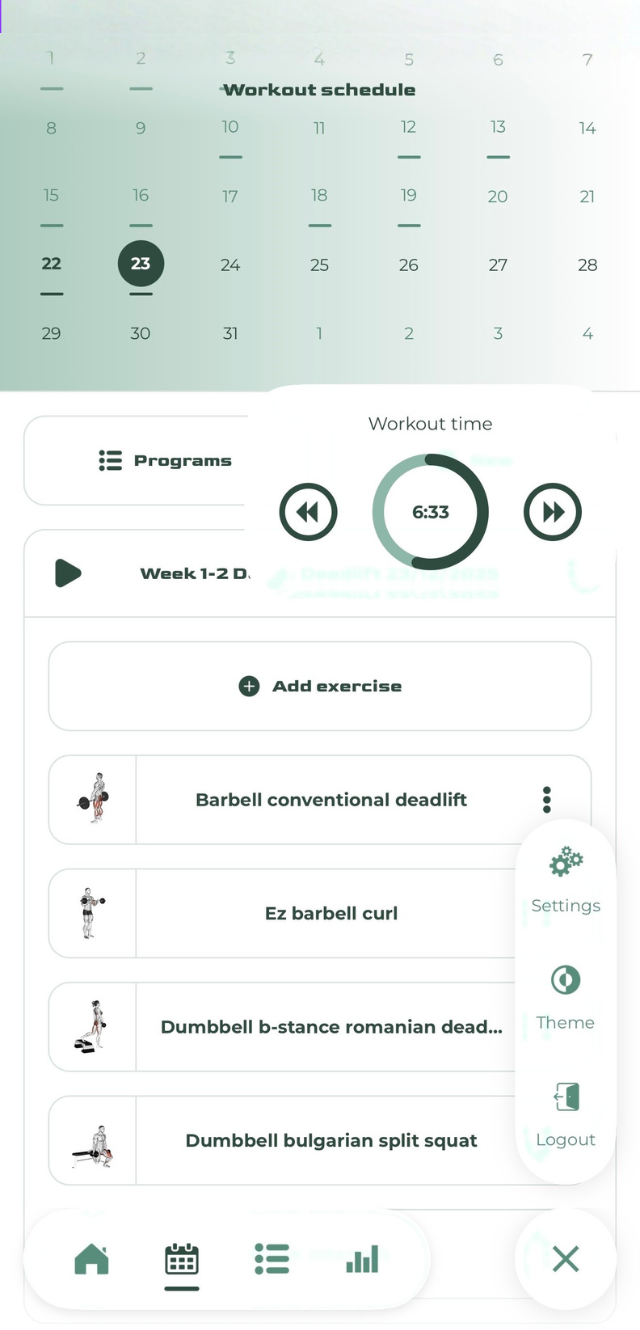
Virtus Athlete home screen with the week's scheduled workouts and progress summary

Frequently Asked Questions (FAQ)

How long is a session?
Ninety minutes or a little more. Eight exercises, four of which carry five sets.
Why is there no T1?
Because heavy work is where most of the fatigue comes from and this is a size program. Deleting it buys three more T2s and three more T3s a day, which is the trade the whole program is built on.
Can I run it with less volume?
Yes, and the author recommends it: drop the last T3 pair from each day and add it back later. Start conservatively.
What if my gym has no safety squat bar?
Use a back squat or a front squat. The bar is not the point, the pattern is.
Do I have to superset?
No, but the sessions get about half an hour longer. The pairs are chosen so the two exercises do not compete, so there is no performance cost to running them together.
Why do the T3 sets use performed reps rather than prescribed reps?
Because they are max rep sets. What you were told to do is a floor and what you actually did is the measurement, so the weight moves on the measurement.
Two lateral raise variations on the same day?
Yes. Shoulders are a lagging body part for most people and this program aims at them deliberately.
Is this a bulking program?
It is a size program, so it works best in a small surplus. The author gained 21 lbs over the year he ran it.

Related Articles

Track This Program

Build unlimited programs, log every set, and track your progress over time. Free on iOS & Android.