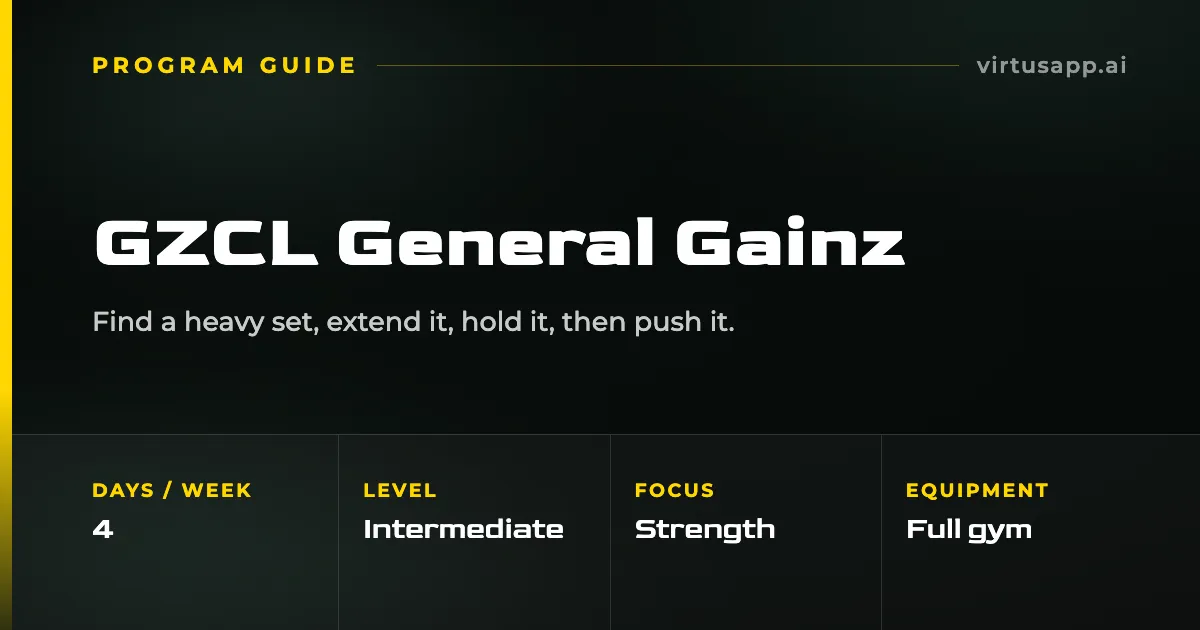
Based on Cody LeFever's General Gainz framework, with some minor adaptations.
Four days, four exercises a session, and one idea: find one hard set, back it up with sets derived from what that set actually gave you, then hold and push it over the following weeks. It is the shortest program in the GZCL family and the one that asks you to think the least while training.
General Gainz is for the intermediate lifter who has run a linear progression and wants a framework rather than a spreadsheet.
It suits you if:
- You have six to twelve months of consistent barbell training behind you
- You want four short sessions instead of four long ones
- You are comfortable taking a set close to failure and judging how hard it was
- You would rather understand a rule than follow a table
It is not a beginner program: a beginner should add weight every session while they still can, and this framework is built for the point where that stops.
The Tiers
| Tier | What it is | Range | Load |
|---|
| T1 | The main lift | 3 to 6 reps | 85% of your max |
| T2 | A supporting compound | 6 to 10 reps | 75% of your max |
| T3 | Isolation, two of them | 10+ reps | Your call |
Those percentages are not arbitrary. 85% is the weight that gives most people a 3 to 6 rep max, and 75% gives a 6 to 10. The tier IS the rep range.
This is the entire framework, and everything else in the program is an application of it.
1. Find
Take one set inside the tier's range. Not a prescribed number of reps, a range: you take the set and see what you get.
A T1 set is 3 to 6 reps. A T2 set is 6 to 10.
2. Extend
Back that set up at the same weight, with the extension derived from what you just did.
T1 extends with singles, one per rep you managed:
You got 5 reps on the find set
  -> 5 further singles at the same weight, 2 to 3 minutes apart
T2 extends with half sets that double the set's volume:
You got 10 reps on the find set
  -> 4 sets of 5 at the same weight, so 20 more reps
If the find set felt easy, add up to three more singles on a T1 or two more half sets on a T2. That is your call on the day and nothing else in the program depends on it.
3. Hold
The next session, repeat exactly. Same weight, same rep target, same extension. This is the step people skip and it is the one that makes the framework work: you are consolidating a rep target before you try to beat it.
4. Push
The session after that, go for one more rep on the find set. If you get it, the extension grows with it.
And Then the Weight Moves
Reaching the top of the range with every extension set completed adds weight and drops the rep target back to the bottom.
T1: 6 reps + 6 singles     -> add 2.5 kg / 5 lbs, back to a 3 rep target
T2: 10 reps + 4 x 5        -> add 2.5 kg / 5 lbs, back to a 6 rep target
4 Training Days
| Day | T1 | T2 | T3 | T3 |
|---|
| Squat Day | Squat | Romanian Deadlift | Seated Leg Curl | Leg Extension |
| Bench Day | Bench Press | Incline Bench Press | Seated Row | Lat Pulldown |
| Deadlift Day | Deadlift | Front Squat | Cable Crunch | Good Morning |
| Press Day | Overhead Press | Weighted Chin Up | Bicep Curl | Skullcrusher |
Four exercises a session. Sessions run 45 to 60 minutes, most of which is the T1's rest periods.
Run the four days in order with at least one rest day between sessions. Monday, Tuesday, Thursday, Friday is the usual layout.
T3: The Part With No Rules
Three sets of ten or more, taken as far as your form holds, on a weight you choose.
There is deliberately no progression rule here. Your rep counts climb as you get stronger, and when three sets of ten stops being work you add weight yourself. T3 exists to add volume to the muscles the day's main lifts use, not to be another thing to track.
| Mechanism | Where |
|---|
| The rep target climbs | Every second clean session, one rep at a time |
| The extension grows with it | Automatically, since it is derived from the find set |
| The weight climbs | Only at the top of the range with every extension completed |
| T3 climbs by itself | Your rep counts rise, and you add weight when you decide to |
Notice what is absent: there is no weekly wave, no deload week, no percentage table beyond the two starting numbers, and no test day. The framework runs until it stops working.
Everything below assumes your form is already solid. Finding your working weight, adding weight, chasing reps, all of it only works if you can perform the lift correctly. While your form is not locked in, that is your only job. Make good form the goal of every set, not the weight on the bar. Drilling the movement with an empty bar beats loading plates onto a lift you cannot control yet.
To learn, don't hesitate to search Google and YouTube (there is a lot of good free material) and record yourself from the side to compare against a proper demonstration. In general, good form means a full controlled range of motion, a braced neutral spine, no bouncing or momentum, a consistent setup every rep, and ending the set when technique breaks down rather than grinding sloppy reps.
You need a one rep max for each T1 and each T2 movement, and a working weight for each T3.
The T1 lifts you probably know. For the T2s, estimate rather than test:
- Take the heaviest weight you have used on that movement for a set of five
- Divide by 0.87, which is roughly what a five rep max is worth
Example:
You do Romanian deadlifts with 100 kg / 220 lbs for 5 reps:
  Estimated 1RM = 100 / 0.87 = 115 kg
                = 220 / 0.87 = 253, round to 250 lbs
  T2 working weight = 75% of that = 85 kg / 185 lbs
Round down. The first week should let you hit the BOTTOM of each range comfortably, because the framework spends the following weeks climbing to the top of it. Starting at a weight where you can only just make the bottom means the range has nowhere to go.
| Tier | Warm-up |
|---|
| T1 | A full ramp: empty bar, then roughly 40%, 60% and 80% of the working weight |
| T2 | Two sets, since the T1 has already warmed the pattern |
| T3 | One light set, or none |
Warm up carefully on the T1 find set. It is one set and it decides how many singles you do, so arriving at it cold costs you the whole session's volume.
| Situation | Rest |
|---|
| T1 find set, and between the singles | 3 to 5 minutes |
| T2 find set | 2 to 4 minutes |
| Between T2 extension sets | 1 to 2 minutes |
| T3 | 60 seconds |
The T1 singles need real rest. Rushing them means fewer of them, which means less volume at the weight you are trying to own.
If you miss the bottom of the range on a find set, the weight is too heavy. Cut it 5% and carry on from there.
If you cannot complete the extension sets, that is the framework telling you the find set was too greedy. Take one fewer rep on the find set next time and complete the extension instead.
If you have been at the top of the range for weeks without the weight moving, you are completing the find set but not the extension. The extension is not optional: it is what earns the increase.
If everything stalls at once, take a light week: same sessions, two thirds of the weight, no set near failure. Then pick up where you left off.
There is no block length. General Gainz is a framework rather than a program with an end date, and it runs for as long as the rep targets keep climbing.
Take a light week when several lifts stall together. When the framework stops moving even after one, swap the T2 and T3 movements for different variations and carry on, or move to a program with more structure such as The Rippler.
The framework is published in Cody LeFever's book and on his blog:
Swole at Every Height

 iOS
iOS Android