Based on Cody LeFever's GZCL Method, with some minor adaptations.
A beginner linear progression program using a 3-tier exercise system. 4 rotating workouts with linear weight increases and built-in failure protocols. Designed to run for 12 cycles.
Written by Hamza J
Based on Cody LeFever's GZCL Method, with some minor adaptations.
A beginner linear progression program using a 3-tier exercise system. 4 rotating workouts with linear weight increases and built-in failure protocols. Designed to run for 12 cycles.
GZCLP is the linear progression variant of the GZCL Method, designed for beginners and early intermediates who want a structured approach to getting stronger.
The program is built around the idea that training should be organized into tiers based on intensity and volume:
This tiered approach ensures you get heavy strength work, moderate volume work, and high-rep accessory work in every session. If you want a program that teaches you how to handle heavy weights while also building a solid base of muscle, GZCLP is an excellent starting point.
| Lift | Movement Pattern |
|---|---|
| Barbell Back Squat | Lower body push |
| Barbell Bench Press | Horizontal push |
| Barbell Standing Military Press (OHP) | Vertical push |
| Barbell Conventional Deadlift | Hip hinge |
Each workout includes one T3 accessory movement. You choose from the available options:
Lat Pulldown Slot (Days 1 & 3):
Dumbbell Row Slot (Days 2 & 4):
The program uses 4 workouts that rotate in order. Each workout contains one T1 lift, one T2 lift, and one T3 accessory:
Day 1:
| Tier | Exercise | Sets × Reps |
|---|---|---|
| T1 | Squat | 5×3+ |
| T2 | Bench Press | 3×10 |
| T3 | Lat Pulldown | 3×15+ |
Day 2:
| Tier | Exercise | Sets × Reps |
|---|---|---|
| T1 | OHP | 5×3+ |
| T2 | Deadlift | 3×10 |
| T3 | Dumbbell Row | 3×15+ |
Day 3:
| Tier | Exercise | Sets × Reps |
|---|---|---|
| T1 | Bench Press | 5×3+ |
| T2 | Squat | 3×10 |
| T3 | Lat Pulldown | 3×15+ |
Day 4:
| Tier | Exercise | Sets × Reps |
|---|---|---|
| T1 | Deadlift | 5×3+ |
| T2 | OHP | 3×10 |
| T3 | Dumbbell Row | 3×15+ |
Notice that each main lift appears as both a T1 (heavy) and T2 (moderate) movement across different days, ensuring balanced development.
T1 is the focus of the workout. You lift heavy with low reps and the last set is AMRAP (As Many Reps As Possible), leaving 1-2 reps in reserve.
Stage 1 (default): 5 sets × 3 reps (last set AMRAP 3+)
Rest: 3-5 minutes between sets.
T2 supports the T1 lift for that day. All sets are straight sets (no AMRAP). The goal is to accumulate volume at a moderate intensity.
Stage 1 (default): 3 sets × 10 reps
Rest: 2-3 minutes between sets.
T3 exercises target weak points and build muscle. Performed for 3 sets of 15+ reps, with the last set being AMRAP.
Rest: 1-1min30 between sets.
GZCLP uses linear progression, meaning you add weight every cycle (every 4 workouts).
| Exercise | Weight Added Per Cycle (kg) | Weight Added Per Cycle (lbs) |
|---|---|---|
| Squat | +5 kg | +10 lbs |
| Deadlift | +5 kg | +10 lbs |
| Bench Press | +2.5 kg | +5 lbs |
| OHP | +2.5 kg | +5 lbs |
The same increment applies to both the T1 and T2 weight for that lift.
AMRAP stands for As Many Reps As Possible. In GZCLP, the last set of T1 and T3 exercises is an AMRAP set.
How to perform AMRAP sets:
The AMRAP set serves two purposes:
GZCLP uses 4 rotating workouts. You simply do them in order regardless of the day of the week.
Recommendations:
Example 3-day schedule:
Week 1: Day 1 / Day 2 / Day 3
Week 2: Day 4 / Day 1 / Day 2
Week 3: Day 3 / Day 4 / Day 1
...and so on
One full cycle (4 workouts) takes about 1-1.5 weeks at 3 sessions per week.
| Exercise Tier | Rest Period |
|---|---|
| T1 (heavy compounds) | 3-5 minutes |
| T2 (moderate compounds) | 2-3 minutes |
| T3 (accessories) | 1-1min30 |
Take as much rest as you need within these ranges to complete your sets with good form. Heavier work requires longer rest.
Everything below assumes your form is already solid. Finding your working weight, adding weight, chasing reps, all of it only works if you can perform the lift correctly. While your form is not locked in, that is your only job. Make good form the goal of every set, not the weight on the bar. Drilling the movement with an empty bar beats loading plates onto a lift you cannot control yet.
To learn, don't hesitate to search Google and YouTube (there is a lot of good free material) and record yourself from the side to compare against a proper demonstration. In general, good form means a full controlled range of motion, a braced neutral spine, no bouncing or momentum, a consistent setup every rep, and ending the set when technique breaks down rather than grinding sloppy reps.
You need to enter separate starting weights for T1 and T2 for each of the 4 main lifts (8 values total).
Your T1 weight should be a weight you can comfortably lift for 5 sets of 3 reps with good form. If you know your 5-rep max, start with approximately 85% of your 5RM.
Your T2 weight should be a weight you can comfortably lift for 3 sets of 10 reps. This will typically be around 50-60% of your T1 weight.
It's better to start too light than too heavy. The linear progression will catch up quickly.
One of GZCLP's defining features is its built-in failure protocol. Instead of simply deloading when you stall, the program changes the rep scheme to let you keep progressing with the same weight.
When you cannot complete all reps at a given stage, move to the next stage:
Stage 1:  5×3+  (5 sets of 3 reps, last set AMRAP)
    ↓ fail
Stage 2:  6×2+  (6 sets of 2 reps, last set AMRAP)
    ↓ fail
Stage 3: 10×1+  (10 sets of 1 rep, last set AMRAP)
    ↓ fail
Test new 5RM, restart Stage 1 at 85% of new 5RM
How it works:
When you cannot complete all reps at a given stage, move to the next stage:
Stage 1: 3×10  (3 sets of 10 reps)
    ↓ fail
Stage 2: 3×8   (3 sets of 8 reps)
    ↓ fail
Stage 3: 3×6   (3 sets of 6 reps)
    ↓ fail
Restart at Stage 1, slightly heavier than the weight you were using
(the app adds 7.5 kg / 15-20 lbs, within the original's 9 kg / 20 lb cap)
How it works:
T3 exercises don't use the stage system. Simply increase the weight when you can hit 25+ reps on the AMRAP set. The app detects this automatically: hit 25+ on the last set and it adds the weight next session and resets you to 3×15.
Before each T1 exercise, perform 3-4 warm-up sets with increasing weight:
| Set | Weight | Reps | Rest |
|---|---|---|---|
| 1 | ~40% of working weight | 5 | 45 seconds |
| 2 | ~60% of working weight | 3 | 60 seconds |
| 3 | ~80% of working weight | 2 | 60 seconds |
| Work sets | 100% | As prescribed | 3-5 minutes |
T2 exercises often need fewer warm-up sets since the muscles are already warm from T1. T3 exercises typically need no warm-up beyond a light first set.
The program is configured for 12 cycles of 4 workouts each (48 total sessions). At 3-4 sessions per week, expect approximately 3-4 months of training.
However, GZCLP can be run indefinitely thanks to the stage system. When you stall, the failure protocol resets your weights and you continue progressing.
If you would like to read the original GZCL Method blog post:
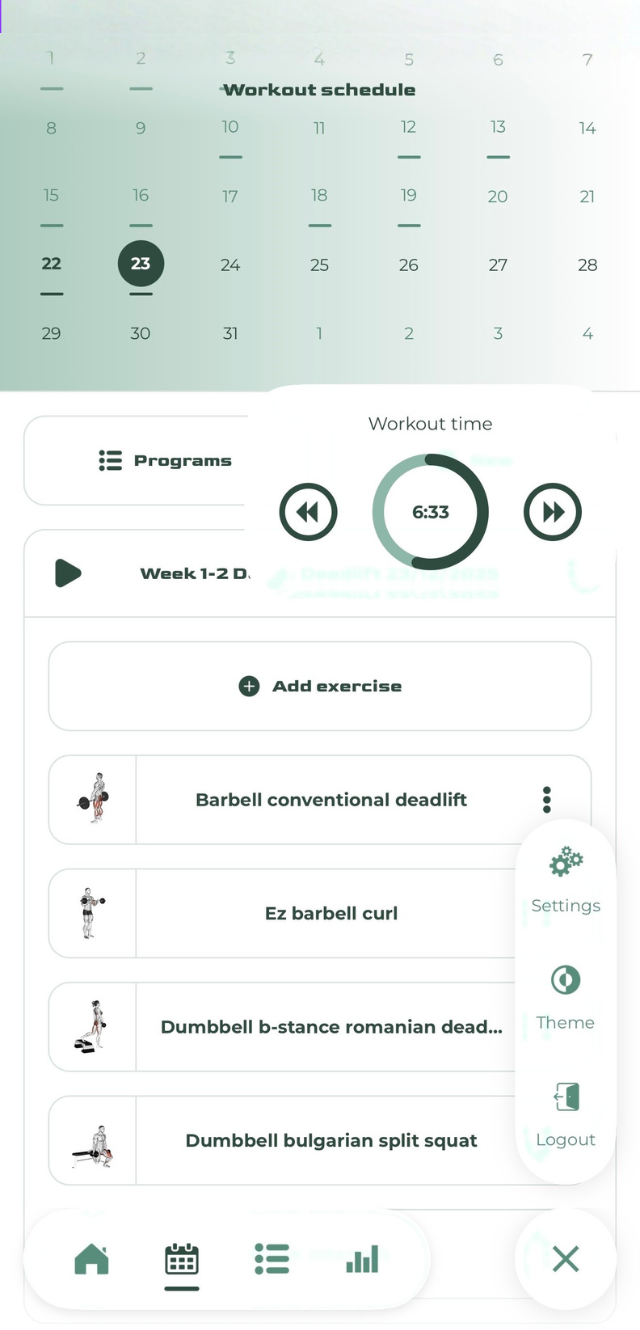
Virtus Athlete fully integrates GZCLP, handling all the linear progression, stage tracking, and T3 exercise selection for you. Just enter your T1 and T2 weights and start training.
Free on iOS and Android.
Still comparing logging apps? See the best workout tracker apps in 2026 for how the options stack up on program support like GZCLP.
Build unlimited programs, log every set, and track your progress over time. Free on iOS & Android.
 App Store
 Google Play