Back to BlogPrograms

How to run the German Volume Training program

2026-08-1112 min read

Written by Hamza J

How to run the German Volume Training program
Contents

Based on Charles Poliquin's German Volume Training program, with some minor adaptations.

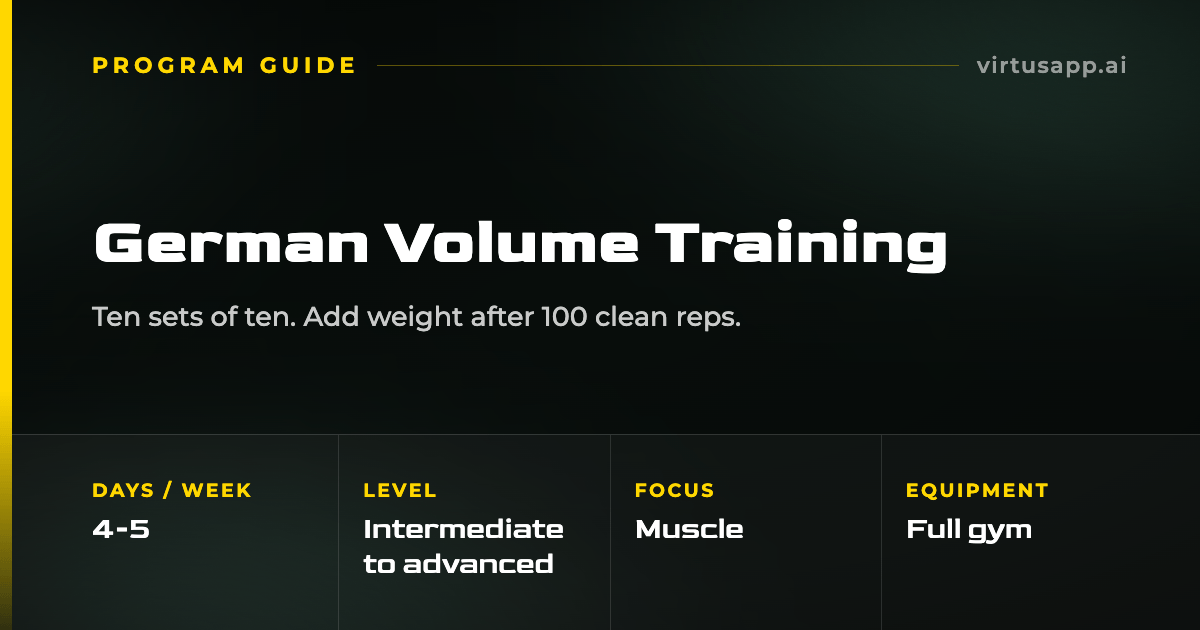
The ten sets method: one compound exercise pair per workout performed for 10 sets of 10 reps with a weight you could lift 20 times, on strict 60-90 second rests. Popularized in the 1970s by German national weightlifting coach Rolf Feser as an off-season mass builder, and brought to the modern training world by Charles Poliquin. Designed to run for 30 days per phase.

Who Is This Program For?

GVT is for intermediate lifters who want maximum muscle mass in a short, focused block. It is famous for adding size fast; gaining several kilograms of lean mass in a 6-week block is common with adequate eating. It is not a strength program: the loads are moderate, the volume is what does the damage.

The program focuses on:

  • Volume: 100 reps of one big exercise per muscle group in a single session
  • Simplicity: only 4 exercises per workout, in two supersets
  • Strict rests: 60-90 seconds, timed with a stopwatch
  • Frequency: each muscle group trained once every 5 days

If you can put your ego away, lift a "light" weight for 10 straight sets, and eat to grow, this is it.

Program Structure

The 5-Day Cycle

DayWorkout
1Chest and Back
2Legs and Abs
3Off
4Arms and Shoulders
5Off

Repeat the cycle. Each body part is trained once every 5 days. Poliquin is explicit that higher frequency ruins recovery at this volume; one session per body part every 4-5 days is plenty.

How the Supersets Work

Each workout has two exercise pairs:

  • The "A" pair (A1 and A2) is the core of the program: two antagonist compound exercises, each for 10 sets of 10. Perform one set of A1, rest 90 seconds, one set of A2, rest 90 seconds, and repeat until both exercises have 10 sets.
  • The "B" pair (B1 and B2) is supplementary work for 3 sets only, alternated with 60 second rests. Poliquin warns that doing 10 sets of the B work is a fast road to overtraining.

Day 1 - Chest and Back

ExerciseSets x RepsTempoRest
A1: Decline Dumbbell Press10 x 10402090 sec
A2: Chin-Up10 x 10402090 sec
B1: Incline Dumbbell Flye3 x 10-12302060 sec
B2: One-Arm Dumbbell Row3 x 10-12302060 sec

Day 2 - Legs and Abs

ExerciseSets x RepsTempoRest
A1: Back Squat10 x 10402090 sec
A2: Lying Leg Curl10 x 10402090 sec
B1: Low-Cable Pull-In3 x 15-20202060 sec
B2: Seated Calf Raise3 x 15-20202060 sec

Day 4 - Arms and Shoulders

ExerciseSets x RepsTempoRest
A1: Parallel Bar Dip10 x 10401090 sec
A2: Incline Hammer Curl10 x 10401090 sec
B1: Bent-Over Lateral Raise3 x 10-12202060 sec
B2: Seated Dumbbell Lateral Raise3 x 10-12202060 sec

Tempo

The four-digit tempo is seconds for: lowering, pause at bottom, lifting, pause at top. So 4020 means lower for 4 seconds and lift in 2 with no pauses. Long-range movements (squats, dips, chins, presses) use a 4-second eccentric; shorter-range curls and extensions use a 3-second eccentric. The slow lowering is half the program; rushing it turns 100 controlled reps into 100 wasted ones.

Exercise Selection

Only one exercise per body part, and it must be a compound movement that recruits a lot of muscle. Isolation exercises cannot survive 10 sets and don't deserve them. Keep the same exercises for the whole phase; the program works by mastering and progressively overloading one movement, not by variety.

Understanding the 10x10 Weight

Start with 60% of your 1RM, which is roughly the weight you could lift for 20 reps to failure in one all-out set.

Example: If your best squat is 140 kg (310 lbs), your GVT squat weight is about 84 kg (185 lbs).

That weight will feel insultingly easy for sets 1-4. By set 7 it will not. Many lifters actually feel briefly stronger around sets 8-9 as short-term neural adaptation kicks in. Never train to failure on the 10x10 work: stop each set at 10 even when more reps are there, because you must save capacity for the later sets.

Progression: The 100-Rep Rule

The progression rule is unforgiving and simple:

  • Complete all 10 sets of 10 (100 clean reps) with constant rest intervals, and only then
  • Increase the weight by 4-5% the next workout and repeat the process

If you finished set 10 with fewer than 10 reps, the weight does not change. There are no forced reps, no drop sets, and no failure training; the volume takes care of the overload. On a 100 kg (220 lbs) 10x10, the next step is 104-105 kg (about 230 lbs).

Get Your Form Right First

Everything below assumes your form is already solid. Finding your working weight, adding weight, chasing reps, all of it only works if you can perform the lift correctly. While your form is not locked in, that is your only job. Make good form the goal of every set, not the weight on the bar. Drilling the movement with an empty bar beats loading plates onto a lift you cannot control yet.

To learn, don't hesitate to search Google and YouTube (there is a lot of good free material) and record yourself from the side to compare against a proper demonstration. In general, good form means a full controlled range of motion, a braced neutral spine, no bouncing or momentum, a consistent setup every rep, and ending the set when technique breaks down rather than grinding sloppy reps.

Finding Your Starting Weights

  1. If you know your 1RM on the A exercises, take 60% of it
  2. If you don't, find a weight you could lift for 20 reps to failure, and use that
  3. When in doubt, round down. The first sets are supposed to feel easy

Examples:

  • 100 kg (220 lbs) bench 1RM: use 60 kg (130 lbs)
  • Chin-ups or dips too easy for 20 reps: add small plates to a belt; too hard: use band assistance or a machine equivalent

For the B exercises, pick a weight you can handle for the full rep range with 1-2 reps in reserve.

Warming Up

Because the working weight is only 60% of max, warm-ups are short. Before each A pair:

SetWeightRepsRest
1~50% of working weight845 seconds
2~75% of working weight560 seconds
Work sets100%10 x 1090 seconds

Rehearse the tempo during warm-ups. The B exercises need no dedicated warm-up; you will be thoroughly warm.

Rest Times

SituationRest Period
Between A1 and A2 sets (superset alternation)90 seconds
Between B1 and B2 sets60 seconds

Use a stopwatch. Poliquin is adamant about this: as fatigue builds you will unconsciously stretch the rests, and constant rest intervals are part of the overload. The short rests are also why the weight must stay humble.

Deload / Stall Protocol

GVT is self-regulating: the weight only increases after a complete 10x10, so a "stall" simply means repeating the same weight until you earn the increase. If you cannot complete the sets for three workouts in a row on the same exercise:

  • Check recovery first: sleep 7-9 hours, eat in a surplus, get 1.5-2.2 g of protein per kg of bodyweight (0.7-1 g per lb)
  • Confirm your rests are exactly 90 seconds and your tempo honest; both drifting is the usual culprit
  • If genuinely stuck, reduce the weight by 5% and rebuild

After the 30-day phase, take a 3-week transition: 4-6 sets per body part in the 6-8 rep range, before starting another intensive phase.

Program Duration

One phase is six 5-day cycles: 30 days, 18 workouts.

Why 30 days?

  • The volume is extreme; adaptation is rapid but so is the slide into overtraining
  • Poliquin prescribes six cycles, then a 3-week lower-volume phase
  • Advanced lifters can then run a second phase of 10 sets of 6 using a weight they could lift 12 times, with the same rules

Run German Volume Training on Virtus Athlete

Virtus Athlete fully integrates German Volume Training, handling the 10x10 tracking, the 100-rep progression rule, and the strict rest timers for you. Just enter your starting weights and start training.

Free on iOS and Android.

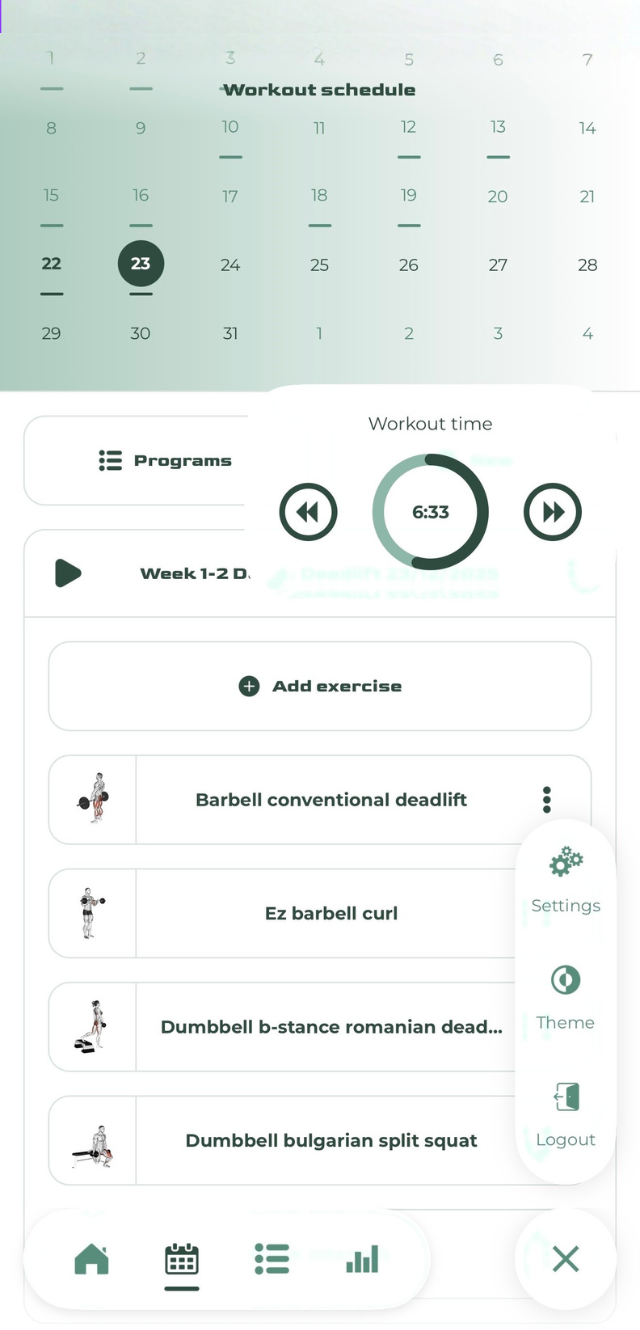
Virtus Athlete home screen with the week's scheduled workouts and progress summary

Frequently Asked Questions (FAQ)

How long does one full run take?
One phase is 30 days: six 5-day cycles, 18 workouts. With the recommended 3-week transition phase after, a full run is about 7-8 weeks.
The weight feels too light. Should I add more?
No. If you picked a true 20-rep weight, sets 7-10 will humble you. Finishing all 100 reps is the only way to earn more weight.
Should I train to failure?
Never on the 10x10 work. Stop every set at 10 reps. Failure training on top of this volume wrecks the later sets and your recovery.
Can I swap exercises?
Pick any big compound per body part that you can perform safely for 10 sets (for example, bench press instead of decline dumbbell press). Then keep it for the whole phase. No isolation exercises in the A slots.
Why train chest with back and biceps with triceps?
Antagonist supersets. While one muscle works, the opposite one recovers, which keeps quality high with short rests and cuts workout time in half.
What happens if I miss a workout?
Pick up where you left off and keep the cycle order. Don't try to make up missed sessions by doubling up.
How do I enter my starting weights?
Enter 60% of your 1RM, or the weight you could lift 20 times, for each A exercise. The program handles the 100-rep progression rule from there.
What happens after the program?
Run the 3-week transition (4-6 sets of 6-8 reps per body part), then either repeat 10x10 with your new weights or move to the advanced 10x6 phase with a 12-rep-max load.

Related Articles

Track This Program

Build unlimited programs, log every set, and track your progress over time. Free on iOS & Android.