Free weights and machines both build muscle. The dogma that one is real and the other is fake is wrong. The right question is which tool fits your goal, your experience, and your session.
This guide compares free weights and machines on the things that actually matter: muscle growth, strength, safety, learning curve, and time efficiency. Then it gives a simple rule for when to use each.

What the Research Actually Shows
Studies comparing free weights and machines for hypertrophy find very small differences when volume, intensity, and effort are matched. Free weights produce slightly more total muscle activation across stabilizing muscles. Machines produce slightly more isolation on the target muscle. Both produce comparable size gains over 8 to 12 weeks.
For strength, free weights win cleanly. Force transferred through a barbell trains the whole movement chain, including stabilizers. A machine bench press translates poorly to a barbell bench press. The reverse transfer is much better.
Free Weights: What They Are Good At
Trains stabilizers and motor coordination. The body has to balance the bar or dumbbell through space, recruiting smaller stabilizing muscles. This is part of why compound lifts drive systemic strength.
Scales infinitely with progressive overload. Add 1.25 kg plates and the bar keeps climbing. See microloading.
Transfers to real life. Lifting a heavy object off the floor in real life looks like a deadlift, not a leg press. Free-weight strength translates to functional strength.
Time efficient. One barbell or one pair of dumbbells can run 4 to 6 exercises in a single session.
Cheap and accessible. A home gym with a barbell, plates, and a rack costs less than a year of commercial gym membership.
Machines: What They Are Good At
Easier to learn. A leg press requires almost no technique. A barbell squat takes weeks to learn safely. Beginners can drive volume on machines while still building technique on free weights.
Safer to push hard. Pinned in a machine, you cannot get crushed. You can take a set closer to failure on a leg extension than you can on a barbell squat.
Better for isolation. A pec deck isolates the chest more cleanly than a flat bench, because the supporting muscles do not assist as heavily.
Less recovery cost. Two sets of leg press feel less systemic than two sets of barbell squat. Useful late in a workout or when total fatigue is high.
Stable when injured or fatigued. If your back is sore from yesterday's deadlift, a machine row lets you train the back without reloading the spine.
Side-by-Side Comparison
| Variable | Free Weights | Machines |
|---|---|---|
| Muscle growth (matched volume) | Equal | Equal |
| Strength carryover | Strong | Weak |
| Learning curve | Steep | Shallow |
| Safety at high intensity | Lower | Higher |
| Stabilizer recruitment | High | Low |
| Time efficiency | High | Medium |
| Functional carryover | High | Low |
| Best for beginners (compounds) | Yes | Partially |
| Best for beginners (isolation) | Partially | Yes |
Free Weights vs Machines for Beginners
Beginners should learn the basic free-weight compound lifts first, then use machines as accessories. The skills that come from learning to squat, bench, deadlift, row, and overhead press carry forward for decades. The skills that come from a leg press machine carry forward only to leg presses.
A reasonable beginner setup:
| Block | Tool |
|---|---|
| Compounds (squat, bench, deadlift, OHP, row) | Free weights |
| Single-joint accessory (curl, triceps extension, lateral raise) | Free weights or cable |
| Higher-rep finisher (leg curl, leg extension, pec deck) | Machine |
See build a routine for the structural framework and 10 beginner mistakes for the most common errors.
When Machines Are the Right Choice
Limited gym, no rack, or no spotter. Smith machines, leg press, and seated rows can run a full lower-body or pulling session safely without partners.
Injury rehab. A machine that isolates the target muscle without stressing a recovering joint is often the smarter choice.
Late-workout volume. After the compound work, machines add volume without piling on systemic fatigue.
Hypertrophy-focused training. When the goal is size, not strength, machines let you push closer to failure on each set with lower injury risk.
When Free Weights Are the Right Choice
Building strength. The 1RM tests, the standards, the comparisons all use free weights.
Training stabilizers and core. Standing pressing, deadlifting, squatting all hammer core and stabilizers in ways machines cannot.
Functional strength for sport or life. Picking up a child, moving furniture, sprinting from a stop all look more like free-weight patterns.
Home gym training. A barbell and plates set up in 5 square meters runs a complete program for years.
The Right Mix
For most lifters chasing the standard goals (size, strength, body composition), a productive session is roughly 60 to 80 percent free weights and 20 to 40 percent machines. Compounds first, isolation work and machines second.
The "free weights only" purist often misses easy gains from late-session machine volume. The "machines only" gym-goer often plateaus on strength and never learns to handle a real barbell. Mix both. Pick the right tool for the right movement.
Looking for a workout tracker?
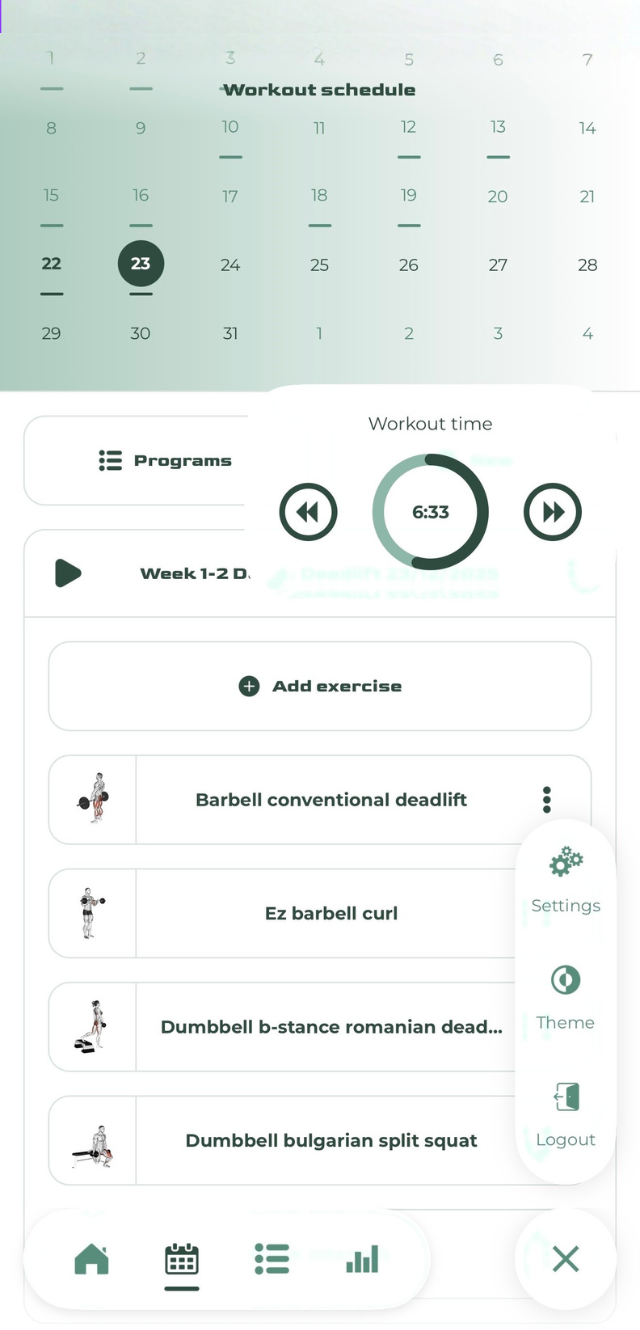
If you want to make real progress and build discipline in the gym, use Virtus Athlete. Free on iOS and Android.