Back to BlogPrograms

How to run the Dumbbell Stopgap program

2026-08-119 min read

Written by Hamza J

How to run the Dumbbell Stopgap program
Contents

Based on the Dumbbell Stopgap program from the r/Fitness wiki, with some minor adaptations.

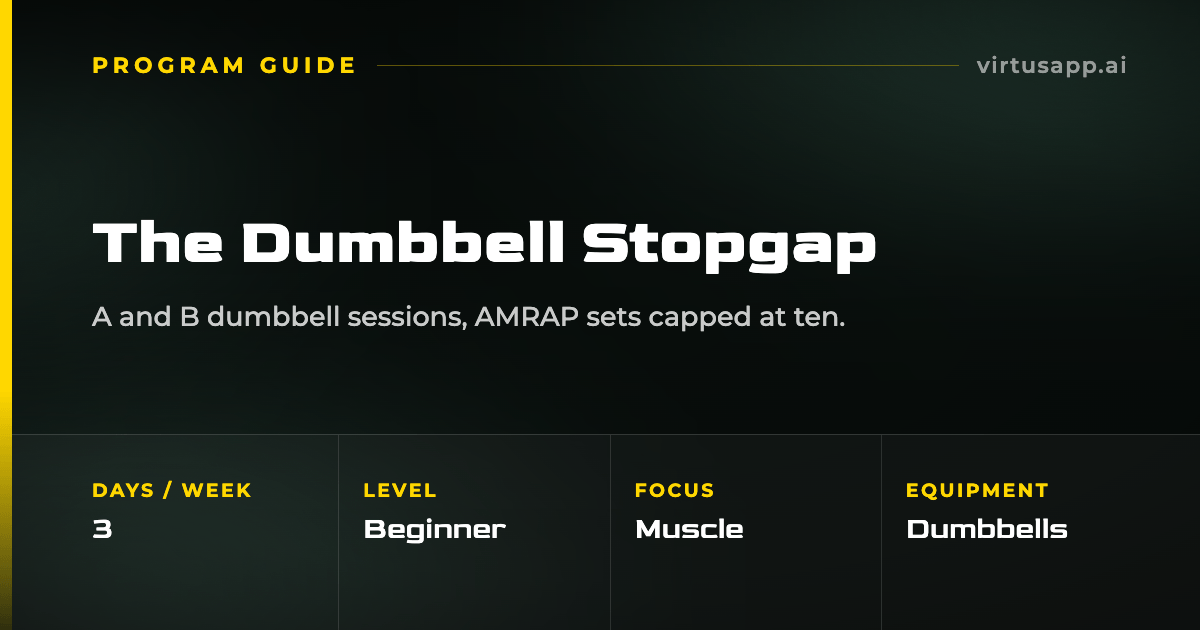
A minimal A/B alternating dumbbell program for 3 days per week. Four exercises per workout, every set an AMRAP capped at 10 reps, with a simple step progression: hit 3×10 and move up one dumbbell size. It is deliberately designed as a bridge, something to run with just dumbbells until you can access better equipment.

Who Is This Program For?

The Dumbbell Stopgap is for lifters whose only equipment is a set of dumbbells and who want a structured routine instead of improvising. The wiki is upfront about what it is: a stopgap until you can get to a barbell, a gym, or a fuller home setup, not an optimal long-term muscle and strength program.

The program focuses on:

  • Minimal equipment: a dumbbell progression (fixed pairs or adjustables), nothing else
  • Simplicity: 2 workout templates, 4 exercises each, one progression rule
  • Full-body coverage: legs, push, pull, and core in every session
  • Honest expectations: it keeps you progressing while your situation is limited

If you are stuck at home with a pair of adjustable dumbbells and want to make real progress anyway, this is the program to run.

Program Structure

Equipment Required

  • A set of dumbbells: either a progression of fixed dumbbells (usually in 2.5 or 5 lb steps) or a pair of adjustable dumbbells
  • No bench required: the press is done from the floor

A/B Alternating Workouts

The program uses two workouts that alternate across 3 training days per week:

Workout A:

ExerciseSets × Reps
Bulgarian Split Squat (or Lunge)3 × AMRAP up to 10
Floor Press3 × AMRAP up to 10
Straight-Legged Deadlift3 × AMRAP up to 10
Plank3 × max hold

Workout B:

ExerciseSets × Reps
Bulgarian Split Squat (or Lunge)3 × AMRAP up to 10
Seated Shoulder Press (or Savickas Press)3 × AMRAP up to 10
Standing Two-Dumbbell Bent Over Row3 × AMRAP up to 10
Plank3 × max hold

The Savickas press is a shoulder press performed sitting on the floor with your legs straight out in front of you, which removes all leg drive and back lean.

Weekly Schedule

Train 3 days per week, alternating A and B, with a rest day between sessions and two rest days on the weekend:

Odd Weeks (1, 3, 5...):

  • Monday: Workout A
  • Wednesday: Workout B
  • Friday: Workout A

Even Weeks (2, 4, 6...):

  • Monday: Workout B
  • Wednesday: Workout A
  • Friday: Workout B

Understanding the Set Scheme

"3 × AMRAP up to 10" means: for each set, do as many reps as possible with good form, stopping at 10. Do that 3 times, resting 1 minute between sets, then move to the next exercise.

  • If a weight is heavy, your sets might look like 6, 5, 4. That is fine, keep chasing reps.
  • If you hit 10 on every set, the weight is done: you move up next time.
  • Planks work the same way in spirit: 3 holds, each as long as possible.

Single-side exercises (split squats, lunges) are performed per leg: an AMRAP up to 10 on each side counts as one set.

Progression: How Weights Increase

The Stopgap uses a simple step progression, where one "step" is the next dumbbell size available to you (usually 2.5 or 5 lbs, about 1.25 or 2.5 kg):

ConditionAction
All 3 sets hit 10 reps on an exerciseIncrease that dumbbell weight by one step next time you do the exercise
Stuck at the same reps and same weight for 3 workoutsDecrease that dumbbell weight by two steps and progress again

Each exercise progresses independently: your rows can move up while your presses rebuild. When you step up, your reps will drop below 10. Chase them back up to 3×10, then step up again.

Get Your Form Right First

Everything below assumes your form is already solid. Finding your working weight, adding weight, chasing reps, all of it only works if you can perform the lift correctly. While your form is not locked in, that is your only job. Make good form the goal of every set, not the weight on the bar. Drilling the movement with an empty bar beats loading plates onto a lift you cannot control yet.

To learn, don't hesitate to search Google and YouTube (there is a lot of good free material) and record yourself from the side to compare against a proper demonstration. In general, good form means a full controlled range of motion, a braced neutral spine, no bouncing or momentum, a consistent setup every rep, and ending the set when technique breaks down rather than grinding sloppy reps.

Finding Your Starting Weights

For each exercise, pick a weight where your first AMRAP set lands around 6-8 reps. That leaves room to build toward 3×10 over a few sessions before your first step up.

If You Don't Know Your Starting Weights

  1. Start with a light-to-moderate pair you are confident with
  2. Do one AMRAP set capped at 10
  3. If you hit 10 easily, go up a step next session
  4. If you cannot reach 5, go down a step next session
  5. Within 2-3 sessions the progression calibrates itself

It's better to start too light than too heavy. Hitting 3×10 quickly and stepping up costs you nothing.

Warming Up

The original write-up does not prescribe a warmup, so keep it light and quick:

  • 2-3 minutes of easy movement (jumping jacks, brisk walk, arm circles)
  • Before each exercise, 1 lighter set of 5-8 reps with a smaller dumbbell (or bodyweight for split squats)

The AMRAP cap does the rest: the first working set naturally regulates how hard you can push that day.

Rest Times

SituationRest Period
Between sets1 minute
Between exercises1-2 minutes

The prescribed rest is 1 minute between sets. If a weight is near the bottom of the rep range and grinding, taking closer to 2 minutes is a fair trade to keep rep quality up.

When You Stall

The stall rule is built into the program:

  1. A stall is being stuck at the same weight and the same reps for 3 consecutive workouts on an exercise
  2. When that happens, drop that exercise's dumbbells by two steps (for example, from 40 lbs back to 30 lbs with 5 lb steps)
  3. Build back up with the same 3×10 rule. The rebuild reps come fast and you generally pass your old sticking point

Before you take the reset, check the basics: sleep, food, and whether you are cutting rests short. If a bodyweight-limited exercise stalls (planks, or split squats with your heaviest pair), add reps, slow the tempo, or pause at the bottom instead.

Program Duration

The Stopgap has no fixed length by design. It is a bridge: the wiki explicitly frames it as something to run until you gain access to a barbell, a gym, or a fuller home setup, and not as a long-term program. Run it for as long as your equipment situation demands, and switch to a fuller program as soon as you can. If your dumbbells and your schedule allow more volume, the Dumbbell PPL is the natural next step even without new equipment.

Run the Dumbbell Stopgap on Virtus Athlete

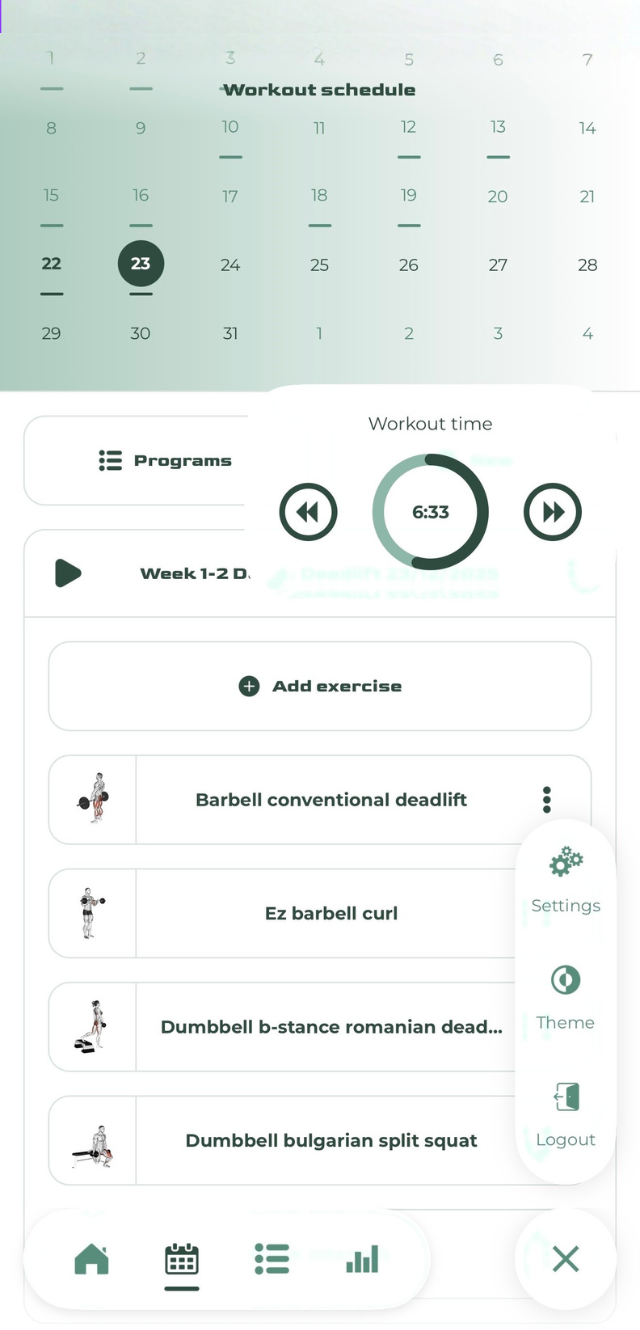
Virtus Athlete fully integrates the Dumbbell Stopgap, handling the A/B alternation, the 3×10 step progression, and the two-step reset on stalls for you. Just enter your starting weights and start training.

Free on iOS and Android.

Virtus Athlete home screen with the week's scheduled workouts and progress summary

Frequently Asked Questions (FAQ)

How long does one full run take?
There is no fixed end date. Sessions take about 30-40 minutes, 3 days per week, and you run it until you get access to better equipment. Most people use it for a few weeks to a few months.
Bulgarian split squat or lunge?
Either. The split squat loads the legs harder with light dumbbells, the lunge is easier to learn. Pick one and stick with it so progression is measurable.
Why the floor press instead of a bench press?
Because the program assumes you have no bench. The floor press covers horizontal pushing safely with only dumbbells and a floor.
What is a Savickas press?
A shoulder press done sitting on the floor with legs straight in front of you. With nothing to lean against and no leg drive, it is strict and surprisingly humbling. Use it if you find yourself cheating on seated presses.
What if my dumbbells max out on an exercise?
Slow the tempo (3-4 second lowering), pause at the bottom, or keep adding reps past 10. For legs, the Bulgarian split squat variant demands far less weight than lunges.
What's the difference between this and the Dumbbell PPL?
The Stopgap is simpler and smaller: 3 days, 4 exercises per workout, a 10-rep cap, and no bench or pull-up bar needed. The Dumbbell PPL runs 3-6 days with 5-6 exercises per workout in a 3-12 range, and needs a bench and a pull-up bar. Stopgap is the bridge, PPL is the fuller dumbbell program.
How do I enter my starting weights?
Enter a weight where your first set lands around 6-8 reps. The 3×10 step progression handles everything from there.

Related Articles

Track This Program

Build unlimited programs, log every set, and track your progress over time. Free on iOS & Android.