Back to BlogPrograms

How to run the Cube Method program

2026-08-1112 min read

Written by Hamza J

How to run the Cube Method program
Contents

Based on Brandon Lilly's The Cube Method, with some minor adaptations.

A 10-week powerlifting program built on conjugate rotation. Squat, bench and deadlift are each trained once per week, and each one gets a different job that week: heavy, explosive, or reps. Over three weeks every lift has done all three. Three waves of three weeks plus a meet week make one full cycle.

Who Is This Program For?

The Cube Method is for the lifter who has an honest 1-rep max on all three competition lifts and has stopped adding weight session to session. If you can still add 2.5 kg / 5 lbs to your squat every workout, a linear program like GZCLP or StrongLifts will give you more in less time. Come back to the Cube when that well runs dry.

The core idea is that you cannot peak everything at once, so you should stop trying. Instead of pushing all three lifts hard in the same week, the Cube deliberately desynchronises them:

  • One lift goes heavy: low reps at high intensity, building maximal strength
  • One lift goes explosive: light weight moved fast, building rate of force development
  • One lift goes reps: moderate weight for volume, building muscle and cleaning up technique

Because a heavy squat week lands on an explosive bench week and a rep deadlift week, no single session buries you for the rest of the week. That is what lets the program run at high intensity for ten weeks straight.

It suits you if you have a meet or a test day on the calendar, you train four days per week, and you are comfortable working with percentages of a real max rather than feel.

Program Structure

The 3 Main Lifts

LiftMovement Pattern
Barbell Back SquatLower body push
Barbell Bench PressHorizontal push
Barbell Conventional DeadliftHip hinge

4 Training Days Per Week

DayFocus
Day 1Squat
Day 2Bench Press
Day 3Deadlift
Day 4Bodybuilding / weak point work

Day 4 is part of the program, not an optional extra. It is where you fix the things that are holding your total back.

The Rotation

Each lift cycles through heavy, explosive and rep work on a 3-week loop:

Week in waveSquatBench PressDeadlift
Week 1HeavyExplosiveRep
Week 2ExplosiveRepHeavy
Week 3RepHeavyExplosive

This same rotation repeats in weeks 4 to 6 and again in weeks 7 to 9, with heavier loads and fewer reps each wave.

The Loading Scheme

All percentages are of your true 1-rep max for that lift.

Day typeWave 1 (weeks 1-3)Wave 2 (weeks 4-6)Wave 3 (weeks 7-9)
Heavy5×2 @ 80%3×2 @ 85%1×2 @ 90%, 1×1 @ 92.5%, 1×1 @ 95%, then 1×AMRAP @ 80%
Explosive8×3 @ 60%6×2 @ 65%5×2 @ 70%
Rep3×8 @ 70%3×6 @ 80%3×3 @ 85%

Read it together with the rotation table. In week 1 the squat does 5 sets of 2 at 80%, the bench does 8 sets of 3 at 60%, and the deadlift does 3 sets of 8 at 70%. In week 2 the squat does 8 sets of 3 at 60%, the bench does 3 sets of 8 at 70%, and the deadlift does 5 sets of 2 at 80%. And so on.

What Each Day Type Actually Means

Heavy day. Low reps, high percentage, no grinding. You are not testing anything. If a rep turns into a fight, the weight was wrong, not the day. The wave 3 heavy day is the only session that walks up to a near-maximal single, and it finishes with one back-off set at 80% taken for as many clean reps as you can manage while leaving 1 to 2 in the tank.

Explosive day. The weight is light on purpose. Every rep is driven as fast as you can while keeping the bar path identical to your competition lift. If the bar is not moving fast, the set has failed even though the reps were completed. Keep rest short so the session stays crisp.

Rep day. Moderate weight, moderate reps. This is your muscle-building and technique-polishing day. The bar speed will slow near the end of a set of 8. That is fine, but the last rep should still look like the first.

Meet Week (Week 10)

Week 10 closes the cycle. You work up to a heavy single on each of the three lifts and treat your last attempts like competition attempts: full commands, full setup, no misses you had not planned for.

Whatever you hit in week 10 becomes the max you plug into the next cycle. There is no assistance work and no bodybuilding day in meet week.

Day 4: The Bodybuilding Day

Pick 3 to 5 movements that attack your weak points and perform 4 to 5 sets of 8 to 12 reps at a moderate load, taking each set close to failure. Keep heavy barbell work off this day.

Typical choices:

Weak pointMovements
Lockout / tricepsTriceps pushdowns, dumbbell overhead extensions, close grip press
Upper backChest supported rows, lat pulldowns, face pulls
ShouldersDumbbell overhead press, lateral raises
Posterior chainHamstring curls, back extensions, glute ham raises
ArmsBarbell curls, hammer curls

Choose based on where your lifts break down, not on what you enjoy. If your bench dies at lockout, triceps and upper back get the volume.

Progression: How Weights Increase

The Cube does not add weight session to session. Progression happens in two places.

Within a cycle, the percentages climb wave to wave while reps drop:

Day typeWave 1Wave 2Wave 3
Heavy80%85%90% to 95%
Explosive60%65%70%
Rep70%80%85%

Between cycles, you retest in meet week and start the next 10 weeks from the new numbers. If your squat 1RM goes from 180 kg / 400 lbs to 190 kg / 420 lbs, every percentage in the next cycle is calculated off 190 kg / 420 lbs.

That is the whole progression model. There is no weekly weight bump and no AMRAP-driven auto-regulation on the main work, apart from the single back-off set in wave 3. The programmed weights are meant to be enough. Going heavier than prescribed because you feel good is how people blow up the back half of the cycle.

Get Your Form Right First

Everything below assumes your form is already solid. Finding your working weight, adding weight, chasing reps, all of it only works if you can perform the lift correctly. While your form is not locked in, that is your only job. Make good form the goal of every set, not the weight on the bar. Drilling the movement with an empty bar beats loading plates onto a lift you cannot control yet.

To learn, don't hesitate to search Google and YouTube (there is a lot of good free material) and record yourself from the side to compare against a proper demonstration. In general, good form means a full controlled range of motion, a braced neutral spine, no bouncing or momentum, a consistent setup every rep, and ending the set when technique breaks down rather than grinding sloppy reps.

Finding Your Starting Weights

You need one number per lift: your current 1-rep max for squat, bench press and deadlift. Everything else is calculated from those three values.

If You Know Your 1RM

Enter it. If the max is more than three months old, or you hit it on a day everything went perfectly, round it down.

If You Don't Know Your 1RM

  1. Find a weight you can lift for 3 to 5 clean reps
  2. Estimate with the Epley formula: Weight × Reps × 0.0333 + Weight
  3. Round the result down to the nearest 2.5 kg / 5 lbs

Example:

You squat 140 kg for 5 reps:
  Estimated 1RM = 140 × 5 × 0.0333 + 140 = 163.3 kg
  Round down to 160 kg

You squat 315 lbs for 5 reps:
  Estimated 1RM = 315 × 5 × 0.0333 + 315 = 367.4 lbs
  Round down to 365 lbs

The Training Max Option

If you are unsure, or you are coming back from a layoff, use 90% of your 1RM as the number you feed the percentages. Wave 3 heavy days ask for 95%, and 95% of an inflated max is a missed rep. A conservative number keeps every session completable, which is the entire point.

Warming Up

Warm-up sets are not counted in the working sets above. Before the first working set of each main lift:

SetWeightRepsRest
1Empty bar (20 kg / 45 lbs)845 seconds
2~40% of working weight545 seconds
3~60% of working weight360 seconds
4~80% of working weight290 seconds
Work setsAs prescribedAs prescribedSee rest table

On heavy days in wave 3, add one or two more small jumps so you take at least 5 total sets to reach your top weight. On explosive days you need less: the working weight is only 60% to 70% and two or three light sets are plenty.

The bodybuilding day needs no barbell ramp, just a light first set on each movement.

Rest Times

Session typeRest Period
Heavy day working sets3-5 minutes
Explosive day sets60 seconds
Rep day sets2-3 minutes
Bodybuilding day60-90 seconds

The short rest on explosive day is deliberate. The stimulus is bar speed and total quality reps, not fatigue. If 60 seconds is not enough to move the bar fast, the weight is too heavy, not the rest too short.

When You Miss Reps

The Cube Method has no scheduled deload week. Ten weeks of undulating loads is the fatigue management. Week 10 is the only true reset.

That works only if your starting maxes are honest, so use this as the failure protocol:

If you miss reps on a heavy day:

  • Stop the exercise for that session. Do not chase the missed set
  • Drop the 1RM you entered for that lift by 5% and recalculate the rest of the cycle
  • Finish the remaining waves at the new number

If you miss reps on a rep day:

  • Complete the sets you can and cut the last set short rather than grinding
  • If it happens twice in a row on the same lift, drop that lift's max by 5%

If bar speed dies on an explosive day:

  • Reduce the explosive percentage by 5% for that lift. Speed is the whole point of the day

If you miss two or more sessions in a week:

  • Repeat that week rather than skipping ahead. The waves only work if you run them in order

A missed rep is information about your entered max, not a character flaw. Adjust the input and keep moving.

Program Duration

One full cycle is 10 weeks: three 3-week waves plus meet week. At 4 training days per week that is 40 sessions.

At the end of week 10 you retest, take the new maxes, and start again. The Cube is designed to be repeated. Most lifters run it back to back around a competition calendar, timing meet week to land on or near an actual meet.

If you are not competing, treat week 10 as a test day and take at least a few easy days before starting the next cycle.

Access the Original Program

The Cube Method is published as a book by Brandon Lilly. The full text, including his own written explanations of each day type, is available here:

The Cube Method by Brandon Lilly

Run the Cube Method on Virtus Athlete

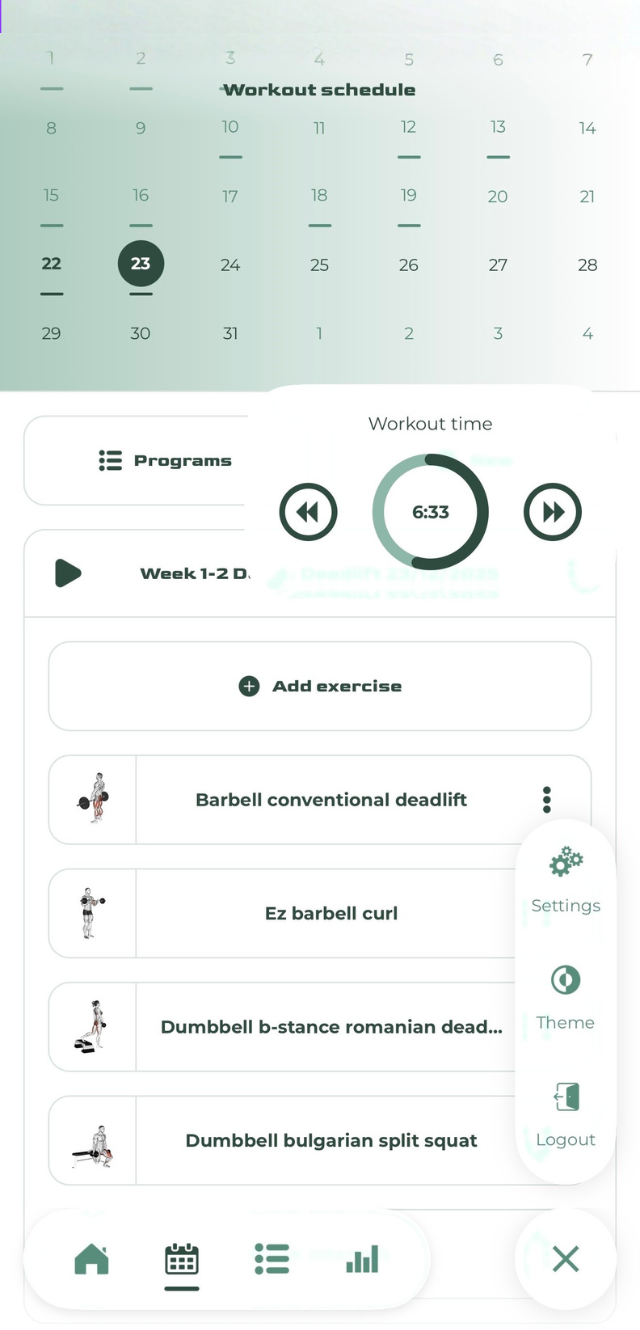
Build the three main days and the bodybuilding day as your own workouts in Virtus Athlete, then let the app handle the rest: set logging, rest timers between heavy singles, per-exercise progress charts so you can see whether wave 3 actually moved the needle, and a full history you can check before meet week.

Free on iOS and Android.

Virtus Athlete home screen with the week's scheduled workouts and progress summary

Frequently Asked Questions (FAQ)

How long does one full run take?
10 weeks, at 4 sessions per week, so 40 total workouts. Three 3-week waves plus meet week.
Can I swap the main lifts?
No. Squat, bench press and deadlift are the program. The Cube exists to peak those three lifts. You can swap freely on the bodybuilding day.
Which lift is heavy in week 1?
Squat. Bench is explosive and deadlift does reps. The rotation shifts by one position each week.
Can I run it on 3 days per week?
You can, by dropping the bodybuilding day, but you lose the weak point work that the program relies on to fix sticking points. If time is the issue, shorten the bodybuilding day to 3 movements instead of cutting it.
Do I use my true 1RM or a training max?
Either works, as long as you are consistent for the whole cycle. Use your true 1RM only if it is recent and clean. Otherwise use 90% of it and let the numbers stay honest.
What if I have no meet to peak for?
Treat week 10 as a max test. The retested numbers become the input for your next cycle, which is exactly what a meet would give you.
Why is the explosive day so light?
Because the target is bar speed, not load. Moving 60% as fast as physically possible trains rate of force development, which is what gets you off the chest and out of the hole on your heavy days.
Can I add extra accessory work to the main lift days?
Keep it small. The original program puts weak point work on day 4 for a reason: adding volume to the three main days is the fastest way to run out of recovery by wave 3.

Related Articles

Track This Program

Build unlimited programs, log every set, and track your progress over time. Free on iOS & Android.