Back to BlogPrograms

How to run the Candito 6-Week Strength program

2026-08-1110 min read

Written by Hamza J

How to run the Candito 6-Week Strength program
Contents

Based on Jonnie Candito's 6 Week Strength Program, with some minor adaptations.

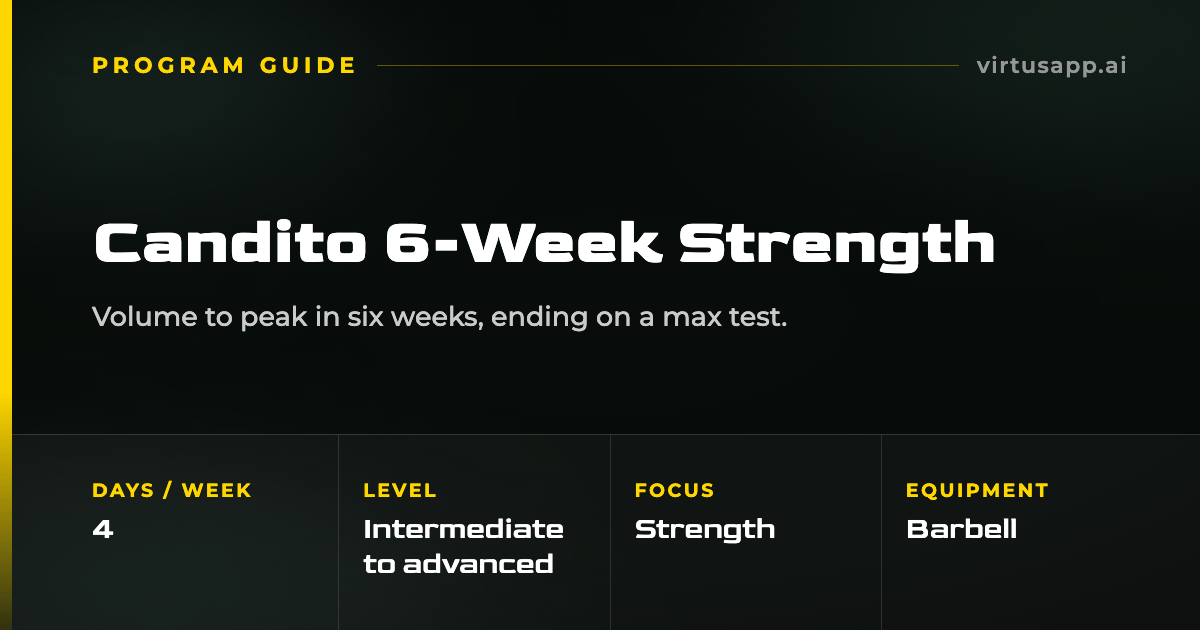
A free periodized strength program for the squat, bench press, and deadlift. Six weeks that swing like a pendulum from high-volume muscular conditioning through hypertrophy, linear strength work, and heavy weight acclimation, to near-maximal top sets in week 5 and an optional max test in week 6.

Who Is This Program For?

The Candito 6-Week Strength Program is for lifters past the beginner stage who want a structured block that peaks their squat, bench, and deadlift. It is one of the most popular free powerlifting programs ever released, and it is built to be repeated cycle after cycle.

The program focuses on:

  • Block periodization: each week has a distinct role, from volume to near-max intensity
  • The big three: squat, bench press, and deadlift drive the whole program
  • Structured accessories: upper body sessions include mandatory back, shoulder, and bicep work
  • A built-in peak: week 5 tells you exactly how much stronger you got, and week 6 lets you prove it

If you want a repeatable 6-week block with a clear test at the end, or you are peaking for a meet, this is a proven choice.

Program Structure

The Six Weeks

WeekPhaseSessions
1Muscular Conditioning5 (3 upper, 2 lower)
2Hypertrophy5 (3 upper, 2 lower)
3Linear Max OT4 (upper/lower split)
4Heavy Weight Acclimation / Explosiveness4 (upper/lower split)
5Intense Strength Training3 (one per lift)
6Deload or Max Test (optional)Optional

All working weights are calculated from your 1-rep max for each lift. The official spreadsheet computes every set for you, which is exactly what the app does as well.

Weeks 1-2: Volume Block

The block opens with high-volume full-body work at moderate intensity to condition the muscles for the heavy lifting ahead. The loading is heavier than most "volume" programs, staying near 80% for strength specificity:

  • Week 1, Lower Day 1: Squat 4×6 at 80%, Deadlift 2×6 at 80%
  • Week 1, Lower Day 2: Squat 4×8 at 70%, Deadlift 2×8 at 70%
  • Week 1, Upper Days: Bench Press ramping sets of 10 at 50%, 10 at 67.5%, 8 at 75%, and 6 at 77.5%, plus the mandatory accessories
  • Week 2 raises the difficulty: squat sessions built around a 10-rep top set at 80%+ followed by back-off sets with short 1-minute rests

Week 2 is the highest-volume week of the program.

Weeks 3-4: Strength Block

Volume drops sharply and intensity climbs about 5% per week, with regular work at 85-90% and above:

  • Week 3 (Linear Max OT): low-rep strength work in the 4-6 rep range, two upper and two lower sessions, no optional accessories
  • Week 4 (Heavy Acclimation / Explosiveness): ascending heavy triples and 1-2 rep sets to acclimate your nervous system to heavy weights, paired with explosive lower body work done for 4 reps per set so every rep stays truly explosive

Week 5: Intense Strength

Only three sessions, each dedicated to one lift. You work up to a final top set of 1-4 reps at 97.5% of your entered max. This set is the test built into the program:

  • A double at 97.5% means you got stronger (most lifters can only double about 95%)
  • Four reps means you got much stronger

Week 6: Deload, Restart, or Max Out

Three options:

  1. Deload and start the next cycle at week 1
  2. Skip week 6 entirely and restart at week 1
  3. Test your real 1RM, then add a week 7 deload before the next cycle

If you compete, the program is designed so week 6 lands on meet week. If you don't want to max out, project your new 1RM from the week 5 top set: multiply the weight by 1.03 for 2 reps, 1.06 for 3 reps, or 1.09 for 4 reps.

Accessory Work

Upper Body Sessions (Mandatory)

Every upper session includes bench press plus three required accessories:

CategoryExamples
BackDumbbell rows, weighted pull-ups
ShouldersSeated dumbbell overhead press
BicepsDumbbell curls, barbell curls

Optional Exercises

  • Up to 2 optional exercise slots per upper session, using isolation movements (triceps extensions, curls, laterals) in the 8-12 rep range
  • 4 sets total per optional exercise, including the warm-up set, nothing more
  • Lower body sessions have no mandatory accessories: choose hypertrophy or explosive accessory work depending on your goal

Optional work is intentionally left without percentages so you can autoregulate based on how you feel that day.

Progression: How Weights Increase

Progression happens between cycles, not within one:

  1. Run the 6 weeks from your current 1RM values
  2. In week 5 or 6, establish your new (tested or projected) 1RM for each lift
  3. Start the next cycle with the new maxes

The failure rule: if you fail to complete any set as written, drop that lift's max by 5% in the calculations and keep going. This keeps the later weeks honest and prevents one inflated max from wrecking the block.

Get Your Form Right First

Everything below assumes your form is already solid. Finding your working weight, adding weight, chasing reps, all of it only works if you can perform the lift correctly. While your form is not locked in, that is your only job. Make good form the goal of every set, not the weight on the bar. Drilling the movement with an empty bar beats loading plates onto a lift you cannot control yet.

To learn, don't hesitate to search Google and YouTube (there is a lot of good free material) and record yourself from the side to compare against a proper demonstration. In general, good form means a full controlled range of motion, a braced neutral spine, no bouncing or momentum, a consistent setup every rep, and ending the set when technique breaks down rather than grinding sloppy reps.

Finding Your Starting Weights

You need an accurate 1-rep max for squat, bench press, and deadlift. Every working weight in all six weeks is computed from these three numbers.

If You Know Your 1RM

Enter it directly, and be honest. An inflated max makes week 2 miserable and week 5 impossible.

If You Don't Know Your 1RM

  1. Find a weight you can lift for 3-5 reps with good form
  2. Use the formula: Weight × Reps × 0.0333 + Weight

Example:

You squat 120 kg (265 lbs) for 5 reps:
  Estimated 1RM = 120 × 5 × 0.0333 + 120 = 140 kg (308 lbs)
  Week 1 Day 1: 4×6 at 80% = 112 kg (247 lbs)

It's better to start too light than too heavy. The failure rule will correct an inflated max, but only after it has cost you sessions.

Warming Up

Work up to each day's first working set with progressively heavier, low-rep sets: empty bar, then 3-4 jumps of decreasing reps. In weeks 4 and 5, take the last warm-ups as singles and doubles so you reach the heavy top sets fresh. The week 1-2 upper sessions build the ramp into the program itself (the 50% and 67.5% sets of 10).

Rest Times

Exercise TypeRest Period
Main lifts (squat, bench, deadlift)3-8 minutes, as needed
Week 2 back-off sets1 minute (prescribed)
Mandatory accessories2-3 minutes
Optional exercises1-2 minutes

Candito prescribes full rest on the main lifts: 3-8 minutes is optimal depending on the set. Most sessions fit inside 45-60 minutes.

When You Fail Reps

  1. Apply the program's rule: failed a set as written, drop that lift's calculation max by 5% and continue the block
  2. Do not repeat the failed session. The block keeps moving forward.
  3. Check recovery: 7-9 hours of sleep, enough calories, protein at 1.5-2.2 g per kg (0.7-1 g per lb) of bodyweight
  4. If week 5 falls apart entirely, your entered maxes were too high. Finish with a deload, re-test conservatively, and restart the cycle with honest numbers.

Program Duration

One cycle is 6 weeks (or 7 with a max-out week plus deload). The program is built to be run repeatedly: each cycle ends with new maxes that seed the next cycle. Two to four back-to-back cycles is a common way to structure several months of training.

Access the Original Program

If you would like to read the original program page:

Candito Training HQ

A mirror of the official spreadsheet is also available on Lift Vault.

Run Candito 6-Week Strength on Virtus Athlete

Virtus Athlete fully integrates the Candito 6-Week Strength Program, handling the phase-by-phase percentages, the accessory structure, and the cycle-to-cycle max updates for you. Just enter your 1RM values and start training.

Free on iOS and Android.

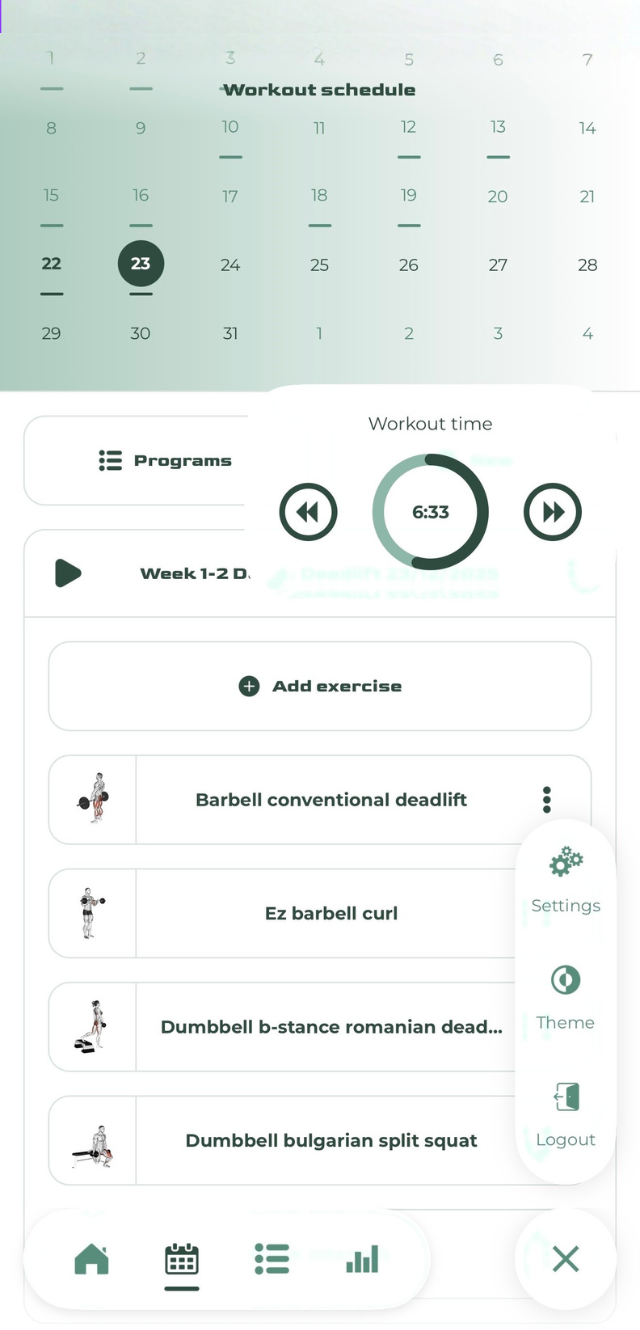
Virtus Athlete home screen with the week's scheduled workouts and progress summary

Frequently Asked Questions (FAQ)

How long does one full run take?
One cycle is 6 weeks (about 21-24 sessions), or 7 weeks if you max out in week 6 and add the deload week.
Do I have to max out in week 6?
No. You can deload, or skip straight to a new cycle using the projected 1RM from your week 5 top set (weight × 1.03 for 2 reps, × 1.06 for 3, × 1.09 for 4).
Why does the volume drop so suddenly in week 3?
That is the design: the pendulum swings from volume to intensity. Week 2's workload conditions you, then weeks 3-5 convert it into maximal strength with far fewer reps.
Can I add extra accessories?
Follow the limits: the three mandatory upper accessories, at most 2 optional isolation exercises for 4 sets each. The program's later weeks need you fresh, not exhausted by arm day.
Is this good for peaking for a meet?
Yes. Time the cycle so week 6 lands on meet week: the program peaks you at the end of week 5.
What about the overhead press?
The main program is built on the competition lifts. Shoulder work is covered by the mandatory shoulder accessory in every upper session.
How do I enter my starting weights?
Enter your 1-rep max for squat, bench press, and deadlift. The app calculates every set of all six weeks from those three numbers, exactly like the official spreadsheet.

Related Articles

Track This Program

Build unlimited programs, log every set, and track your progress over time. Free on iOS & Android.