Back to BlogPrograms

How to run the Burrito But Big program

2026-08-1112 min read

Written by Hamza J

How to run the Burrito But Big program
Contents

Based on u/benjaminbk's General Gainz adaptation, built on Cody LeFever's GZCL principle, with some minor adaptations.

Twelve weeks of General Gainz with a shape borrowed from 5/3/1: eight weeks of leader work where the rep target climbs and the weight stays put, then a four week anchor where the reps fall away and singles take their place. Four days a week, four exercises a session, and a weight you choose rather than one the app calculates.

Who Is This Program For?

Burrito But Big is for the intermediate lifter who wants size and likes the General Gainz way of working: find a hard set, back it up, and let the numbers tell you where you are.

It suits you if:

  • You understand the find and extend idea, or are willing to read the General Gainz guide first
  • You want twelve weeks with a defined start and end rather than an open framework
  • You are happy choosing your own weights session to session
  • Four exercises a session is enough for you

It is not a beginner program. It never tells you what weight to use, and a lifter who cannot yet judge a hard set of six will spend the leader phase guessing.

Leader and Anchor

PhaseWeeksWhat happens
Leader 11 to 4The rep target climbs from 6 to 9. The weight stays where you put it
Leader 25 to 8The same climb again, from 7 to 10, from a heavier starting weight
Anchor9 to 12The rep target FALLS from 6 to 3, and singles fill the space behind it

The leader builds the volume. The anchor spends it. Week 12 is a rep max with nothing behind it at all.

Program Structure

4 Training Days

DayT1T2T3T3
Lower ASquatRomanian DeadliftBicep CurlReverse Fly
Upper ABench PressOverhead PressPendlay RowLateral Raise
Lower BDeadliftFront SquatHanging Leg RaiseSkullcrusher
Upper BOverhead PressClose Grip Bench PressPulloverBicep Curl

Four exercises a session, 60 to 90 minutes depending on how many extension sets you take. The arm and shoulder work sitting on the lower days is deliberate: it is where the recovery is.

The Leader Weeks

Every T1 and T2 week has the same shape: one find set, then four half sets.

WeekT1 targetT1 extensionT2 targetT2 extension
164 × 384 × 4
274 × 494 × 5
384 × 4104 × 5
494 × 5114 × 6
574 × 494 × 5
684 × 4104 × 5
794 × 5114 × 6
8104 × 5124 × 6

The extension is always four sets at half the find set's reps, which doubles the volume of the set you just did. That is the General Gainz rule and every row above is that arithmetic.

The weight is yours. Work up to the week's rep target, record what you used, and the app puts it back next week. When the target climbs by one and the set still moves well, keep the weight. When it stops moving, take some off. That is the whole loading model.

The Anchor Weeks

WeekT1T2
96RM + 6 × 18RM + 4 × 4
105RM + 5 × 17RM + 2 × 3, 2 × 4
114RM + 4 × 16RM + 4 × 3
123RM only5RM only

The T1 extension turns into singles at the find set's weight, one per rep you were targeting. The T2 comes down in both reps and sets so it stops competing.

Week 12 is the test. A rep max with nothing after it on both tiers. Whatever you hit is what the next cycle starts from.

T3

Three sets of ten or more, taken as far as your form holds, on both T3 movements, every week of the twelve.

There is no rule here and there is not meant to be one. Your rep counts climb as you get stronger, and you add weight yourself when three sets of ten stops being work.

Progression: What Actually Moves

MechanismWhere
The rep target climbsEvery week of the leader phase, by one
The weight climbsWhen you decide it should, between mesocycles or within one
The reps fall and the singles growThe anchor phase
T3 climbs by itselfYour rep counts rise; you add weight when you choose to

Notice what is missing: there is no percentage anywhere in this program and no automatic increment. Burrito But Big schedules the SHAPE of every session for twelve weeks and leaves the load entirely to you.

That is not a gap, it is the design. The rep target is what changes, and the whole point is finding what weight meets it today.

Get Your Form Right First

Everything below assumes your form is already solid. Finding your working weight, adding weight, chasing reps, all of it only works if you can perform the lift correctly. While your form is not locked in, that is your only job. Make good form the goal of every set, not the weight on the bar. Drilling the movement with an empty bar beats loading plates onto a lift you cannot control yet.

To learn, don't hesitate to search Google and YouTube (there is a lot of good free material) and record yourself from the side to compare against a proper demonstration. In general, good form means a full controlled range of motion, a braced neutral spine, no bouncing or momentum, a consistent setup every rep, and ending the set when technique breaks down rather than grinding sloppy reps.

Finding Your Starting Weights

You enter one weight per exercise: the weight you can take for week one's target.

  • T1: the weight you can do for a hard set of six
  • T2: the weight you can do for a hard set of eight
  • T3: the weight you can do for three sets of ten

That is it. There is no max to test and no percentage to compute.

Err low on the T1 and T2. Week 1 asks for a six rep set followed by four sets of three at the same weight, and week 4 asks for a nine rep set followed by four sets of five. A weight you can only just get six reps with will not survive to week 4 at nine.

Example, squat:

You can squat 100 kg / 225 lbs for a hard, clean 6
  Week 1: work up to 100 kg for 6, then 4 x 3 at 100 kg
  Week 2: 100 kg for 7 if you have it, then 4 x 4
  Week 4: 100 kg for 9, then 4 x 5
  Week 5: put 5 kg on it and start the climb again from 7

Warming Up

TierWarm-up
T1A full ramp: empty bar, then roughly 40%, 60% and 80% of the find weight
T2Two sets, since the T1 has already warmed the pattern
T3One light set, or none

The find set is the one set of the session that decides everything else, so arriving at it cold costs you the whole extension.

Rest Times

SituationRest
T1 find set3 to 3.5 minutes
Between T1 extension sets2 to 3 minutes
T2 find set2.5 minutes
Between T2 extension sets1 to 2 minutes
Anchor singles2 to 3 minutes
T360 seconds

When Things Go Wrong

If you miss the week's rep target, take the weight off rather than repeating it. The target is the fixed thing in this program and the weight is the variable, so a missed target means the weight was wrong.

If you cannot complete the extension sets, the find set was too greedy. Take one fewer rep on the find set and complete the extension instead: the extension is where the size comes from.

If week 5 feels harder than week 4 did, you added too much between mesocycles. The second leader restarts three reps lower for a reason, so the weight jump should be small: 2.5 kg on upper body, 5 kg on lower.

If the anchor singles are grinding, cut the weight. The anchor is meant to feel sharp, not heavy.

If you miss a session, pick it up where you left off. The twelve weeks only work in order.

Program Duration

12 weeks at 4 sessions a week, which is 48 workouts.

Week 12 is the test. Take the numbers you hit there as the starting weights for the next cycle, take a few easy days, and run it again.

If two cycles in a row end with the same week 12 numbers, the answer is a different program rather than a third cycle.

Run Burrito But Big on Virtus Athlete

Twelve weeks of changing rep targets across sixteen slots is exactly what a notebook loses track of. Virtus Athlete writes the right target and the right extension for every week, carries your weight forward so you never have to look it up, and keeps the whole twelve weeks in one chart so week 12's test sits next to week 1's find set.

Free on iOS and Android.

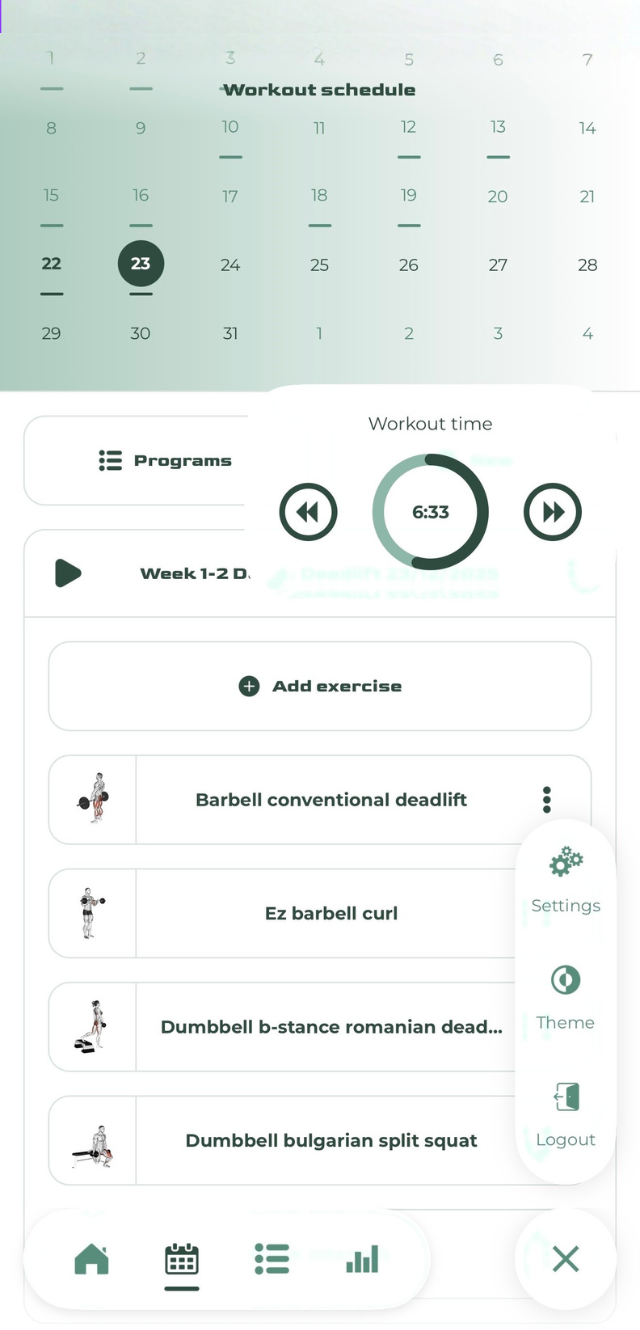
Virtus Athlete home screen with the week's scheduled workouts and progress summary

Frequently Asked Questions (FAQ)

How long does one full run take?
12 weeks at 4 sessions a week, so 48 workouts. Eight weeks of leader and four of anchor.
Why does the app not tell me what weight to use?
Because the program does not. It prescribes a rep target and tells you to find the weight that meets it. What the app does is remember what you used and put it back next week, which is exactly what the framework asks you to do with a notebook.
What is the difference between this and General Gainz?
General Gainz is an open framework with a hold and push cycle and no end date. Burrito But Big schedules twelve weeks of it with a leader and an anchor, so the rep target climbs on a calendar rather than on your performance.
Why does the second leader mesocycle start at 7 and not 6?
Because you spent four weeks earning it. Restarting at the same target from a heavier weight is what makes the second run productive rather than a repeat.
Can I change the exercises?
The T1s should stay as the four main lifts. T2 should be a close variation of that day's pattern. T3 is completely free.
Should I take the find set to failure?
Stop one rep short. The extension sets come after it at the same weight, and a find set taken to failure means there is no extension to do.
Can I run this three days a week?
Run the four days in order regardless of the calendar. The twelve weeks will take about sixteen.
Why is arm work on leg day?
Because it costs nothing there. Curls after squats cost you nothing on the next upper day, and curls after bench cost you triceps you were about to use.

Related Articles

Track This Program

Build unlimited programs, log every set, and track your progress over time. Free on iOS & Android.