Back to BlogPrograms

How to run the Bro Split program

2026-08-1111 min read

Written by Hamza J

How to run the Bro Split program
Contents

Based on Muscle & Strength's Ultimate Bro Split, with some minor adaptations.

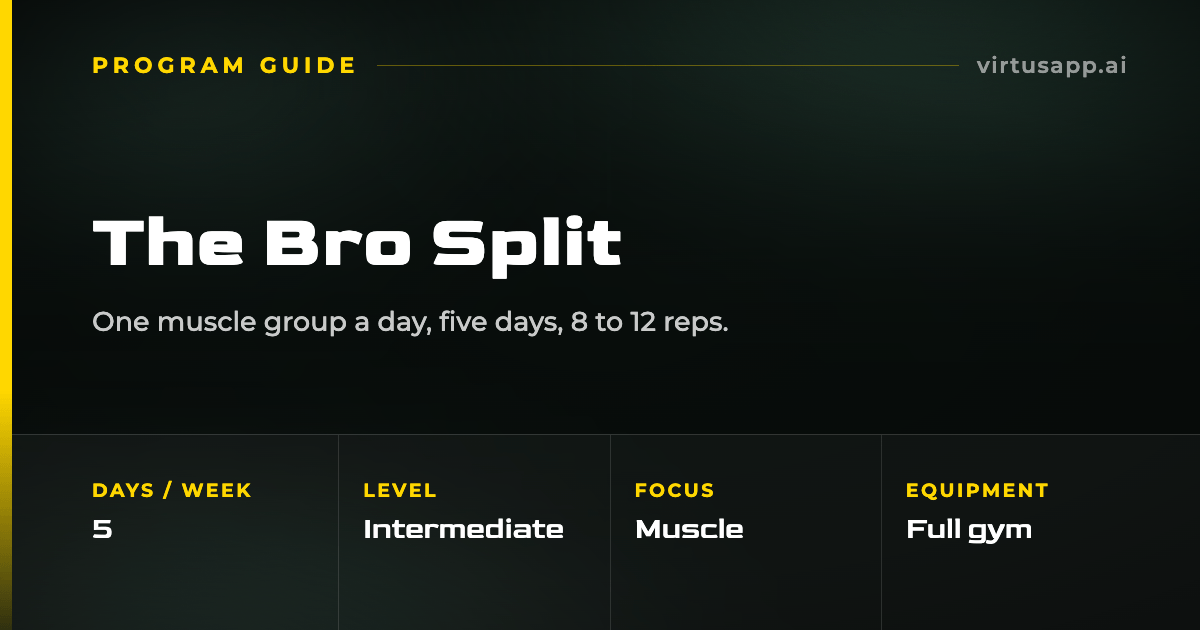
The classic 5-day body part split. One muscle group per day, chest, legs, shoulders, back and arms, with double progression in the 8-12 rep range. Designed to run for 12 weeks.

Who Is This Program For?

The bro split is for the intermediate lifter who wants a simple, high volume bodybuilding routine and who enjoys walking into the gym knowing exactly which body part is getting destroyed today.

The program focuses on:

  • One muscle group per session: all your chest work on chest day, all your back work on back day
  • Volume per session: 15 to 18 hard sets on a single muscle group in one workout
  • Recovery between sessions: a full week before that muscle is trained again
  • Simplicity: five workouts, five body parts, no rotation to track

It is honest about its trade-off. Training each muscle once per week is a lower frequency than most modern hypertrophy programming recommends. What you get in exchange is a session structure that is easy to follow, easy to enjoy, and easy to be consistent with. A program you actually run beats a better program you abandon.

This is not a beginner program. It assumes you can handle 15 or more working sets on one muscle group without your form falling apart in the last third of the session.

What We Changed From The Original

Two things, and they are worth stating up front so you know exactly what came from the source and what did not.

ItemMuscle & Strength originalHow we run it
Sets and reps3 sets of 10, flat, on every exercise3 sets of 8-12
Progression"Increase the weight used whenever capable"Double progression on the 8-12 range

Everything else, the split, the day order, the exercise selection, the 12 week duration, is exactly as published.

Program Structure

The Weekly Schedule

DayBody Part
MondayChest
TuesdayLegs
WednesdayShoulders
ThursdayBack
FridayArms
SaturdayRest
SundayRest

Back and arms land on consecutive days, which means your biceps get direct work on Friday after being hit hard by rows and pulldowns on Thursday. If that bothers you, reorder the week. Legs, rest, chest, back, shoulders, rest, arms puts a day between back and arms and works just as well. The five sessions matter, the calendar does not.

Workout Details

Monday: Chest

ExerciseSets x Reps
Barbell Bench Press3x8-12
Dumbbell Incline Bench Press3x8-12
Decline Hammer Strength Machine Press3x8-12
Pec Dec3x8-12
Push Up3x8-12

Tuesday: Legs

ExerciseSets x Reps
Barbell Back Squat3x8-12
Machine Hack Squat3x8-12
Leg Press3x8-12
Leg Extension3x8-12
Leg Curl3x8-12
Calf Raise3x8-12

Wednesday: Shoulders

ExerciseSets x Reps
Seated Shoulder Press3x8-12
Arnold Press3x8-12
Lateral Raise3x8-12
Upright Row3x8-12
Reverse Fly Machine3x8-12
Shrug3x8-12

Thursday: Back

ExerciseSets x Reps
Deadlift3x8-12
Lat Pull Down3x8-12
Hammer Strength Row3x8-12
Cable Row3x8-12
Straight Arm Lat Pull Down3x8-12

Friday: Arms

ExerciseSets x Reps
Barbell Bicep Curl3x8-12
Preacher Curl3x8-12
Incline Dumbbell Curl3x8-12
Dip3x8-12
Skullcrusher3x8-12
Rope Pressdown3x8-12

Sessions run about 45 to 70 minutes each.

Understanding the Set Scheme

Every exercise in this program is 3 sets of 8 to 12 reps at the same weight. There are no AMRAP sets, no pyramids, no ramping loads. Straight sets across the board.

The uniformity is the point. When every slot is identical, the only thing you have to think about in the gym is whether today's set beat last week's set.

Leave 1 to 2 reps in reserve on the first two sets of each exercise. The last set of each exercise can be taken close to failure. Taking all three sets to failure on 5 or 6 exercises for the same muscle group is how a 60 minute session becomes a 90 minute session where the last three exercises are worthless.

Progression: How Weights Increase

The whole program runs on double progression. You progress reps first, then weight. Two variables, in a fixed order.

  1. Pick a weight you can complete for 8 reps on all 3 sets
  2. Every week, try to add reps, staying inside the 8-12 range
  3. When you hit 12 reps on all 3 sets with good form, add weight
  4. At the new weight you will drop back to around 8 reps. Climb again.

Example on incline dumbbell press:

Week 1: 27.5 kg (60 lbs) x 8, 8, 8
Week 2: 27.5 kg (60 lbs) x 10, 9, 8
Week 3: 27.5 kg (60 lbs) x 11, 11, 10
Week 4: 27.5 kg (60 lbs) x 12, 12, 12  (top of range on all sets)
Week 5: 30 kg (65 lbs) x 9, 8, 8       (add weight, restart the climb)

How Much To Add

Exercise TypeWeight Added
Barbell compounds (bench, squat, deadlift, row)+2.5 to 5 kg (5 to 10 lbs)
Machines and cables+1 pin, usually 2.5 to 5 kg (5 to 10 lbs)
Dumbbells+1 increment, usually 2 to 2.5 kg (5 lbs) per hand
Isolation work (raises, curls, extensions)+1.25 to 2.5 kg (2.5 to 5 lbs)

Because each muscle is trained once per week, a full run of the 8 to 12 climb on a given exercise takes 3 to 5 weeks. That is normal and it is much slower than a beginner program. Over 12 weeks you should expect two or three completed climbs per exercise, not twelve.

Bodyweight Exercises

Push ups and dips are in the program at 3x8-12 like everything else. When 12 reps on all three sets becomes easy, add load: a weight belt or a plate for dips, a plate on the back or feet elevated for push ups. Do not just keep adding reps into the twenties, that stops being the same exercise.

When The Numbers Do Not Move

Progress is not linear. Some weeks you will hit exactly the same reps as the week before. That is not a stall, that is a Tuesday. Only treat it as a real stall when the same exercise fails to add a single rep on any set for three consecutive weeks.

Get Your Form Right First

Everything below assumes your form is already solid. Finding your working weight, adding weight, chasing reps, all of it only works if you can perform the lift correctly. While your form is not locked in, that is your only job. Make good form the goal of every set, not the weight on the bar. Drilling the movement with an empty bar beats loading plates onto a lift you cannot control yet.

To learn, don't hesitate to search Google and YouTube (there is a lot of good free material) and record yourself from the side to compare against a proper demonstration. In general, good form means a full controlled range of motion, a braced neutral spine, no bouncing or momentum, a consistent setup every rep, and ending the set when technique breaks down rather than grinding sloppy reps.

Finding Your Starting Weights

For every exercise, you want the weight you can hit for 8 clean reps on all 3 sets, with 1 to 2 reps left in the tank on the first set.

For the barbell lifts, if you do not know:

  1. Start with just the empty barbell (20 kg / 45 lbs)
  2. Perform 8 reps
  3. Add 5-10 kg (10-20 lbs)
  4. Perform another set of 8 reps
  5. Repeat until bar speed noticeably slows or form starts to break down
  6. Subtract one increment. Use that weight as your starting weight

For deadlift, start at 40-60 kg (95-135 lbs) so the bar sits at the correct height.

For machines, cables and dumbbells, run the same ramp with one pin or one dumbbell increment at a time.

Err light. There are 5 or 6 exercises per session and you have to survive all of them. A first exercise chosen at your absolute limit turns the back half of the workout into junk volume.

Warming Up

Before the first exercise of each session, perform 3 to 4 warm-up sets with increasing weight:

SetWeightRepsRest
1~40% of working weight1045 seconds
2~60% of working weight660 seconds
3~80% of working weight360 seconds
Work sets100%8-12As needed

Example: If your working weight for bench press is 80 kg (175 lbs):

  • Set 1: 30 kg (65 lbs) x 10
  • Set 2: 47.5 kg (105 lbs) x 6
  • Set 3: 62.5 kg (135 lbs) x 3
  • Work sets: 80 kg (175 lbs) x 3x8-12

For the exercises that follow, one light feeler set is enough. The muscle is already warm, and full ramps on all six exercises would double the length of the session.

Deadlift on back day deserves the full ramp even though it is the first exercise, and so does squat on leg day.

Rest Times

The source program is deliberate about this: do not time your rest. Rest as long as you need to recover, then start the next set.

If you want numbers to anchor to:

Exercise TypeRest Period
Heavy compounds (squat, deadlift, bench, press)2-3 minutes
Machines and secondary compounds90-120 seconds
Isolation work (raises, curls, extensions, calves)60-90 seconds

The point of not timing it is that a stopwatch makes people start sets they are not ready for. On a program where the entire session is one muscle group, arriving under-recovered at exercise four means exercise four does nothing.

When You Stall

A stall on this program means an exercise has not gained a single rep on any set for three consecutive weeks.

Work through these in order:

  1. Rest longer on that exercise. Add a full minute.
  2. Move it earlier in the session. An exercise that stalls at position five may progress fine at position two. Reordering the middle of a session is free.
  3. Check the last set. If you are stopping with 3 or 4 reps in reserve on the final set, you are not close enough to failure to drive adaptation. The last set should be hard.
  4. Check recovery. Sleep 7 to 9 hours. Eat enough. Get 1.5 to 2.2 g of protein per kg of bodyweight (0.7 to 1 g per pound).
  5. Reduce the weight by 10% on that exercise and rebuild the 8 to 12 climb from there.

Example:

Lateral raise stuck at 12 kg (25 lbs) x 9, 9, 8 for three weeks:
  New weight: 12 x 0.90 = 10.8 kg, round to 10 kg (22.5 lbs)
  Rebuild the 8 to 12 climb from 10 kg

If an exercise stalls twice in a row after a deload, swap it. Replace it with a movement in the same pattern: a different row for a stalled row, a different press for a stalled press. One muscle group per week is a low frequency, and some movements simply will not progress at that frequency for everyone.

Each exercise is handled independently. A stall on preacher curl has nothing to do with your squat.

Program Duration

This program is designed to run for 12 weeks (12 cycles of 5 workouts, 60 sessions in total).

Why 12 weeks?

  • At one session per muscle group per week, you need real time for the 8 to 12 climbs to complete
  • 12 weeks gives you roughly two to three completed weight increases per exercise
  • It is long enough to judge honestly whether once-per-week frequency works for you

Take at least one full rest day per week for the entire run, and take a genuine deload week if you reach week 8 or 9 feeling beaten up. A deload week here means the same sessions at 60% of your working weights, two sets instead of three, nowhere near failure.

Run the Bro Split on Virtus Athlete

Virtus Athlete fully integrates the Bro Split, handling the double progression on every exercise, the 5-day rotation and the deload logic for you. Just enter your starting weights and start training.

Free on iOS and Android.

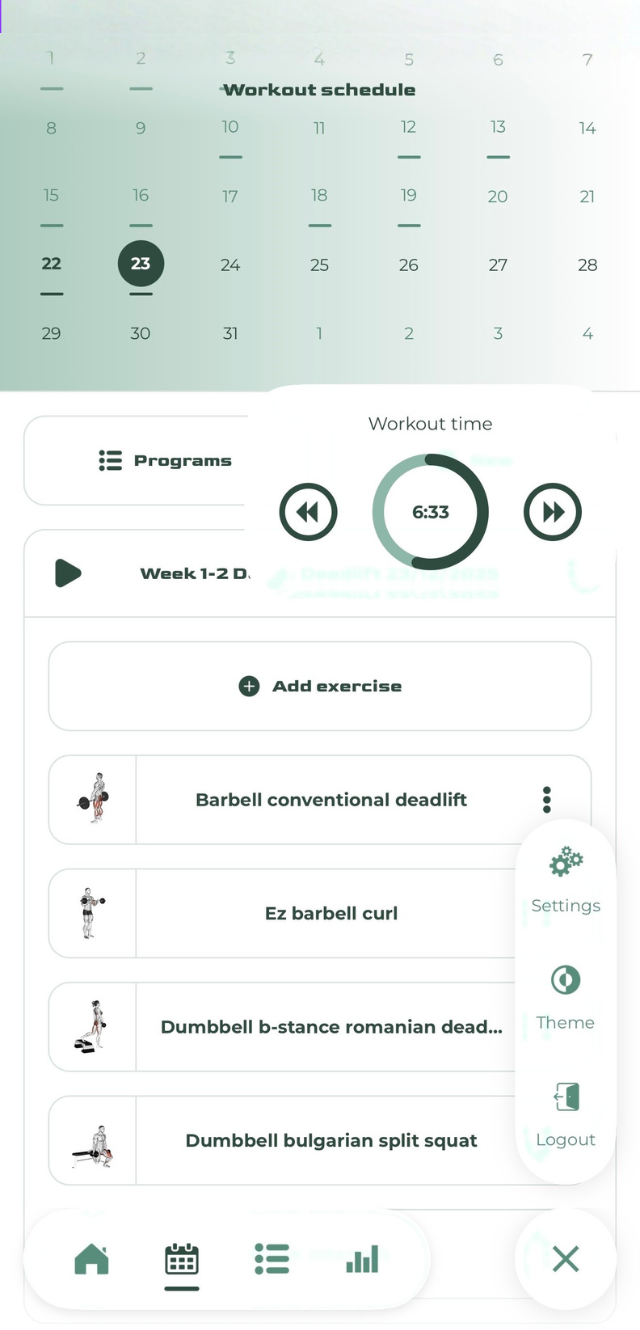
Virtus Athlete home screen with the week's scheduled workouts and progress summary

Frequently Asked Questions (FAQ)

How long does one full run take?
With 12 cycles of 5 workouts each (60 total sessions) at 5 days per week, expect approximately 12 weeks (~3 months).
Does the day order matter?
No. Back and arms land next to each other in the published order, which doubles up on biceps two days running. Rearranging is fine. Legs, rest, chest, back, shoulders, rest, arms is a common fix. What matters is that you hit all five sessions and can give each one everything you have.
Is once per week enough frequency for each muscle?
Research generally favours training a muscle twice per week over once for hypertrophy. The counterweight is adherence and per-session volume. If you like this structure and you will actually run it for 12 weeks, it will build muscle. If frequency is your priority, an upper/lower or push pull legs split fits better.
Where do abs go?
They are not programmed. Add them at the end of any session, on whichever days you can. Two or three sessions per week of 2 to 3 sets is plenty.
Can I do cardio?
Yes. If fat loss is the priority, 30 minutes first thing in the morning on four days per week. If muscle is the priority, keep it to two or three 15 to 20 minute sessions after the weights. Avoid heavy cardio on leg day.
Can I swap exercises?
Yes, within the same pattern. If your gym has no Hammer Strength row, use a chest supported row or a barbell row. If there is no pec dec, use cable flyes. Keep the number of exercises per day the same so the volume per body part does not drift.
The sessions feel too long. What do I cut?
Cut the last exercise of the day, not sets from the first ones. Five exercises at three hard sets beats six exercises where the last two are junk.
What happens if I miss a workout?
Pick up where you left off. Do not double up two body parts into one session to catch up.
How do I enter my starting weights?
Enter the weight you can hit for 8 clean reps on all three sets with 1 to 2 reps in reserve on the first set. The program handles the progression from there.
What happens after 12 weeks?
Restart with your current weights and a refreshed exercise selection, or move to a higher frequency split if the once-per-week frequency did not produce what you wanted.

Related Articles

Track This Program

Build unlimited programs, log every set, and track your progress over time. Free on iOS & Android.