Based on Mehdi Hadim's StrongLifts 5×5 program, with some minor adaptations.
A simple A/B alternating barbell program for beginners. 3 days per week with linear progression on 5 compound lifts. Designed to run for 12 weeks.
Written by Hamza J
Based on Mehdi Hadim's StrongLifts 5×5 program, with some minor adaptations.
A simple A/B alternating barbell program for beginners. 3 days per week with linear progression on 5 compound lifts. Designed to run for 12 weeks.
StrongLifts 5×5 is for new or returning lifters who want to get stronger and build muscle with a straightforward approach. The entire program revolves around just five barbell exercises performed in two alternating workouts.
The program focuses on:
If you want a no-nonsense program that tells you exactly what to do and when to add weight, this is it.
| Lift | Movement Pattern |
|---|---|
| Barbell Back Squat | Lower body push |
| Barbell Bench Press | Horizontal push |
| Barbell Overhead Press (OHP) | Vertical push |
| Barbell Conventional Deadlift | Hip hinge |
| Barbell Row | Horizontal pull |
The program uses two workouts that alternate across 3 training days per week:
Workout A:
| Exercise | Sets × Reps |
|---|---|
| Squat | 5×5 |
| Bench Press | 5×5 |
| Barbell Row | 5×5 |
Workout B:
| Exercise | Sets × Reps |
|---|---|
| Squat | 5×5 |
| Overhead Press | 5×5 |
| Deadlift | 1×5 |
The deadlift is performed for only 1 set of 5 reps instead of 5×5. The deadlift is extremely taxing on the body, and you're already squatting 5×5 three times per week using many of the same muscles. One heavy set is enough to drive progression without overloading recovery.
Each workout follows the same order:
This ordering ensures you hit the most challenging movements when your energy is highest.
The workouts alternate in an A/B pattern across each week:
Odd Weeks (1, 3, 5...):
Even Weeks (2, 4, 6...):
Train 3 days per week with at least one rest day between sessions. A typical schedule is Monday / Wednesday / Friday.
The program can also be performed 2 days per week if time is limited. This yields approximately 80% of the strength gains compared to the 3-day frequency. Just keep alternating Workout A and Workout B.
5×5 means five sets of five reps using the same weight across all sets. If you're squatting 60 kg, you do five separate sets of five reps at 60 kg, resting between each set.
This is called "straight sets," meaning the weight stays the same for every set. The only exception is the deadlift at 1×5 (one set of five reps).
StrongLifts 5×5 uses linear progression, meaning you add weight every session.
| Exercise | Weight Added | Frequency |
|---|---|---|
| Squat | +2.5 kg (5 lbs) | Every session |
| Bench Press | +2.5 kg (5 lbs) | Every session it appears |
| Overhead Press | +2.5 kg (5 lbs) | Every session it appears |
| Barbell Row | +2.5 kg (5 lbs) | Every session it appears |
| Deadlift | +5 kg (10 lbs) | Every session it appears |
The weight added is to the total bar weight, not per side. Since the squat appears in every workout (3 times per week), it progresses the fastest.
Only add weight if you completed all sets and reps with proper form:
Everything below assumes your form is already solid. Finding your working weight, adding weight, chasing reps, all of it only works if you can perform the lift correctly. While your form is not locked in, that is your only job. Make good form the goal of every set, not the weight on the bar. Drilling the movement with an empty bar beats loading plates onto a lift you cannot control yet.
To learn, don't hesitate to search Google and YouTube (there is a lot of good free material) and record yourself from the side to compare against a proper demonstration. In general, good form means a full controlled range of motion, a braced neutral spine, no bouncing or momentum, a consistent setup every rep, and ending the set when technique breaks down rather than grinding sloppy reps.
If you don't know your starting weights:
For deadlift and barbell row, start with 30-45 kg (65-95 lbs) since these exercises require plates to reach proper bar height.
It's better to start too light than too heavy. The linear progression will catch up quickly.
Before each exercise, perform 3-4 warm-up sets with increasing weight. This prepares your joints and muscles for the working weight and lets you practice the movement pattern.
| Set | Weight | Reps | Rest |
|---|---|---|---|
| 1 | ~40% of working weight | 5 | 45 seconds |
| 2 | ~60% of working weight | 3 | 60 seconds |
| 3 | ~80% of working weight | 2 | 60 seconds |
| Work sets | 100% | 5×5 | 1.5-5 minutes |
Example: If your working weight for squat is 80 kg:
Warm-up sets should feel easy. They are not work sets. If two exercises use similar muscles back-to-back, the second exercise needs fewer warm-up sets since the muscles are already warm.
| Situation | Rest Period |
|---|---|
| Between sets (weight felt easy) | 1.5-3 minutes |
| Between sets (weight felt heavy) | 3-5 minutes |
| Between exercises | Up to 5 minutes |
Take as much rest as you need to complete your sets with good form. Rushing rest periods leads to missed reps.
Not all failures are the same. Understanding the type helps you fix the root cause:
If you cannot complete all 5 reps on a set with proper form:
Poor recovery is one of the top reasons for failing reps. Ensure you're covering the basics:
If you fail to complete 5×5 at the same weight for three consecutive sessions, deload:
Example:
Bench stuck at 70 kg for 3 sessions:
  New weight: 70 × 0.90 = 63 kg (round to nearest increment)
  Progress from 63 kg adding 2.5 kg per session
Each exercise deloads independently, so a stall on bench press doesn't affect your squat weight. Exhaust other solutions first (better sleep, nutrition, longer rest, microloading) before resorting to a deload.
A plateau occurs when you remain stuck at the same weight despite deloading and rebuilding. This is normal as you get stronger because linear progression doesn't last forever.
Not a plateau:
Common mistakes when dealing with plateaus:
What to do when you truly plateau:
Straight sets (default): same weight for all 5 sets, targeting RPE 6-8 (2-4 reps in reserve). Recommended for new and returning lifters.
Top/back-off sets: 1 heavy set of 5 reps followed by 4 lighter sets of 5 reps. Use this approach when you consistently fail on straight sets and have exhausted deloads.
Benefits of top/back-off sets:
Most strength and muscle gains come from the main 5 lifts. Assistance work is optional and adds approximately 15 minutes per workout.
Workout A additions:
Workout B additions:
Workout A additions:
Workout B additions:
Workout A additions:
Workout B additions:
Research shows that compound lifts alone build substantial arm size. You need approximately 10+ weekly sets per muscle group for maximum gains, and medium volume (5-9 sets) already yields about 80% of potential muscle growth. The main lifts already provide significant volume for arms, shoulders, and back.
Cardio can be combined with StrongLifts 5×5 without interfering with strength gains if programmed correctly.
When: rest days (Tuesday/Saturday, optionally Thursday)
Duration: 10-25 minutes per session. Start with less if you're not conditioned.
Intensity: moderate. You should be able to hold a conversation while doing it.
Type: any form you enjoy, such as cycling, rowing, swimming, jogging, or brisk walking.
Moderate-intensity cardio on rest days acts as active recovery, flushing blood into muscles and reducing soreness from lifting.
The program provides full-body coverage through compound movements:
| Muscle Group | Exercises |
|---|---|
| Quads & Glutes | Squat, Deadlift |
| Hamstrings | Deadlift, Squat, Row |
| Chest | Bench Press |
| Shoulders | Overhead Press, Bench Press |
| Back | Barbell Row, Deadlift |
| Triceps | Bench Press, Overhead Press |
| Biceps | Barbell Row |
| Core | Squat, Deadlift, Overhead Press |
This program is designed to run for 12 weeks (12 cycles of 3 workouts each, totaling 36 sessions).
Why 12 weeks?
The 5×5 method dates back to at least 1958, when British bodybuilder Reg Park published his 5×5 approach in "Strength and Bulk Training for Weight Lifters and Body Builders." Park, a 3x Mr. Universe winner (1951, 1958, 1965) and Arnold Schwarzenegger's mentor, was the first bodybuilder to bench press 500 lbs, and also lifted 605 lbs in the squat and 700 lbs in the deadlift.
Notably, powerlifting as a sport didn't exist until 1964, six years after Park published his program. The 5×5 workout originated as a bodybuilding program, not a strength sport methodology.
The 5×5 framework evolved through contributions from Bill Starr, Stuart McRobert, Glenn Pendlay, Pavel Tsatsouline, and others who adapted the core principles for different training goals. Mehdi Hadim later popularized it as StrongLifts 5×5 for a modern audience.
If you would like to read the original program page:
Virtus Athlete fully integrates StrongLifts 5×5, handling all the linear progression and workout alternation for you. Just enter your starting weights and start training.
Free on iOS and Android.
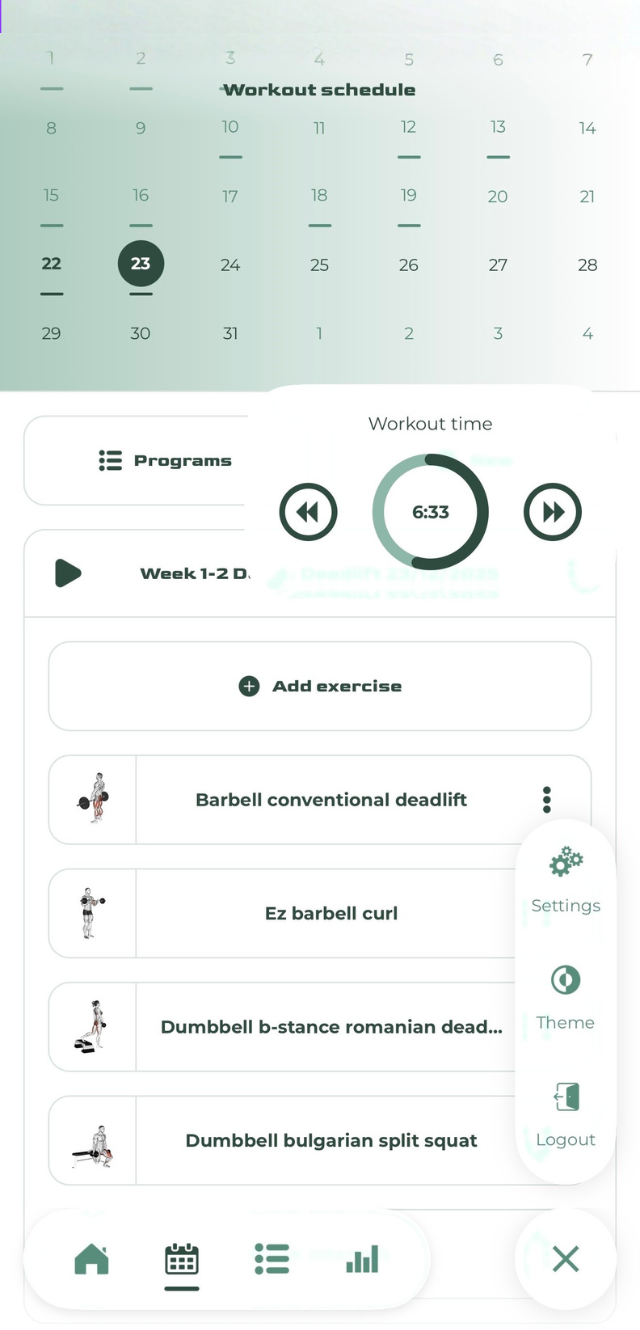
Build unlimited programs, log every set, and track your progress over time. Free on iOS & Android.
 App Store
 Google Play