Based on John Sheaffer's GreySkull LP, with some minor adaptations.
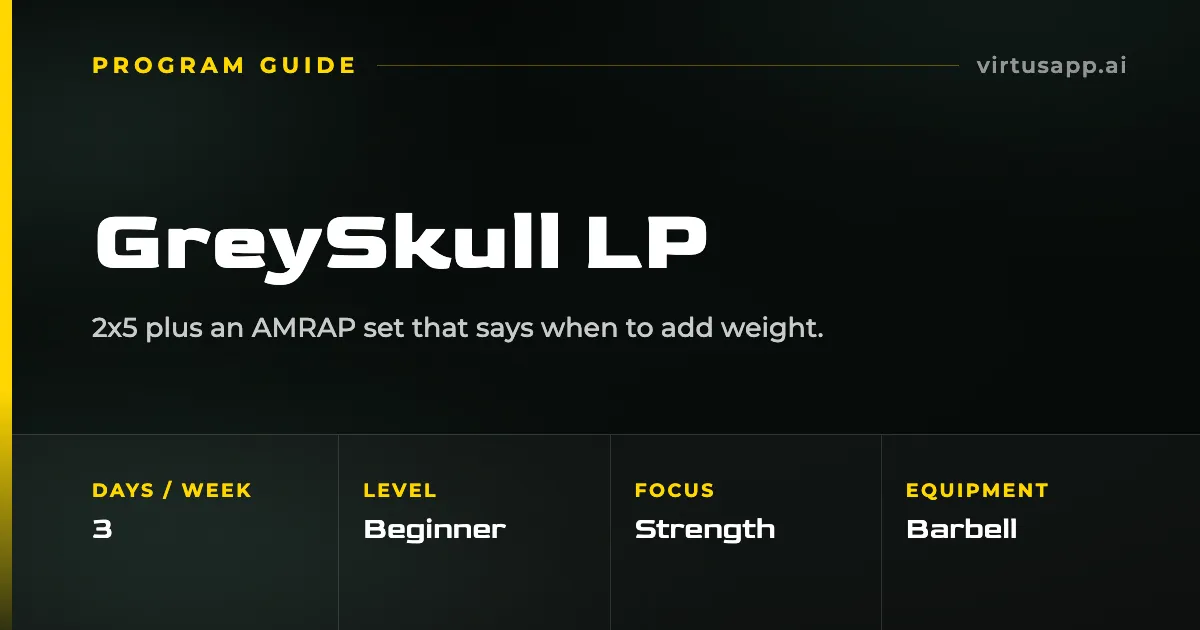
A linear progression program built around a simple twist: the last set of every lift is taken for as many reps as possible. 3 full body days per week, upper body pressing first, squats twice a week, deadlifts once. The AMRAP set drives the progression, telling you when to add the normal increment, when to jump faster, and when to reset.
GreySkull LP is for new or returning lifters who want linear progression without the rigidity of fixed five-rep sets. John Sheaffer (also known as Johnny Pain) built it after running the classic novice programs and deciding they left too much on the table: too rigid, too squat-dominant, and no way to express a good day.
The program focuses on:
- Low fixed volume: two sets of five, then one all-out set
- Autoregulation: on good days the AMRAP set gives you extra volume, on bad days you just hit the minimum
- Upper body priority: pressing comes first in every session, while you are freshest
- Built-in resets: stalls are part of the plan, with a 10% reset that turns into a high-rep rebuilding phase
If you like the idea of adding weight every session but want each workout to adapt to how strong you actually are that day, this is the program.
The Main Lifts
| Lift | Movement Pattern |
|---|
| Barbell Overhead Press | Vertical push |
| Barbell Bench Press | Horizontal push |
| Barbell Back Squat | Lower body push |
| Barbell Conventional Deadlift | Hip hinge |
Weekly Layout
Every session starts with a press. The overhead press and bench press alternate from session to session. Squats are performed on the first and third day of the week, the deadlift on the middle day.
Day 1 (e.g., Monday):
| Exercise | Sets × Reps |
|---|
| Overhead Press or Bench Press | 2×5, 1×5+ |
| Squat | 2×5, 1×5+ |
Day 2 (e.g., Wednesday):
| Exercise | Sets × Reps |
|---|
| Bench Press or Overhead Press | 2×5, 1×5+ |
| Deadlift | 1×5+ |
Day 3 (e.g., Friday):
| Exercise | Sets × Reps |
|---|
| Overhead Press or Bench Press | 2×5, 1×5+ |
| Squat | 2×5, 1×5+ |
Because the two presses simply alternate, the press you start the week with swaps every week. Over two weeks, each press gets trained three times.
Week 1: Press / Bench / Press
Week 2: Bench / Press / Bench
Train 3 days per week with at least one rest day between sessions. A typical schedule is Monday / Wednesday / Friday.
Understanding 2×5, 1×5+
The notation means two straight sets of five reps, then a final set where 5 reps is the minimum and you keep going for as many reps as possible with good form. The deadlift skips the straight sets entirely: one single all-out set of 5 or more reps per week.
The AMRAP set is the engine of the program. Stop the set when your form starts to break down, not when you hit an arbitrary number.
Optional Plug-Ins
The base program is deliberately minimal, and Sheaffer's book offers plug-ins to bolt on according to your goals. The most common ones:
- Curls: 2 sets of 10-15 after the main work
- Weighted chin-ups: 2 sets of 6-8, once you can do at least 6-8 bodyweight chin-ups
- Frequency work: easy bodyweight pull-ups or push-ups spread through the week
Plug-ins are optional. The main lifts drive the progress.
GreySkull LP uses linear progression, meaning you add weight every session, with the AMRAP set deciding how fast.
| Exercise | Standard Increment | If AMRAP hits 10+ reps |
|---|
| Overhead Press | +1.25 kg (2.5 lbs) | +2.5 kg (5 lbs) |
| Bench Press | +1.25 kg (2.5 lbs) | +2.5 kg (5 lbs) |
| Squat | +2.5 kg (5 lbs) | +5 kg (10 lbs) |
| Deadlift | +2.5 kg (5 lbs) | +5 kg (10 lbs) |
The weight added is to the total bar weight, not per side.
The 10-rep rule: if your final AMRAP set reaches 10 or more reps, the weight is too light for you, so you double the increment next session. Keep doubling each session until the AMRAP set drops back under 10 reps, then return to the standard increment.
Microplates are required. The 1.25 kg (2.5 lb) upper body jumps only work with fractional plates of 0.5 kg (1.25 lbs) per side. Sheaffer considers them mandatory for running the program as written.
Everything below assumes your form is already solid. Finding your working weight, adding weight, chasing reps, all of it only works if you can perform the lift correctly. While your form is not locked in, that is your only job. Make good form the goal of every set, not the weight on the bar. Drilling the movement with an empty bar beats loading plates onto a lift you cannot control yet.
To learn, don't hesitate to search Google and YouTube (there is a lot of good free material) and record yourself from the side to compare against a proper demonstration. In general, good form means a full controlled range of motion, a braced neutral spine, no bouncing or momentum, a consistent setup every rep, and ending the set when technique breaks down rather than grinding sloppy reps.
If you don't know your starting weights:
- Start with just the empty barbell (20 kg / 45 lbs)
- Perform 5 reps
- Add 5-10 kg (10-20 lbs)
- Perform another set of 5 reps
- Repeat until bar speed noticeably slows or form starts to break down
- Use that weight as your starting weight
For the deadlift, start with 40-45 kg (90-95 lbs) since the bar needs full size plates to sit at proper height.
It's better to start too light than too heavy. GreySkull LP self-corrects this better than any other novice program: if you start too light, your AMRAP sets will hit 10+ reps and the double increments will catch you up within a few weeks.
Before each exercise, perform 3-4 warm-up sets with increasing weight. This prepares your joints and muscles for the working weight and lets you practice the movement pattern.
| Set | Weight | Reps | Rest |
|---|
| 1 | ~40% of working weight | 5 | 45 seconds |
| 2 | ~60% of working weight | 3 | 60 seconds |
| 3 | ~80% of working weight | 2 | 60 seconds |
| Work sets | 100% | 2×5, 1×5+ | 1.5-5 minutes |
Example: If your working weight for squat is 80 kg:
- Set 1: 30 kg × 5
- Set 2: 47.5 kg × 3
- Set 3: 62.5 kg × 2
- Work sets: 80 kg × 2×5, then 1×5+
Warm-up sets should feel easy. They are not work sets.
| Situation | Rest Period |
|---|
| Between sets (weight felt easy) | 1.5-3 minutes |
| Between sets (weight felt heavy) | 3-5 minutes |
| Before the AMRAP set | 3-5 minutes |
| Between exercises | Up to 5 minutes |
The AMRAP set is where the program's progress is made, so make sure you are fully rested before it. Rushing into it costs you reps.
A lift fails when the final AMRAP set falls below 5 reps. When that happens on a lift:
- Take 10% off the bar for that lift only
- Resume the standard progression from the reduced weight
Example:
Bench AMRAP falls to 4 reps at 80 kg:
  New weight: 80 × 0.90 = 72 kg (round to nearest increment)
  Progress from 72 kg adding 1.25 kg per session
Each exercise resets independently, so a stall on the bench press doesn't affect your squat weight.
The reset is not wasted time. On the way back up, the lighter weights turn your AMRAP sets into 8-12 rep sets, which is a deliberate hypertrophy phase. By the time you return to your old sticking point you are carrying more muscle and more momentum, and you typically blow straight past it. Before resetting, check the usual suspects: sleep 7-9 hours, eat enough calories, get 1.5-2.2 g of protein per kg of bodyweight (0.7-1 g per lb), and rest longer between sets.
GreySkull LP has no fixed end date by design. The reset mechanic keeps linear progression alive far longer than fixed-rep programs, because every reset converts into a hypertrophy wave that fuels the next run at the weight.
A typical run lasts 3 to 6 months. When a lift stalls at the same weight across two or three resets despite good recovery, you have exhausted the linear progression on that lift and are ready for intermediate programming.
If you would like to read the original program, it is published as a book, with a detailed free writeup available online:
The GreySkull LP by John Sheaffer
GreySkull LP Program Overview on Lift Vault

 iOS
iOS Android