4 minutes. 8 rounds. 20 seconds work, 10 seconds rest. That's a Tabata.
A Tabata workout is a high-intensity interval protocol with a strict 20:10 ratio for 8 rounds, exactly 4 minutes of total work. To run one correctly, you need a timer that signals every 20-second work interval and 10-second rest.
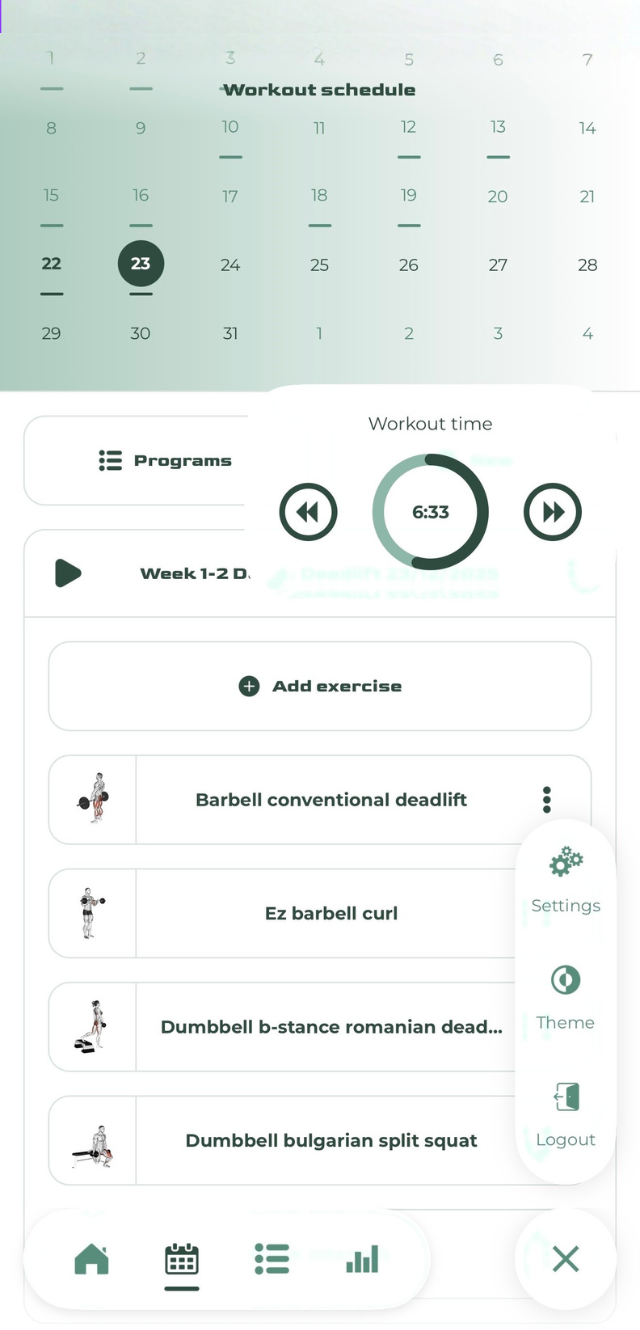
The Virtus Athlete app has a built-in interval timer for Tabata, EMOM, AMRAP, and any custom work/rest protocol. Download it free, works offline, plays clear audio cues so you don't have to look at your phone mid-set.
The original Tabata study (Izumi Tabata, 1996) used:
- Work: 20 seconds at 170% of VO₂ max (essentially all-out)
- Rest: 10 seconds
- Rounds: 8 (4 minutes total)
- Modality: stationary bike
The protocol produced larger improvements in both anaerobic and aerobic capacity than 60 minutes of moderate cardio, in the original study population.
What got popularized as "Tabata" since then is a loose interpretation: any 20/10 × 8 protocol on any exercise. Real Tabata-protocol intensity (170% VO₂ max) is brutal, most "Tabata workouts" online are far below that intensity, which is fine for general fitness but won't replicate the original results.
- Pick a movement (or a sequence of movements).
- Start the timer.
- Work hard for 20 seconds.
- Rest 10 seconds.
- Repeat 8 times.
Total: 4 minutes. Most timers (including Virtus) play a beep at the start and end of each interval so you don't have to watch the screen.
For multi-Tabata workouts, take a 1-minute rest between Tabatas.
1. Single-Movement Tabata (Beginner)
8 rounds of:
- 20 seconds: jump squats, burpees, mountain climbers, or rower
- 10 seconds rest
Pick one movement. Hammer it for the full 4 minutes.
2. Squat-Sprint Tabata (Lower Body)
Alternate rounds:
- Round 1, 3, 5, 7: bodyweight jump squats
- Round 2, 4, 6, 8: high-knees in place
20 sec work / 10 sec rest × 8.
3. Push-Pull Tabata (Upper Body)
Alternate rounds:
- Odd rounds: push-ups
- Even rounds: inverted rows or band pulls
20 / 10 × 8.
4. Cardio Tabata (Conditioning)
Pick one machine, bike, rower, or ski erg. 20 seconds all-out, 10 seconds slow recovery, 8 rounds.
This is closest to the original Tabata protocol.
5. The 4-Round Tabata Stack (Advanced)
4 separate Tabatas, 1 minute rest between:
- Tabata 1: rower
- Tabata 2: kettlebell swings
- Tabata 3: burpees
- Tabata 4: mountain climbers
Total: 4 × 4 min = 16 min work + 3 min rest = 19 minutes.
This is a complete metabolic conditioning session.
1. Going too slow. "Tabata" without near-max intensity is just interval cardio. If you can do 20 reps each round, the weight or movement is too easy.
2. Long rest periods. 10 seconds is the rule. Stretching it to 20-30 seconds defeats the protocol's design.
3. Mixing in skill-heavy movements. Olympic lifts, muscle-ups, double-unders, these break down under fatigue and increase injury risk. Stick to simple, high-output movements.
4. Doing Tabata every day. The intensity is too high for daily use. 1-2 Tabatas per week, max, integrated into a broader program.
The 20/10 ratio creates an oxygen debt that the 10-second rest cannot pay back. By round 3-4, you are operating in deep anaerobic territory. The body responds by improving:
- VO₂ max (aerobic capacity)
- Anaerobic threshold
- Lactate clearance
- Mental tolerance for discomfort
But Tabata is not a strength-building protocol. The intensities are too high to recruit max-strength fibers, and the volume is too low to drive muscle hypertrophy. Use it for conditioning, not for hypertrophy.

 iOS
iOS Android