You don't need to attempt a true 1RM to know what you can lift.
A one-rep max (1RM) is the most weight you can lift for a single repetition. Knowing it lets you set training percentages accurately, plan progressions, and compare lifts across exercises. But actually attempting a max lift is risky and unnecessary for most lifters. The Epley formula estimates your 1RM from any submaximal set with surprising accuracy.
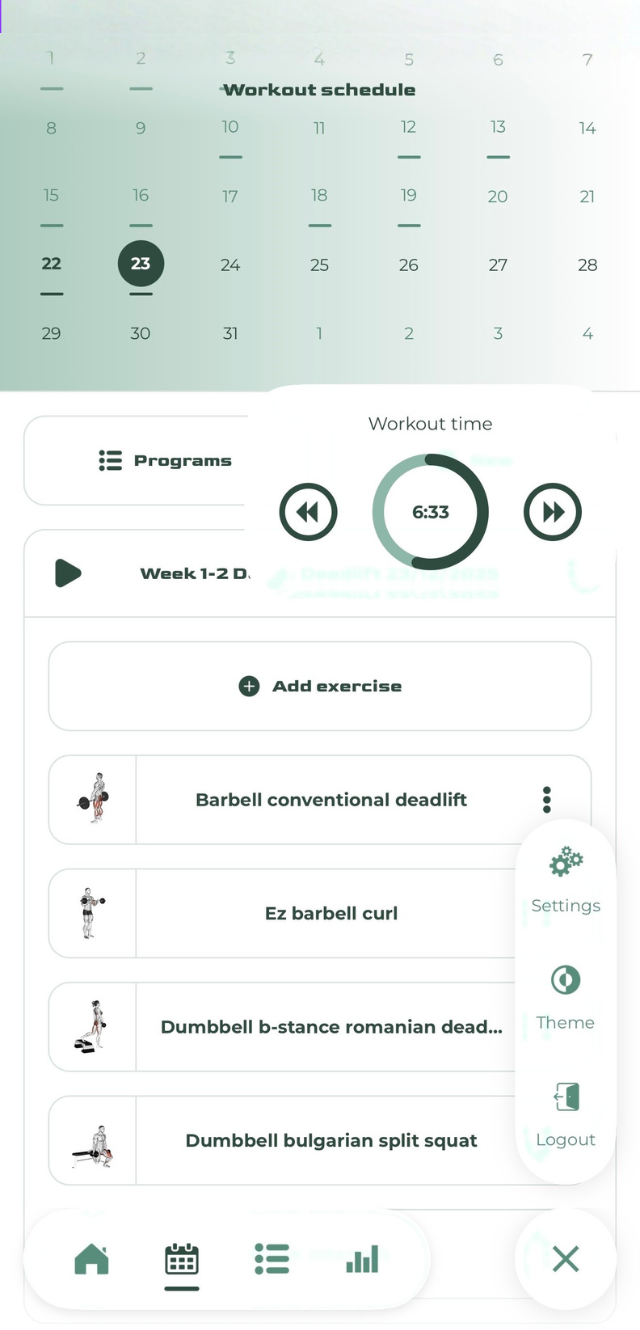
The Virtus Athlete app has a 1RM calculator built in. Open the app, enter the weight you lifted and the reps you completed, and your estimated 1RM appears instantly along with weights for every rep range. Download the app to use it on every lift. Also available as a free web tool that accepts both kg and lb.
The most widely used 1RM formula:
1RM = weight × (1 + reps/30)
If you bench press 80 kg for 8 reps, your estimated 1RM is:
80 × (1 + 8/30) = 80 × 1.267 = 101.3 kg
The formula is most accurate in the 2-10 rep range. Below 2 reps it overestimates. Above 10 reps it loses accuracy because muscular endurance becomes a bigger factor than pure strength.
The Virtus Athlete app uses Epley because it is the formula with the best research support for general strength training, especially in the 3-8 rep range where most lifters work.
- Pick a weight you can lift for 2 to 10 reps with good form.
- Take the set as close to failure as you can manage safely (1-2 reps in reserve).
- Note the weight and the reps completed.
- Plug into the formula or use the app.
For best accuracy, use a weight that lands you in the 5-8 rep range. The formula's error grows in both directions outside this window.
The Epley formula reverses to give you the weight for a target rep range, given your 1RM:
weight = 1RM / (1 + target_reps/30)
If your bench 1RM is 100 kg and you want to do sets of 5:
100 / (1 + 5/30) = 100 / 1.167 = 85.7 kg
This is how the app populates your working weight for every rep range automatically.
| Reps | % of 1RM | Use Case |
|---|
| 1 | 100% | True max attempt |
| 2 | 95% | Heavy doubles, peak strength |
| 3 | 90% | Heavy triples, peaking |
| 5 | 85% | Strength work (5/3/1, Starting Strength) |
| 6 | 83% | Strength-hypertrophy crossover |
| 8 | 79% | Hypertrophy zone (top end) |
| 10 | 75% | Hypertrophy / volume |
| 12 | 71% | Hypertrophy / endurance crossover |
| 15 | 65% | Muscular endurance |
| 20 | 60% | Endurance, conditioning |
These percentages come directly from the Epley formula. They're useful for programming rep schemes from a known 1RM (or estimated 1RM).
Progressive overload programming. Your program calls for 3 × 5 at 85%? Plug your 1RM in, the app gives you the weight to load.
Comparing lifts. A 100 kg bench for 5 reps and an 85 kg bench for 8 reps look similar in absolute volume but the Epley estimates are different (117 vs 108 kg). 1RM is a cleaner cross-comparison.
Avoiding max attempts. A new lifter has no business attempting a true 1RM. A trained 5RM with the Epley formula gives the same information at a fraction of the injury risk.
Tracking progress. If your e1RM (estimated 1RM) keeps climbing across mesocycles, you're getting stronger, even if you never test a true max.
Epley is an approximation. The estimate gets less reliable when:
- Reps go above 10. The further beyond 10, the more endurance dominates over strength. A 30-rep set of squats does not actually represent the 1RM the formula predicts.
- You stop short of failure. If you bench 80 × 8 with 5 reps in reserve, your true e1RM is much higher than the formula returns.
- The lift involves heavy technique loss at fatigue. Olympic lifts, snatches, cleans, and jerks don't follow the Epley curve cleanly because technique degrades fast.
For most barbell lifts (squat, bench, deadlift, overhead press, rows) in the 3-10 rep range, taken close to failure, Epley is accurate within 2-5%.

 iOS
iOS Android