Back to BlogPrograms

How to run the Dumbbell PPL program

2026-06-0811 min read

Written by Hamza J

How to run the Dumbbell PPL program

Based on the Dumbbell PPL program by u/gregariousHermit on the r/Fitness wiki, with some minor adaptations.

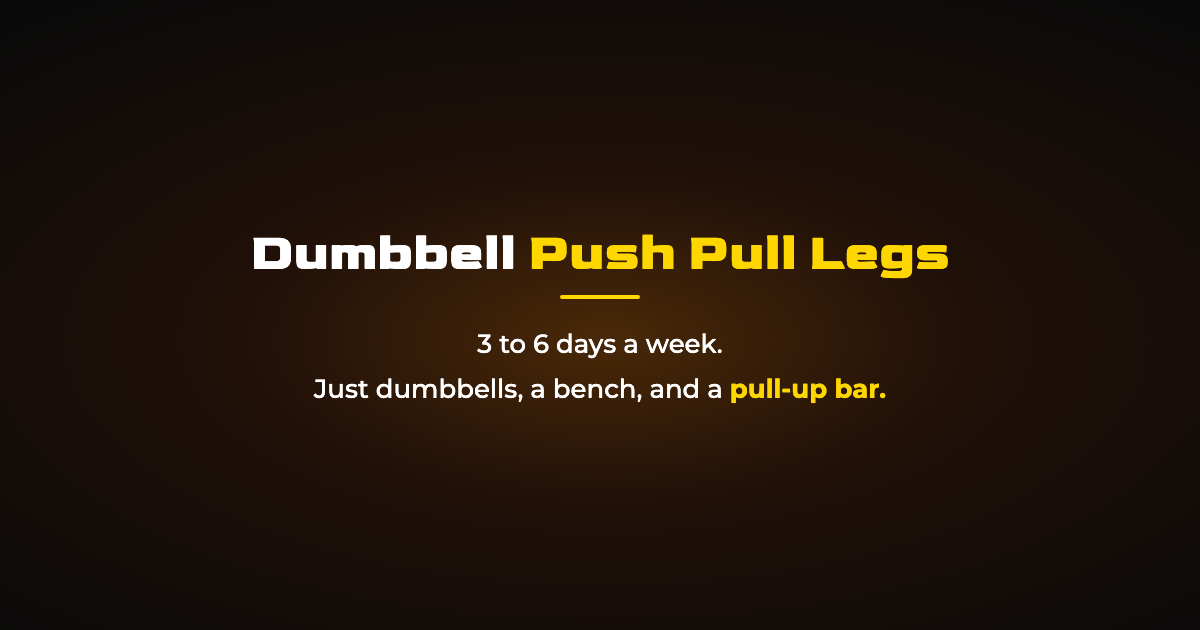
A flexible Push/Pull/Legs split using only dumbbells, an adjustable bench, and a pull-up bar. Hypertrophy-focused with double progression on every exercise. Run it 3, 4, or 6 days per week.


Who Is This Program For?

Dumbbell PPL is for lifters with home dumbbells who want more volume than the Dumbbell Stopgap and a hypertrophy-focused template. It takes the well-established Push/Pull/Legs split, applies it with dumbbells, and uses double progression to drive consistent muscle growth.

The program focuses on:

  • Frequency flexibility: train 3, 4, or 6 days per week
  • Hypertrophy: 3-12 rep range with AMRAP top sets
  • Balanced split: each muscle group hit at least once (or twice on 6 days)
  • Minimal barbell dependency: only requires dumbbells, a bench, and a pull-up bar

If you have a home gym without a barbell, travel often, or just prefer dumbbells, this is the most popular community-tested option.


Program Structure

Equipment Required

  • Adjustable dumbbells (or a range of fixed-weight pairs)
  • Adjustable bench (flat bench works as a fallback)
  • Pull-up bar

The Three Workouts

Push Day:

ExerciseSets × Reps
Dumbbell Chest Press3 × 3-12
Incline Dumbbell Chest Fly3 × 3-12
Arnold Press3 × 3-12
Dumbbell Triceps Extension3 × 3-12
Hanging Leg Raise3 × 3-12

Pull Day:

ExerciseSets × Reps
Pull-ups (or Bodyweight Rows)3 × 3-12
Dumbbell Bent Over Row3 × 3-12
Reverse Fly3 × 3-12
Dumbbell Bicep Curl3 × 3-12
Dumbbell Shrug3 × 3-12
Hanging Leg Raise3 × 3-12

Leg Day:

ExerciseSets × Reps
Goblet Squat3 × 3-12
Dumbbell Lunge3 × 3-12
Single Leg Romanian Deadlift3 × 3-12
Standing Calf Raise3 × 3-12
Hanging Leg Raise3 × 3-12

Weekly Schedule Options

3-Day Split (Beginner)

DayWorkout
MondayPush
TuesdayRest
WednesdayPull
ThursdayRest
FridayLegs
SaturdayRest
SundayRest

4-Day Split (Intermediate)

Alternate Push/Pull/Legs through the week, taking rest days strategically:

DayWorkout
MondayPush
TuesdayPull
WednesdayRest
ThursdayLegs
FridayPush
SaturdayRest
SundayRest

6-Day Split (Advanced)

DayWorkout
MondayPush
TuesdayPull
WednesdayLegs
ThursdayPush
FridayPull
SaturdayLegs
SundayRest

Understanding the Set Scheme

The "3 × 3-12" scheme means 3 sets, each performed AMRAP (As Many Reps As Possible) capped at 12 reps.

How it works:

  • Pick a weight where your first set lands somewhere in the 3-12 rep range
  • For each set, do as many reps as possible with good form, stopping at 12 (do not exceed)
  • Stop 1-2 reps before failure, when bar speed slows or form breaks down
  • Rest about 90 seconds between sets

The wide 3-12 rep range exists because dumbbell jumps are coarse. When you increase weight, you might drop to 5 reps. When you've adapted, you might hit 12. The range absorbs that variability.


Progression: How Weights Increase

Dumbbell PPL uses double progression: chase reps within the range first, then increase weight.

Standard Progression

ConditionAction
All 3 sets hit 12 repsIncrease dumbbell weight by one increment next session
Stuck at same weight + same reps for 3 consecutive sessionsDeload that exercise by ~10% and rebuild

When you increase weight, your reps will drop. That's expected. Chase them back up to 12 over the next several sessions.

Bodyweight Exercises

For pull-ups and hanging leg raises:

  • If you cannot hit 3 reps yet, use band-assisted variations or negatives
  • When you can hit 3×12 with bodyweight, progress to weighted variations (hold a dumbbell between your feet)
  • Add weight in the smallest increment available

Rest Times

SituationRest Period
Between sets~90 seconds
Between exercises1-2 minutes

90 seconds is the default. If you're hitting heavier weights at the bottom of the rep range (3-5 reps), extend to 2-3 minutes. If you're at the top of the range (10-12), 60-90 seconds works.


Finding Your Starting Weights

For each exercise, pick a weight where your first set lands somewhere between 5 and 10 reps. This gives you room to grow within the 3-12 range before needing to increase.

If You Don't Know Your Starting Weights

  1. Start with a moderate dumbbell pair you've used before, or the lightest pair you have
  2. Perform a single set up to 12 reps
  3. If you hit 12 with reps to spare, increase weight next session
  4. If you can't hit 5, decrease weight next session
  5. The double progression will sort itself out within 2-3 sessions

It's better to start too light than too heavy. The first few sessions are calibration.


Warming Up

Before each compound exercise, perform 1-3 warm-up sets with increasing weight:

  • Set 1: ~50% of working weight × 5 reps
  • Set 2: ~75% of working weight × 3 reps
  • Set 3 (optional): ~90% × 1 rep
  • Working sets: 100% × 3×3-12

Isolation exercises (curls, raises, flyes) typically need fewer warm-up sets since the muscles are already warm from the compounds.


Program Duration

The program is designed to run for 8 weeks as a structured cycle. After that, you can:

  • Restart at your current weights
  • Continue indefinitely if double progression keeps working
  • Transition to a barbell-based program if you gain barbell access

Access the Original Program

If you would like to read the original Dumbbell PPL write-up:

Dumbbell PPL on the r/Fitness Wiki


Run Dumbbell PPL on Virtus Athlete

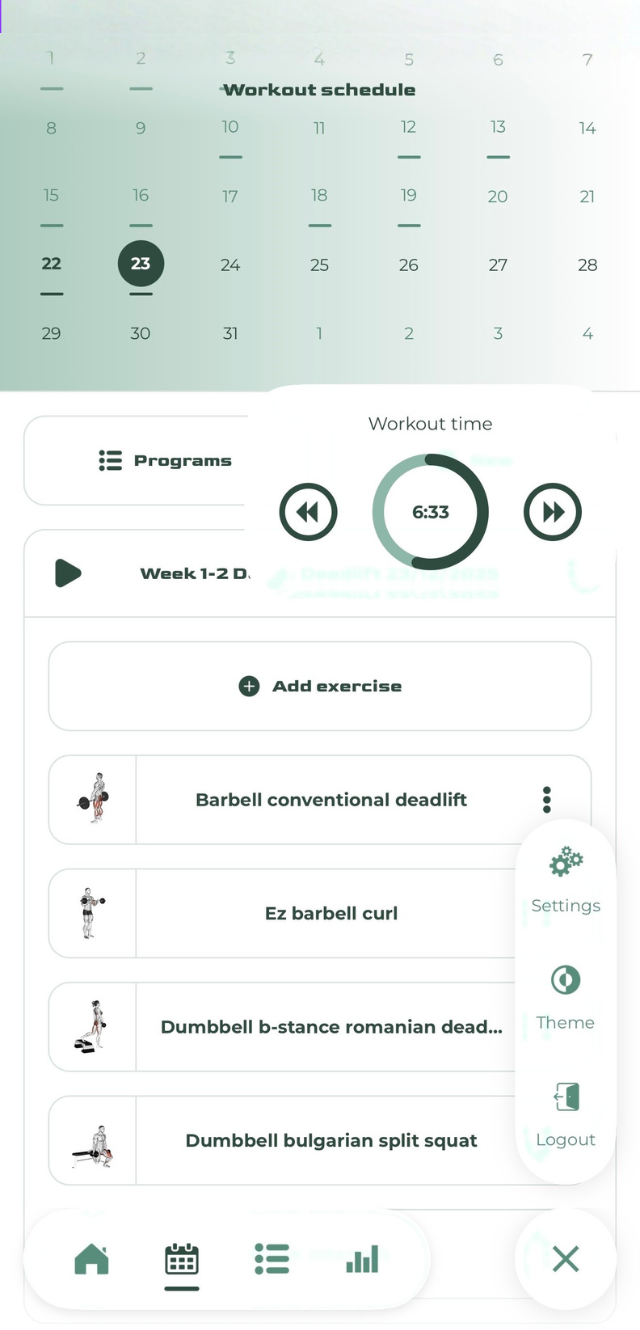
Virtus Athlete fully integrates Dumbbell PPL, handling the schedule (3, 4, or 6 day), double progression within the 3-12 rep range, and deload logic for you. Just enter your starting weights, pick your schedule, and start training.

Download Virtus Athlete


Frequently Asked Questions (FAQ)

How long does one full run take?
With 8 weeks at 3-6 sessions per week, expect 24-48 total workouts over ~2 months.
Which schedule should I pick?
- 3-day: beginners, time-constrained, or when recovering from heavy life stress - 4-day: intermediates with average recovery - 6-day: advanced lifters or those who genuinely train 6 days/week without recovery issues Don't pick a higher frequency thinking it will get you results faster. Recovery drives progress.
Can I swap exercises?
Stick with the prescribed exercises. They are chosen to cover the muscle groups well with only dumbbells. If you absolutely need to swap, replace with a similar movement (e.g., Goblet Squat ↔ Dumbbell Front Squat).
What if I don't have a pull-up bar?
Use heavy dumbbell rows or inverted rows under a sturdy table as a substitute for pull-ups. You'll be slightly less balanced for vertical pulling but the program still works.
What if my dumbbells aren't heavy enough for goblet squats and rows?
This is the main limitation of dumbbell-only training. Strategies: - Use slower tempos (3-4 second negatives) - Add pauses at the bottom of the lift - Increase reps within the range (you can go above 12 if dumbbells max out) - Switch leg exercises to single-leg variants (Bulgarian split squats, single-leg RDLs) which require less weight
What about cardio?
Add cardio on rest days. 20-30 minutes of moderate-intensity work (walking, cycling, rowing) won't interfere with strength gains.
What's the difference between this and the Dumbbell Stopgap?
The Stopgap is simpler (3 days, 4 exercises per workout, 3×10 cap). Dumbbell PPL has more volume (3-6 days, 5-6 exercises per workout, 3-12 rep range). PPL builds more muscle but requires more equipment and recovery.
How do I enter my starting weights?
Enter a weight where you can hit 5-10 reps on your first set. The double progression handles the rest.

Related Articles

Track This Program

Build unlimited programs, log every set, and track your progress over time. Free on iOS & Android.

Virtus Athlete

The workout app that puts YOU in control of your strength and fitness journey

Follow us

Get the App

Available on iOS and Android for free.

© 2026 Verum Services. All rights reserved.

Virtus Athlete is a training tool, not a medical device nor a substitute for professional guidance. Train responsibly, do your own research, and consult a qualified fitness professional if needed.