Most lifters are already dehydrated.
Water is the most overlooked performance variable in the gym. You track your sets, your reps, your protein. But if you are not tracking your water intake, you are leaving strength on the table.
Written by Hamza J
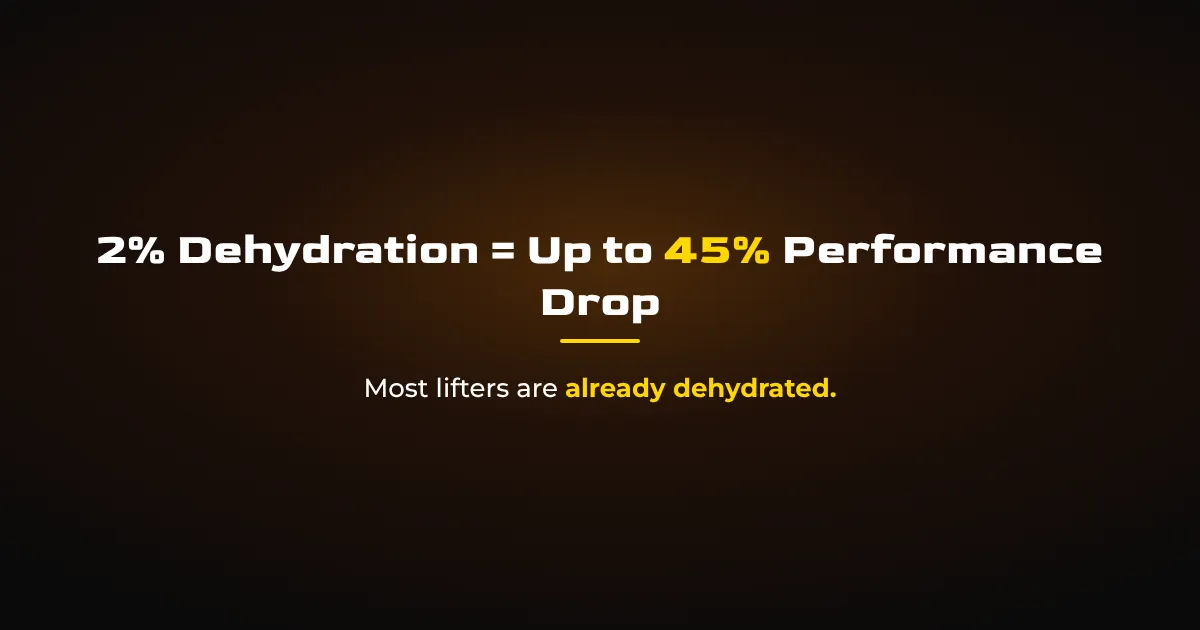
Most lifters are already dehydrated.
Water is the most overlooked performance variable in the gym. You track your sets, your reps, your protein. But if you are not tracking your water intake, you are leaving strength on the table.
Performance decline begins at just 2% body weight loss from dehydration. For a 180-pound lifter, that is only 3.6 pounds of water, easily lost during a hard training session.
| Dehydration Level | Performance Impact |
|---|---|
| 2% body weight | Measurable decline begins |
| 2.5% body weight | Up to 45% drop in high-intensity capacity |
| 2.9% body weight | 19% lower body power loss, 7% upper body |
| 5% body weight | ~30% work capacity decrease |
These are not extreme scenarios. A lifter who skips water before training and sweats through an hour-long session can easily hit 2-3% dehydration.
Dehydration shifts your hormones in the wrong direction:
Research found a strong correlation between dehydration and elevated cortisol, and between dehydration and suppressed testosterone. The more dehydrated you are, the more catabolic your environment becomes.
You can lose 1.5 liters or more of water before feeling thirsty. By the time you are thirsty, your performance is already reduced.
Early signs lifters miss:
If you wait for thirst to tell you to drink, you are already behind.
| When | How Much |
|---|---|
| Daily baseline | ~0.5 oz per pound bodyweight (e.g., 200 lb = 100 oz) |
| Pre-workout (2 hours before) | 500-700 ml (16-24 oz) |
| During training | 120-240 ml (4-8 oz) every 15-20 minutes |
| Post-workout | ~700 ml (24 oz) per pound lost during session |
These are guidelines, not rigid rules. Adjust based on climate, sweat rate, and session intensity. The goal is to never reach the 2% threshold.
Water alone is not enough. Athletes lose 1,000-3,000 mg of sodium per hour through sweat. Even mild electrolyte imbalance can reduce muscular power by up to 15%.
Key electrolytes for training:
Adding electrolytes to your training water is more effective than plain water alone, especially for sessions lasting 60+ minutes.
Log every set, track your lifts, and see your progress over time. Free on iOS & Android.

 iOS
iOS Android