Back to BlogMovements

The Best Ab Exercises for a Strong, Defined Core

2026-06-156 min read

Written by Hamza J

The Best Ab Exercises for a Strong, Defined Core

Sit-ups are not the answer.

Most people training abs do too much trunk flexion (sit-ups, crunches) and almost no anti-rotation or anti-extension work. The result: a sore neck and a weak core under heavy load. The best ab exercises train all three functions of the core, in the right balance.


The 3 Functions of the Core

The core is not just the rectus abdominis (the "six-pack muscle"). It includes obliques, transverse abdominis, erector spinae, and the deep stabilizers. These muscles do three things:

  1. Anti-extension: preventing your spine from arching backward under load (planks, ab wheel rollouts)
  2. Anti-rotation: preventing your torso from twisting under asymmetric load (Pallof press, suitcase carries)
  3. Trunk flexion: flexing the spine forward (sit-ups, crunches, hanging leg raises)

A complete program hits all three. Most people do only flexion, which builds visible abs but leaves the core weak in the most important real-world function: resisting unwanted movement.


The 8 Best Ab Exercises

1. Hanging Leg Raise

Function: trunk flexion + grip
Why it's elite: the strongest version of trunk flexion, demands full-body control.

Hang from a bar, raise your legs to parallel (or higher). 3 sets of 8-15 reps. Progress by adding weight (ankle weights or dumbbell between feet) or moving from bent-knee to straight-leg.

2. Ab Wheel Rollout

Function: anti-extension
Why it's elite: brutal eccentric load on the entire anterior core.

From knees, roll the wheel forward as far as you can without your hips dropping. 3 sets of 6-10 reps. Progress to standing rollouts (advanced).

3. Plank (with progressions)

Function: anti-extension
Why it's elite: simple, safe, scalable.

Start at 30-60 seconds. Once you can hold 90+ seconds with perfect form, progress: weighted plank, RKC plank (full-body tension), single-arm plank, plank with shoulder taps.

4. Pallof Press

Function: anti-rotation
Why it's elite: trains the most-neglected core function, preventing rotation.

Set a cable handle at chest height. Stand sideways. Hold the handle at your sternum, press out, hold for 2-3 seconds, return. 3 sets of 10 reps per side. Resist the cable's pull.

5. Dead Bug

Function: anti-extension + contralateral coordination
Why it's elite: safest core exercise for lower-back-injured lifters.

Lie on your back, arms extended toward ceiling, knees bent. Lower opposite arm and leg simultaneously, keeping low back flat to the floor. 3 sets of 10 per side. Slow tempo.

6. Hollow Hold

Function: anti-extension + isometric strength
Why it's elite: trains the core position used in gymnastics, Olympic lifts, and overhead pressing.

Lie on your back, lift legs and shoulders off the floor, lower back pressed flat. Hold 20-60 seconds. 3 sets.

7. Side Plank

Function: lateral anti-flexion + obliques
Why it's elite: the only oblique-targeted exercise that doesn't compress the spine.

Hold for 30-60 seconds per side. 3 sets. Progress to weighted side plank or side plank with leg raise.

8. Cable Woodchopper

Function: rotation strength (controlled)
Why it's elite: trains rotational power needed for sports and daily life.

High-to-low or low-to-high cable rotation. 3 sets of 10-12 per side. Use moderate weight, control the negative.

A Sample Core Program

Train core 2-3 times per week. Pick one from each category per session:

Day A:

  • Hanging leg raise: 3 × 10
  • Pallof press: 3 × 10/side
  • Plank: 3 × 60 s

Day B:

  • Ab wheel rollout: 3 × 8
  • Side plank: 3 × 45 s/side
  • Dead bug: 3 × 10/side

Total time: 10-15 minutes. This is more than enough core work for most lifters.


What NOT to Do

Crunches by the hundred. 100 crunches a day builds neck pain and minimal core strength. Replace with hanging leg raises and ab wheel rollouts.

Russian twists with weight. Spinal flexion + rotation under load is the highest-injury combination for the lower back. Use Pallof presses or controlled woodchoppers instead.

Sit-ups with feet hooked. Hooked-feet sit-ups load the hip flexors more than the abs. Either switch to leg raises or do sit-ups with feet free.

Endless side bends with dumbbells. They thicken the obliques (which most people don't want) and don't translate to performance. Skip.


Abs and Body Composition

Visible abs require low body fat, not more ab exercises. Men typically need to be at 10-12% body fat for clear ab definition (top two rows visible around 14-15%). Women: 16-20% for clear definition, with full visibility usually at 16-18%.

The exercises in this guide build a strong, dense core, but if a layer of body fat covers it, it won't show. The path to visible abs is two parts:

  1. Get strong abs with the exercises above (3 sessions/week, 10-15 min each)
  2. Get lean with a calorie deficit and adequate protein (see body recomposition and calorie calculator)

Doing 1000 crunches a day will not reveal abs you don't see. Reduce body fat first.


Looking for a workout tracker?

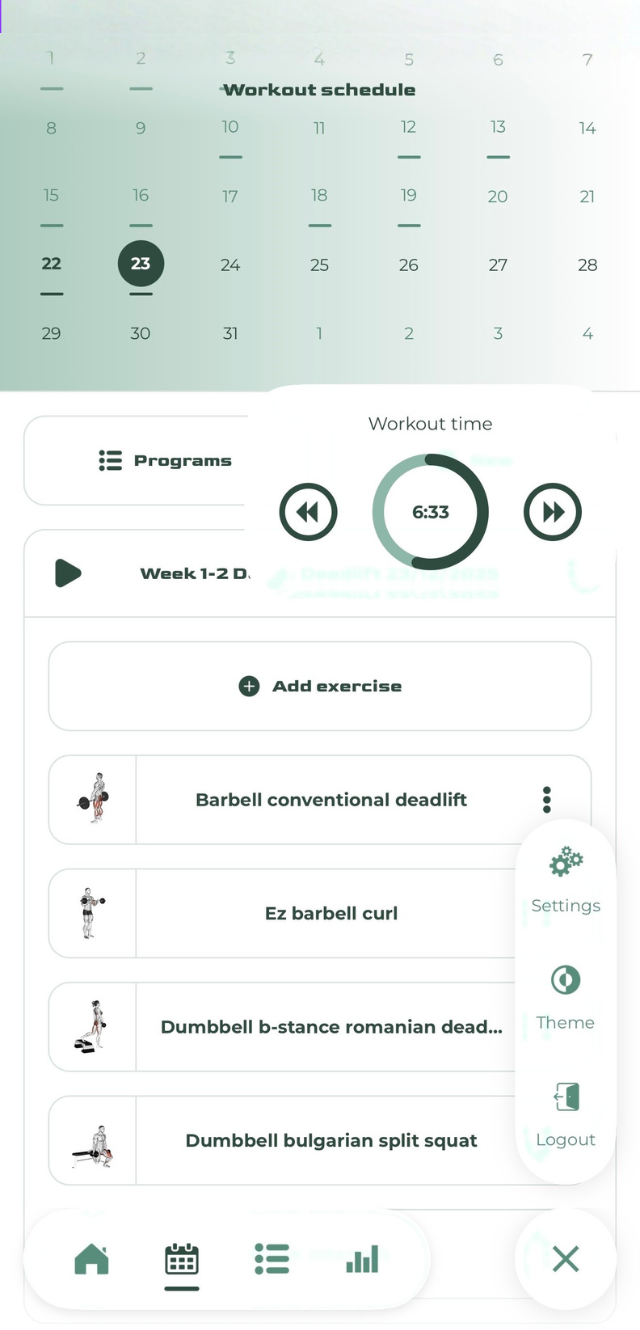
If you want to make real progress and build discipline in the gym, use Virtus Athlete. Free on iOS and Android.


Frequently Asked Questions (FAQ)

What are the best ab exercises?
Hanging leg raise, ab wheel rollout, plank, Pallof press, dead bug, hollow hold, side plank, and cable woodchopper. These cover all three core functions: anti-extension, anti-rotation, and trunk flexion. A balanced program uses 3-4 of these per session.
How often should I train abs?
2-3 times per week is enough for most lifters. The core is already worked indirectly during squats, deadlifts, and overhead pressing, so direct ab work just adds the focused volume needed for hypertrophy and stability.
Do I need to do abs every day?
No. Daily ab training does not build visible abs faster. It just creates fatigue. 3 sessions per week with 3-5 hard sets per exercise is plenty.
Do crunches give you abs?
Crunches train trunk flexion, which is one function of the core. They build the rectus abdominis to some degree but do not address anti-extension or anti-rotation, the more important core functions for performance and injury prevention. Replace high-rep crunches with hanging leg raises and ab wheel rollouts for better results.
What is the best ab exercise for definition?
Definition comes from low body fat, not from a specific exercise. To build visible abs, focus on getting body fat to 10-12% (men) or 16-20% (women) through diet, while training abs 2-3 times per week with progressive overload (heavier hanging leg raises, harder plank variations, weighted side planks).
Can you get abs without sit-ups?
Yes, easily. Many world-class athletes never do a single sit-up. Hanging leg raises, ab wheel rollouts, and hollow holds build stronger abs than sit-ups with less spinal stress.
How long does it take to get visible abs?
Depends entirely on your starting body fat. From 18% to 12% body fat takes about 12-16 weeks of consistent dieting at a 300-500 cal deficit. Your training does not need to change much. Body composition does the heavy lifting.
Should I train abs before or after my workout?
After. Direct ab work fatigues the stabilizers your core needs for compound lifts (squat, deadlift, overhead press). Train compounds first, then dedicate the last 10-15 minutes to core.
What about lower abs vs upper abs?
The rectus abdominis is one continuous muscle, not separated into "upper" and "lower." But you can emphasize different fibers: leg raises bias lower fibers (because the pelvis tilts), crunches and sit-ups bias upper fibers (because the ribcage moves). A balanced program includes both pelvis-moving and ribcage-moving exercises.

Related Articles

Track Your Progress

Log every set, track your lifts, and see your progress over time. Free on iOS & Android.

Virtus Athlete

The workout app that puts YOU in control of your strength and fitness journey

Follow us

Get the App

Available on iOS and Android for free.

© 2026 Verum Services. All rights reserved.

Virtus Athlete is a training tool, not a medical device nor a substitute for professional guidance. Train responsibly, do your own research, and consult a qualified fitness professional if needed.