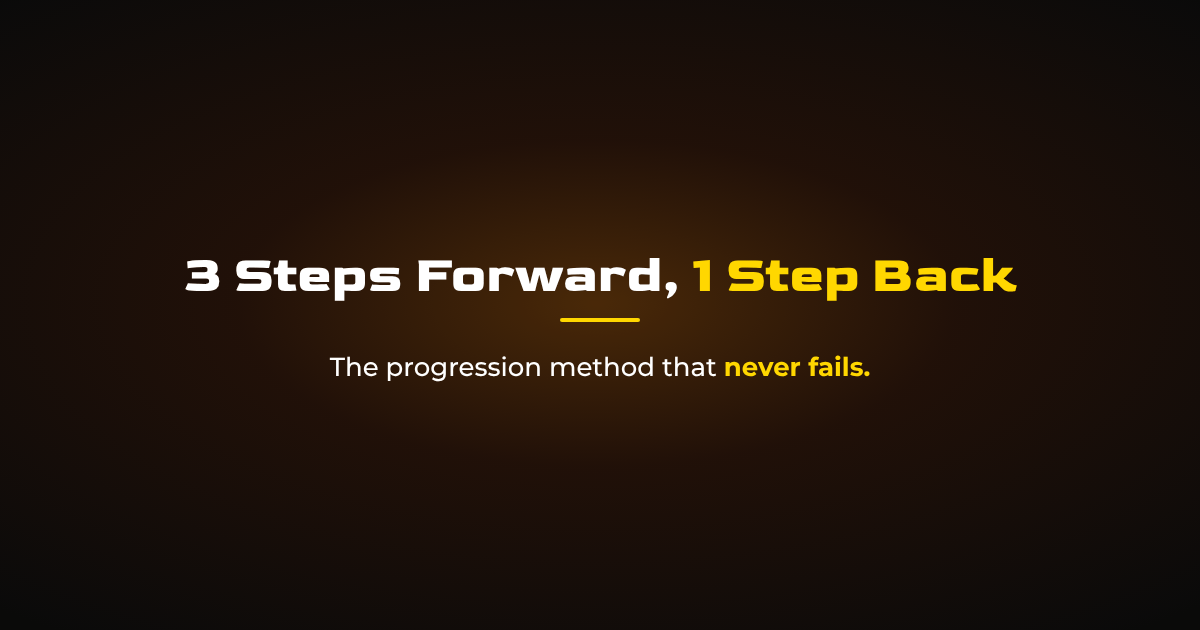
Three steps forward, one step back. Every wave peaks higher than the last.
Linear progression works until it does not. At some point, adding weight every session becomes impossible. Wave loading solves this by building in strategic resets that manage fatigue while still driving progress upward over time.
Why Linear Progression Fails
Linear progression assumes you can recover and adapt between every session. For beginners, this is true. The stimulus is new, adaptation is fast, and the body responds to almost anything.
For intermediate and advanced lifters, this breaks down:
- Fatigue accumulates faster than fitness. After several weeks of increasing load, fatigue masks your true strength.
- Recovery debt builds. Each heavier session requires more recovery, but the next session comes before you have fully recovered.
- Plateaus feel permanent. You hit the same weight three sessions in a row and cannot push past it.
The solution is not to push harder. It is to manage fatigue while continuing to progress.
How Wave Loading Works
Wave loading organizes your progression into waves. Each wave lasts 3-4 weeks. You increase the weight each week within a wave, then drop back at the start of the next wave. The key: you drop back to a point higher than where the previous wave started.
Here is a simple 3-week wave structure for squat:
| Week | Wave | Weight (working sets) |
|---|---|---|
| 1 | Wave 1 | 80kg |
| 2 | Wave 1 | 82.5kg |
| 3 | Wave 1 | 85kg |
| 4 | Wave 2 | 82.5kg |
| 5 | Wave 2 | 85kg |
| 6 | Wave 2 | 87.5kg |
| 7 | Wave 3 | 85kg |
| 8 | Wave 3 | 87.5kg |
| 9 | Wave 3 | 90kg |
In 9 weeks, you went from 80kg to 90kg. You never had more than 3 consecutive weeks of increasing load, so fatigue never spiraled out of control.
Why the Reset Works
The drop-back week at the start of each new wave serves as a mini deload. You are still training with meaningful weight, but the reduced load gives your body a recovery window.
During that reset week:
- Accumulated fatigue dissipates. Your muscles, joints, and nervous system catch up on recovery.
- Performance potential is revealed. Fatigue was masking your true strength. The reset lets it show.
- Confidence builds. You handle a weight that was challenging two waves ago with more ease, reinforcing that you are getting stronger.
This is the core principle: fatigue and fitness both build simultaneously, but fatigue dissipates faster. A short reset drops fatigue while retaining fitness, so you peak higher on the next wave.
Setting Up Your Waves
Here are the variables you control:
Wave length. 3 weeks is standard. 4 weeks works for advanced lifters who need more time at each load. 2 weeks is too short for meaningful adaptation.
Weekly increment. 2.5kg per week is standard for upper body lifts. 2.5-5kg for lower body. Match the increment to the lift and your training level.
Reset amount. Drop back to where week 1 of the previous wave was, or slightly above. If Wave 1 started at 80kg and ended at 85kg, Wave 2 starts at 82.5kg. The reset should be 1-2 increments below the peak.
Rep scheme. Keep reps consistent across the wave. Common choices are 5x5, 3x5, or 4x6. Changing reps and weight simultaneously makes it harder to measure progress.
Where Wave Loading Works Best
Wave loading is designed for compound lifts where progressive overload is the primary goal:
- Squat
- Bench press
- Deadlift
- Overhead press
- Barbell row
For isolation exercises and accessories, double progression or straight sets with rep targets are simpler and equally effective. Wave loading adds complexity that is only justified when the lift demands careful fatigue management.
Wave loading is best suited for intermediate and advanced lifters. If you are still adding weight every session, you do not need wave loading yet. Use it when linear progression stalls.